I take one capsule/day of each of the following supplements, with the exception of strontium and lutein (two capsules/day) and D3 (one capsule three times/week).
I do not take any supplements, except strontium, on Sundays to prevent getting too much of any one of them. I do not take strontium on Sundays if I feel I have not had sufficient calcium-containing foods that day. Vitamins, minerals, and other supplements taken in excess can cause problems.Too much calcium from supplements can contribute to the formation of kidney stones and has been implicated (inconclusively) in heart disease. Try to get most of your calcium from food. Excess amounts of water-soluble vitamins are eliminated in the urine. Supplemental vitamin C, a water-soluble vitamin, increases urinary oxalate concentrations, but whether an increase in urinary oxalate elevates the risk for kidney stones is not yet known. Those predisposed for kidney stone formation may consider avoiding high-dose (greater than or equal to 1 g/day) vitamin C supplementation. I am not predisposed to kidney stones but take only 500 mg/day vitamin C in pill form.
The fat-soluble vitamins are A, D, E and K. They are soluble in organic solvents and are absorbed and transported in a manner similar to that of fats. Excess amounts of fat-soluble vitamins accumulate in the liver, adipose (fat) tissue, and skeletal muscle. Because these vitamins are stored for long periods, dangerous levels can build up. Excess intake of fat-soluble vitamins is more likely to cause you harm than excess intake of water-soluble vitamins. For these reasons, I do not take extra vitamin A, except for the 750 mcg in my multivitamin. I do not take any K2 and only the 80 mcg K1 (as Phytonadione) in my multivitamin. I do take 400 IU natural vitamin E. I do take vitamin D (1000 IU) in my multivitamin. I recently added another D3 supplement with 1000 IU/capsule, but I am only taking it three times per week. If I add up the 1000 IU/day for six days/week in my multi and the 1000 IU for three days/week in the separate D3 supplement, I get 9000 IU vitamin D/week, or about 1286 IU/day. Unless you have a vitamin-D deficiency or insufficiency, as shown by a 25(OH)D blood test,1000 to 2000 IU/day of vitamin D should be plenty.
Bioflavonoids (Antioxidants)
Solgar Citrus Bioflavonoid Complex, 1000 mg per tablet
Digestive Aids
Nature’s Way Primadophilus bifidus (probiotic)
NOW Super Enzymes (breaks down fats, carbs and protein)
Minerals
AOR Strontium Support II, 341 mg strontium (from citrate) per capsule (two capsules daily)
Country Life, Gluten Free, Calcium Magnesium Complex (500 mg Ca, 250 mg Mg per tablet)
KAL Magnesium Glycinate 400 (400 mg in 2 softgels; I take one.)
Solary Selenium, 100 mcg
Vitacost Chelated Zinc (zinc glycinate chelate), 30 mg
Vitamins
Doctor’s Best Lutein with Optilut (20 mg lutein, 4 mg zeaxanthin in two capsules)
Nature Made D3, 1000 IU (one capsule three times/week)
Nature Made Multi Men's 50+, No Iron (OK for men and women; contains 1000 IU vitamin D3 and 21 other nutrients)
Nature Made Vitamin C, 500 m
Solgar Natural Vitamin E (as d-Alpha Tocopherol plus d-Beta, d-Delta and d-Gamma Tocopherols), 400 IU
Solgar Sublingual Methylcobalamin (Vitamin B12), 5000 mcg
Human Skeleton

Showing posts with label vitamin K2. Show all posts
Showing posts with label vitamin K2. Show all posts
Friday, July 3, 2020


Tuesday, January 2, 2018
In Memory of Sara Shackleford DeHart
December 18, 1931 - November 8, 2017
Sara was born December 18, 1931 and passed away at
her Lynnwood, WA home on November 8, 2017.
Arrangements under the direction of Purdy & Walters at Floral Hills,
Lynnwood, WA.
Published in The Herald (Everett) on
Nov. 22, 2017
Sara DeHart was an inspiration to me and others. Ten
years ago, when I started looking for alternatives to Fosamax, there was little
information about strontium citrate (SC). Strontium ranelate was registered in
Europe in 2004 for postmenopausal osteoporosis. I started using SC on January
21, 2008, and Sara's first article about strontium and osteoporosis was posted
July 7, 2008.
Sara DeHart wrote three case studies about her struggle with osteopenia and fragility fractures while taking osteoporosis drugs. Only after taking strontium citrate with sufficient vitamin D3, calcium, and magnesium did the fractures cease. She later added vitamin K2 as well. I wrote a post about each of her articles on strontium.
Sara underwent radiation for inoperable throat cancer in 2000 and again for ductal carcinoma in situ in 2016. Of course, she wrote about those experiences and how to minimize the risk of radiation skin burns. She was a medical professional, professor, and writer until the end. She died November 8, 2017, three weeks short of her 86th birthday.
Wednesday, December 17, 2014
Strontium Citrate and Strontium Ranelate
Strontium ranelate is prescribed for postmenopausal
osteoporosis in the United Kingdom, Australia, much of Europe and Asia, and Mexico.
Due to an increased risk of thrombosis and cardiovascular events in patients
with a history of cardiovascular problems, some doctors are discouraging their
patients from taking strontium ranelate or refusing to prescribe it.
Strontium ranelate is not available in the United States or
Canada. However, strontium citrate can be purchased as a supplement from health
food stores and online distributors. Is
strontium citrate safe and effective?
In 2012, Canadian researchers published the Combination of
Micronutrients for Bone (COMB) Study. Here is the abstract:
“Along with other investigations, patients presenting to an
environmental health clinic with various chronic conditions were assessed for
bone health status. Individuals with compromised bone strength were educated
about skeletal health issues and provided with therapeutic options for
potential amelioration of their bone health. Patients who declined
pharmacotherapy or who previously experienced failure of drug treatment were
offered other options including supplemental micronutrients identified in the
medical literature as sometimes having a positive impact on bone mineral
density (BMD). After 12 months of consecutive supplemental micronutrient
therapy with a combination that included vitamin D3, vitamin K2, strontium,
magnesium and docosahexaenoic acid (DHA), repeat bone densitometry was
performed. The results were analyzed in a group of compliant patients and
demonstrate improved BMD in patients classified with normal, osteopenic and
osteoporotic bone density. According to the results, this combined
micronutrient supplementation regimen appears to be at least as effective as
bisphosphonates or strontium ranelate in raising BMD levels in hip, spine, and
femoral neck sites. No fractures occurred in the group taking the micronutrient
protocol. This micronutrient regimen also appears to show efficacy in
individuals where bisphosphonate therapy was previously unsuccessful in
maintaining or raising BMD. Prospective clinical trials are required to confirm
efficacy.”
Here is the COMB protocol for bone health:
(1) Docosahexaenoic acid or DHA (from Purified Fish Oil): 250 mg/day
(2) Vitamin D3: 2000 IU/day
(3) Vitamin K2 (non-synthetic MK7 form): 100 ug/day
(4) Strontium citrate: 680 mg/day (strontium)
(5) Elemental magnesium: 25 mg/day
(6) Dietary sources of calcium recommended
(7) Daily impact exercising encouraged
The following two paragraphs are quotes from the paper:
“Studies to date have predominantly focused on strontium
ranelate rather than the readily available strontium citrate supplement as used
in this study. The results of this study, however, demonstrate that the
micronutrient combination including strontium citrate is at least as effective
in BMD change as strontium ranelate with suggestion of preferred efficacy of
the former therapy at improving femoral neck outcomes. Furthermore, the ranelic
acid salt is a purely synthetic molecular compound, while citrate is naturally
occurring. It appears to be the strontium portion of the molecules which exerts
most or all of the positive effect on bone. When consuming the strontium
ranelate, for example, the compound splits into two strontium ions and one
molecule of ranelic acid, with each absorbed separately. There is little
evidence that the ranelic acid portion of the strontium ranelate compound
contributes to the effect of strontium on skeletal tissue, and of the small
amount of ranelic acid that is absorbed into the body, almost all is excreted
within a week without ever being metabolized. All forms of strontium have
bioavailabilities in the 25–30% range, but gastric tolerance appears to be
better with the ranelate and citrate forms.”
“With the mounting concern about the safety profile of some
standard medical interventions for bone compromise, strontium is very well
tolerated and has shown remarkably little in the way of side effects or
long-term adverse sequelae. An increased
risk of thrombosis has been noted with strontium ranelate, an effect not
reported (to our knowledge) with strontium citrate [16].”
16. S. J. Genuis and G. K. Schwalfenberg, “Picking a bone
with contemporary osteoporosis management: nutrient strategies to enhance
skeletal integrity,” Clinical Nutrition, vol. 26, no. 2, pp. 193–207, 2007.
The abstract to reference 16:
http://www.clinicalnutritionjournal.com/article/S0261-5614%2806%2900151-8/abstract
The entire article (reference 16) in PDF form:
http://www.uio.no/studier/emner/medisin/nutri/ERN3120/v12/ERN3120-Unit3-Student/02%20Osteoporosis%20and%20Ostaomalacia/Osteoporose-ern%C3%A6ring-03.pdf
The abstract to reference 16:
http://www.clinicalnutritionjournal.com/article/S0261-5614%2806%2900151-8/abstract
The entire article (reference 16) in PDF form:
http://www.uio.no/studier/emner/medisin/nutri/ERN3120/v12/ERN3120-Unit3-Student/02%20Osteoporosis%20and%20Ostaomalacia/Osteoporose-ern%C3%A6ring-03.pdf
The entire COMB Study article can be read here:
Wednesday, November 26, 2014
Vitamin K2: The Missing Nutrient
"Chris Kresser, M.S., L.Ac is a globally recognized leader in the fields
of ancestral health, Paleo nutrition, and functional and integrative
medicine." The Paleo diet excludes dairy and grains. I eat both dairy and grains myself. I am not advocating the Paleo diet, but it may be beneficial for those with allergies or sensitivities to milk or grains or gluten intolerance.
In the following article, he discusses the benefits of vitamin K2.
"A study recently published by the European Prospective Investigation into Cancer and Nutrition (EPIC) has revealed that increased intake of vitamin K2 may reduce the risk of prostate cancer by 35 percent. The authors point out that the benefits of K2 were most pronounced for advanced prostate cancer, and, importantly, that vitamin K1 did not offer any prostate benefits.
The findings were based on data from more than 11,000 men taking part in the EPIC Heidelberg cohort. It adds to a small but fast-growing body of science supporting the potential health benefits of vitamin K2 for bone, cardiovascular, skin, brain, and now prostate health.
Unfortunately, many people are not aware of the health benefits of vitamin K2. The K vitamins have been underrated and misunderstood up until very recently in both the scientific community and the general public.
It has been commonly believed that the benefits of vitamin K are limited to its role in blood clotting. Another popular misconception is that vitamins K1 and K2 are simply different forms of the same vitamin – with the same physiological functions.
New evidence, however, has confirmed that vitamin K2’s role in the body extends far beyond blood clotting to include protecting us from heart disease, ensuring healthy skin, forming strong bones, promoting brain function, supporting growth and development and helping to prevent cancer – to name a few. In fact, vitamin K2 has so many functions not associated with vitamin K1 that many researchers insist that K1 and K2 are best seen as two different vitamins entirely.
A large epidemiological study from the Netherlands illustrates this point well. The researchers collected data on the vitamin K intakes of the subjects between 1990 and 1993 and measured the extent of heart disease in each subject, who had died from it and how this related to vitamin K2 intake and arterial calcification. They found that calcification of the arteries was the best predictor of heart disease. Those in the highest third of vitamin K2 intakes were 52 percent less likely to develop severe calcification of the arteries, 41 percent less likely to develop heart disease, and 57 percent less likely to die from it. (Geleijnse et al., 2004, pp. 3100-3105) However, intake of vitamin K1 had no effect on cardiovascular disease outcomes.
While K1 is preferentially used by the liver to activate blood clotting proteins, K2 is preferentially used by other tissues to deposit calcium in appropriate locations, such as in the bones and teeth, and prevent it from depositing in locations where it does not belong, such as the soft tissues.(Spronk et al., 2003, pp. 531-537) In an acknowledgment of the different roles played by vitamins K1 and K2, the United States Department of Agriculture (USDA) finally determined the vitamin K2 contents of foods in the U.S. diet for the first time in 2006. (Elder, Haytowitz, Howe, Peterson, & Booth, 2006, pp. 436-467)
Another common misconception is that human beings do not need vitamin K2 in their diet, since they have the capacity to convert vitamin K1 to vitamin K2. The amount of vitamin K1 in typical diets is ten times greater than that of vitamin K2, and researchers and physicians have largely dismissed the contribution of K2 to nutritional status as insignificant.
However, although animals can convert vitamin K1 to vitamin K2, a significant amount of evidence suggests that humans require preformed K2 in the diet to obtain and maintain optimal health. The strongest indication that humans require preformed vitamin K2 in the diet is that epidemiological and intervention studies both show its superiority over K1. Intake of K2 is inversely associated with heart disease in humans while intake of K1 is not (Geleijnse et al., 2004, pp. 3100-3105), and vitamin K2 is at least three times more effective than vitamin K1 at activating proteins related to skeletal metabolism. (Schurgers et al., 2007) And remember that in the study on vitamin K2’s role in treating prostate cancer, which I mentioned at the beginning of this article, vitamin K1 had no effect.
All of this evidence points to the possibility that vitamin K2 may be an essential nutrient in the human diet. So where does one find vitamin K2 in foods? The following is a list of the foods highest in vitamin K2, as measured by the USDA:
Unfortunately, precise values for some foods that are likely to be
high in K2 (such as organ meats) are not available at this time. The
pancreas and salivary glands would be richest; reproductive organs,
brains, cartilage and possibly kidneys would also be very rich; finally,
bone would be richer than muscle meat. Fish eggs are also likely to be
rich in K2.
It was once erroneously believed that intestinal bacteria are a major contributor to vitamin K status. However, the majority of evidence contradicts this view. Most of the vitamin K2 produced in the intestine are embedded within bacterial membranes and not available for absorption. Thus, intestinal production of K2 likely makes only a small contribution to vitamin K status. (Unden & Bongaerts, 1997, pp. 217-234)
On the other hand, fermented foods, however, such as sauerkraut, cheese and natto (a soy dish popular in Japan), contain substantial amounts of vitamin K2. Natto contains the highest concentration of K2 of any food measured; nearly all of it is present as MK-7, which research has shown to be a highly effective form. A recent study demonstrated that MK-7 increased the percentage of osteocalcin in humans three times more powerfully than did vitamin K1. (Schurgers & Vermeer, 2000, pp. 298-307)
It is important to note that commercial butter is not a significantly high source of vitamin K2. Dr. Weston A. Price, who was the first to elucidate the role of vitamin K2 in human health (though he called it “Activator X” at the time) analyzed over 20,000 samples of butter sent to him from various parts of the world. As mentioned previously in this paper, he found that the Activator X concentration varied 50-fold. Animals grazing on vitamin K-rich cereal grasses, especially wheat grass, and alfalfa in a lush green state of growth produced fat with the highest amounts of Activator X, but the soil in which the pasture was grown also influenced the quality of the butter. It was only the vitamin-rich butter grown in three feet or more of healthy top soil that had such dramatic curing properties when combined with cod liver oil in Dr. Price’s experiments and clinical practice.
Therefore, vitamin K2 levels will not be high in butter from grain-fed cows raised in confinement feedlots. Since the overwhelming majority of butter sold in the U.S. comes from such feedlots, butter is not a significant source of K2 in the diet for most people. This is yet another argument for obtaining raw butter from cows raised on green pasture.
New research which expands our understanding of the many important roles of vitamin K2 is being published at a rapid pace. Yet it is already clear that vitamin K2 is an important nutrient for human health – and one of the most poorly understood by medical authorities and the general public."
http://chriskresser.com/vitamin-k2-the-missing-nutrient
358 comments
In the following article, he discusses the benefits of vitamin K2.
"A study recently published by the European Prospective Investigation into Cancer and Nutrition (EPIC) has revealed that increased intake of vitamin K2 may reduce the risk of prostate cancer by 35 percent. The authors point out that the benefits of K2 were most pronounced for advanced prostate cancer, and, importantly, that vitamin K1 did not offer any prostate benefits.
The findings were based on data from more than 11,000 men taking part in the EPIC Heidelberg cohort. It adds to a small but fast-growing body of science supporting the potential health benefits of vitamin K2 for bone, cardiovascular, skin, brain, and now prostate health.
Unfortunately, many people are not aware of the health benefits of vitamin K2. The K vitamins have been underrated and misunderstood up until very recently in both the scientific community and the general public.
It has been commonly believed that the benefits of vitamin K are limited to its role in blood clotting. Another popular misconception is that vitamins K1 and K2 are simply different forms of the same vitamin – with the same physiological functions.
New evidence, however, has confirmed that vitamin K2’s role in the body extends far beyond blood clotting to include protecting us from heart disease, ensuring healthy skin, forming strong bones, promoting brain function, supporting growth and development and helping to prevent cancer – to name a few. In fact, vitamin K2 has so many functions not associated with vitamin K1 that many researchers insist that K1 and K2 are best seen as two different vitamins entirely.
A large epidemiological study from the Netherlands illustrates this point well. The researchers collected data on the vitamin K intakes of the subjects between 1990 and 1993 and measured the extent of heart disease in each subject, who had died from it and how this related to vitamin K2 intake and arterial calcification. They found that calcification of the arteries was the best predictor of heart disease. Those in the highest third of vitamin K2 intakes were 52 percent less likely to develop severe calcification of the arteries, 41 percent less likely to develop heart disease, and 57 percent less likely to die from it. (Geleijnse et al., 2004, pp. 3100-3105) However, intake of vitamin K1 had no effect on cardiovascular disease outcomes.
While K1 is preferentially used by the liver to activate blood clotting proteins, K2 is preferentially used by other tissues to deposit calcium in appropriate locations, such as in the bones and teeth, and prevent it from depositing in locations where it does not belong, such as the soft tissues.(Spronk et al., 2003, pp. 531-537) In an acknowledgment of the different roles played by vitamins K1 and K2, the United States Department of Agriculture (USDA) finally determined the vitamin K2 contents of foods in the U.S. diet for the first time in 2006. (Elder, Haytowitz, Howe, Peterson, & Booth, 2006, pp. 436-467)
Another common misconception is that human beings do not need vitamin K2 in their diet, since they have the capacity to convert vitamin K1 to vitamin K2. The amount of vitamin K1 in typical diets is ten times greater than that of vitamin K2, and researchers and physicians have largely dismissed the contribution of K2 to nutritional status as insignificant.
However, although animals can convert vitamin K1 to vitamin K2, a significant amount of evidence suggests that humans require preformed K2 in the diet to obtain and maintain optimal health. The strongest indication that humans require preformed vitamin K2 in the diet is that epidemiological and intervention studies both show its superiority over K1. Intake of K2 is inversely associated with heart disease in humans while intake of K1 is not (Geleijnse et al., 2004, pp. 3100-3105), and vitamin K2 is at least three times more effective than vitamin K1 at activating proteins related to skeletal metabolism. (Schurgers et al., 2007) And remember that in the study on vitamin K2’s role in treating prostate cancer, which I mentioned at the beginning of this article, vitamin K1 had no effect.
All of this evidence points to the possibility that vitamin K2 may be an essential nutrient in the human diet. So where does one find vitamin K2 in foods? The following is a list of the foods highest in vitamin K2, as measured by the USDA:
Foods high in vitamin K2
- Natto
- Hard cheese
- Soft cheese
- Egg yolk
- Butter
- Chicken liver
- Salami
- Chicken breast
- Ground beef
It was once erroneously believed that intestinal bacteria are a major contributor to vitamin K status. However, the majority of evidence contradicts this view. Most of the vitamin K2 produced in the intestine are embedded within bacterial membranes and not available for absorption. Thus, intestinal production of K2 likely makes only a small contribution to vitamin K status. (Unden & Bongaerts, 1997, pp. 217-234)
On the other hand, fermented foods, however, such as sauerkraut, cheese and natto (a soy dish popular in Japan), contain substantial amounts of vitamin K2. Natto contains the highest concentration of K2 of any food measured; nearly all of it is present as MK-7, which research has shown to be a highly effective form. A recent study demonstrated that MK-7 increased the percentage of osteocalcin in humans three times more powerfully than did vitamin K1. (Schurgers & Vermeer, 2000, pp. 298-307)
It is important to note that commercial butter is not a significantly high source of vitamin K2. Dr. Weston A. Price, who was the first to elucidate the role of vitamin K2 in human health (though he called it “Activator X” at the time) analyzed over 20,000 samples of butter sent to him from various parts of the world. As mentioned previously in this paper, he found that the Activator X concentration varied 50-fold. Animals grazing on vitamin K-rich cereal grasses, especially wheat grass, and alfalfa in a lush green state of growth produced fat with the highest amounts of Activator X, but the soil in which the pasture was grown also influenced the quality of the butter. It was only the vitamin-rich butter grown in three feet or more of healthy top soil that had such dramatic curing properties when combined with cod liver oil in Dr. Price’s experiments and clinical practice.
Therefore, vitamin K2 levels will not be high in butter from grain-fed cows raised in confinement feedlots. Since the overwhelming majority of butter sold in the U.S. comes from such feedlots, butter is not a significant source of K2 in the diet for most people. This is yet another argument for obtaining raw butter from cows raised on green pasture.
New research which expands our understanding of the many important roles of vitamin K2 is being published at a rapid pace. Yet it is already clear that vitamin K2 is an important nutrient for human health – and one of the most poorly understood by medical authorities and the general public."
http://chriskresser.com/vitamin-k2-the-missing-nutrient
358 comments
Is Vitamin K2 the New Vitamin D?
This article is dated November 18, 2014, and appeared on Medscape. It is the opinion of one doctor, who admits from the start that he knows nothing about nutrition as it relates to chronic illness. As pointed out by one commenter, he goes on to prove his ignorance by stating that green, leafy vegetables are a good source of vitamin K2. Wrong! They are a good source of vitamin K1. Because the doctor's article is controversial, there are many comments revealing various viewpoints. Be sure to drag and drop the link below and read the comments. There is also a video of the doctor giving his talk.
"Hello and welcome. I am Dr George Lundberg, and this is At Large at Medscape.
I do not know anything about nutrition as it relates to chronic illness, including obesity. I used to think that was because, probably like you, I was taught so little about nutrition in medical school. I have spent a medical lifetime reading articles about nutrition, before and after publication. But I am still woefully ignorant of "nutritional truth."
Take vitamin D. The minimum daily requirement prevents rickets. But then, just a few years ago, it became popular to check vitamin D blood levels. And many people were found to have "low" vitamin D levels. Then many diseases were found to be associated with "vitamin D deficiency," except it turns out that many labs were not doing the tests in equivalent ways.
After a whole lot of fuss and study, the Agency for Healthcare Research and Quality (AHRQ) issued a report this year that finds no consistent correlation between vitamin D and health outcomes such as cardiovascular disease, all-cause mortality, several types of cancer, or bone health.[1] Amazing.
Here are nine things every physician should know about vitamin K2:
Is vitamin K2 the ubiquitous disease-associated vitamin D-like deficiency, sans blood testing, all over again? A fad disease about to pop up, flourish, and disappear? Or is this a real, late-to-the-table, fundamental new understanding of possible causes of many common diseases, disability, and death? And if vitamin K2 is taken correctly, will it result in prevention and treatment of same? Look it up; check it out.
I do not know how this is going to work out, but I have a hunch that vitamin K2 will turn out to be a really big deal rather than only "the new vitamin D," with much fuss and little substance.
Most of this research is being done in Japan and Europe, especially The Netherlands, well away from the US Department of Agriculture and lobbyists for the American food industry and its captured government and academic partners.
I owe my current interest in this topic to a product of the Internet as the world's greatest library—a well-educated, nonscientist who got really interested in this topic and will not let up. Thank you, Micki Jacobs of Cincinnati.
That's my opinion. I am Dr George Lundberg, at large at Medscape."
http://www.medscape.com/viewarticle/834763?nlid=70845_1521&src=wnl_edit_medp_wir&uac=127701PY&spon=17
"Hello and welcome. I am Dr George Lundberg, and this is At Large at Medscape.
I do not know anything about nutrition as it relates to chronic illness, including obesity. I used to think that was because, probably like you, I was taught so little about nutrition in medical school. I have spent a medical lifetime reading articles about nutrition, before and after publication. But I am still woefully ignorant of "nutritional truth."
Take vitamin D. The minimum daily requirement prevents rickets. But then, just a few years ago, it became popular to check vitamin D blood levels. And many people were found to have "low" vitamin D levels. Then many diseases were found to be associated with "vitamin D deficiency," except it turns out that many labs were not doing the tests in equivalent ways.
After a whole lot of fuss and study, the Agency for Healthcare Research and Quality (AHRQ) issued a report this year that finds no consistent correlation between vitamin D and health outcomes such as cardiovascular disease, all-cause mortality, several types of cancer, or bone health.[1] Amazing.
Which Brings Us to Vitamin K
What do you know about vitamin K? It has something to do with blood coagulation, right? Yes, but that is vitamin K1. I am asking about vitamin K2. I bet you have not thought much about that vitamin.Here are nine things every physician should know about vitamin K2:
- It exists.
- It is essential for life and health.
- There is currently no reliable blood test to measure it.
- Your body makes a certain amount via menaquinone-4 (M-4) in your gut from vitamin K1.
- That may not be enough.
- Your body probably needs more vitamin K2 for disease prevention than it manufactures, so nutritional sources are important.
- Foods rich in vitamin K2 (often in the form of M-4 or M-7) include: natto (fermented soybeans); green, leafy vegetables; organ meats such as goose liver; grass-fed beef; dairy; eggs; and fish.
- Or you can take nutritional supplements to achieve healthy levels of vitamin K2.
- Deficiencies of vitamin K2 are now being reported in serious journals to be associated with—get this—all-cause mortality, cardiovascular disease, osteoporosis, diabetes, many forms of cancer, dementia, and chronic inflammation.
Is vitamin K2 the ubiquitous disease-associated vitamin D-like deficiency, sans blood testing, all over again? A fad disease about to pop up, flourish, and disappear? Or is this a real, late-to-the-table, fundamental new understanding of possible causes of many common diseases, disability, and death? And if vitamin K2 is taken correctly, will it result in prevention and treatment of same? Look it up; check it out.
I do not know how this is going to work out, but I have a hunch that vitamin K2 will turn out to be a really big deal rather than only "the new vitamin D," with much fuss and little substance.
Most of this research is being done in Japan and Europe, especially The Netherlands, well away from the US Department of Agriculture and lobbyists for the American food industry and its captured government and academic partners.
I owe my current interest in this topic to a product of the Internet as the world's greatest library—a well-educated, nonscientist who got really interested in this topic and will not let up. Thank you, Micki Jacobs of Cincinnati.
That's my opinion. I am Dr George Lundberg, at large at Medscape."
http://www.medscape.com/viewarticle/834763?nlid=70845_1521&src=wnl_edit_medp_wir&uac=127701PY&spon=17
Wednesday, August 27, 2014
Vitamin K2 Controversy
Japanese researchers have published several
articles on vitamin K2, such as the following one: “Vitamin K2
(Menatetrenone) Effectively Prevents Fractures and Sustains Lumbar Bone Mineral
Density in Osteoporosis” American researchers have been unable to
duplicate the results. One study found that “Vitamin K Treatment Reduces
Undercarboxylated Osteocalcin but Does Not Alter Bone Turnover, Density, or
Geometry in Healthy Postmenopausal North American Women.”
Each study has weaknesses.
For example, the Japanese researchers did
not use placebo capsules for vitamin K2 in the control group. Therefore,
they cannot exclude the possibility that this may have differentially affected
the behavior of study participants in the control and treatment groups,
although they consider this possibility unlikely. Limitations of the study on
North American women include the relatively short (1 yr) study duration and the
inclusion of only healthy women. Thus, the exclusion of osteoporotic women and,
importantly, the short duration of this study prohibited use of fracture
reduction as a study endpoint.
Here are the two abstracts
with links to the full articles:
Abstract
to Asian Article:
We attempted to investigate whether
vitamin K2 (menatetrenone) treatment effectively prevents the
incidence of new fractures in osteoporosis. A total of 241 osteoporotic
patients were enrolled in a 24-month randomized open label study. The control
group (without treatment; n = 121) and the vitamin K2–treated
group (n = 120), which received 45 mg/day orally vitamin K2,
were followed for lumbar bone mineral density (LBMD; measured by dual-energy
X-ray absorptiometry [DXA]) and occurrence of new clinical fractures. Serum
level of Glu-osteocalcin (Glu-OC) and menaquinone-4 levels were measured at the
end of the follow-up period. Serum level of OC and urinary excretion of
deoxypyridinoline (DPD) were measured before and after the treatment. The
background data of these two groups were identical. The incidence of clinical
fractures during the 2 years of treatment in the control was higher than the
vitamin K2–treated group (χ2 = 10.935; p =
0.0273). The percentages of change from the initial value of LBMD at 6, 12, and
24 months after the initiation of the study were −1.8 ± 0.6%, −2.4 ± 0.7%, and
−3.3 ± 0.8% for the control group, and 1.4 ± 0.7%, −0.1 ± 0.6%, and −0.5 ± 1.0%
for the vitamin K2–treated group, respectively. The changes in LBMD
at each time point were significantly different between the control and the
treated group (p = 0.0010 for 6 months, p = 0.0153 for 12 months,
and p = 0.0339 for 24 months). The serum levels of Glu-OC at the end of
the observation period in the control and the treated group were 3.0 ± 0.3
ng/ml and 1.6 ± 0.1 ng/ml, respectively (p < 0.0001), while the serum
level of OC measured by the conventional radioimmunoassay (RIA) showed a
significant rise (42.4 ± 6.9% from the basal value) in the treated group at 24
months (18.2 ± 6.1% for the controls; p = 0.0081). There was no
significant change in urinary DPD excretion in the treated group. These
findings suggest that vitamin K2 treatment effectively prevents the
occurrence of new fractures, although the vitamin K2–treated group
failed to increase in LBMD. Furthermore, vitamin K2 treatment
enhances γ-carboxylation of the OC molecule. http://onlinelibrary.wiley.com/doi/10.1359/jbmr.2000.15.3.515/full
Abstract
to North American Article
Low vitamin K status is associated
with low BMD and increased fracture risk. Additionally, a specific menaquinone,
menatetrenone (MK4), may reduce fracture risk. However, whether vitamin K plays
a role in the skeletal health of North American women remains unclear.
Moreover, various K vitamers (e.g., phylloquinone and MK4) may have differing
skeletal effects. The objective of this study was to evaluate the impact of
phylloquinone or MK4 treatment on markers of skeletal turnover and BMD in
nonosteoporotic, postmenopausal, North American women. In this double-blind,
placebo-controlled study, 381 postmenopausal women received phylloquinone (1 mg
daily), MK4 (45 mg daily), or placebo for 12 mo. All participants received
daily calcium and vitamin D3 supplementation. Serum bone-specific
alkaline phosphatase (BSALP) and n-telopeptide of type 1 collagen (NTX) were
measured at baseline and 1, 3, 6, and 12 mo. Lumbar spine and proximal femur
BMD and proximal femur geometry were measured by DXA at baseline and 6 and 12
mo. At baseline, the three treatment groups did not differ in demographics or
study endpoints. Compliance with calcium, phylloquinone, and MK4 treatment was
93%, 93%, and 87%, respectively. Phylloquinone and MK4 treatment reduced serum
undercarboxylated osteocalcin but did not alter BSALP or NTX. No effect of
phylloquinone or MK4 on lumbar spine or proximal femur BMD or proximal femur
geometric parameters was observed. This study does not support a role for
vitamin K supplementation in osteoporosis prevention among healthy,
postmenopausal, North American women receiving calcium and vitamin D
supplementation. http://onlinelibrary.wiley.com/doi/10.1359/jbmr.081254/full
Subscribe to:
Posts (Atom)
Wandering Skeleton

Artist: Joel Hoekstra
Osteoporotic Bone
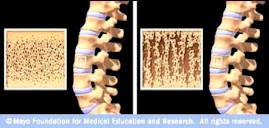
Source: www.mayoclinic.com