Human Skeleton

Human Skeleton

WELCOME TO STRONTIUM FOR BONES BLOG

Have you experienced negative, and even dangerous, side effects from Fosamax (alendronate), Boniva (ibandronate), Actonel (risedronate), Reclast (zoledronic acid), Prolia (denosumab), Forteo (teriparatide), Tymlos (abaloparatide), or other drugs prescribed for osteoporosis? If you have, then rest assured there is a safe, effective treatment for this condition. Strontium, primarily in the form of strontium citrate, is taken orally once a day.

Visitors to my blog can leave comments or ask questions and can remain anonymous, if they wish. Their comments are relayed to my g-mail inbox. Below each post, the number of comments for that post is cited and underlined because it is a link. By clicking on that link below any post, a window opens so that a visitor can leave a comment. Ideally, visitors leave comments on posts most relevant to their comments. All comments to my posts are moderated by me.

Browse the posts and visit the link library of references.


Blog Archive

Showing posts with label osteopenia. Show all posts

Thursday, October 17, 2019

Strontium Citrate Protocols

If you decide to take strontium citrate, you need to ensure you are also getting adequate calcium, magnesium, vitamin D, other vitamins and minerals, and protein. You can get these nutrients from a combination of diet and supplements. Choosing a supplement plan, or protocol, that is right for you can be as simple as choosing one of the three protocols described in this post or by modifying one of them with your own choice of supplements. 

Protocols for Osteoporosis:

 COMB                                                                                 BoneLady 
Strontium citrate                   680 mg                                                  680 mg
Vitamin K2 (MK7)               100 mcg                                                none
Vitamin D3                         2000 IU                                                 1000 IU
Docosahexanoic acid (DHA)250 mg                                                 none
Magnesium                             25 mg                                                  250 mg*
Calcium                       Dietary sources                                    500 mg*  

*BoneLady takes a supplement tablet that contains 250 mg Mg and 500 mg Ca. In addition, she gets about 700 mg Ca from food for a total of about 1200 mg Ca per day.  

Protocol for Osteopenia:

MOTS 
Strontium citrate     450 mg
Vitamin K2 (MK7)     60 mcg
Vitamin D3            2000 IU*
Melatonin                    5 mg
DHA                             none
Magnesium                  none    
Calcium                          * 

*In addition to study medication, participants in the MOTS study were allowed to take less than 1000 IU of vitamin D3 and less than 1000 mg of calcium daily. 


Friday, January 11, 2019

Axial DXA 8 January 2019

The report of my axial DXA scan taken on 8 January 2019 appears below. I have been on 2 grams strontium citrate/day for 11 years. I also take a calcium/magnesium tablet (500 mg Ca/250 mg Mg), a multivitamin with 1000 IU vitamin D3, and several other supplements. I get plenty of protein in my diet. I exercise daily.

As you can see, my DXA results were excellent, except for my left femoral neck, which showed no change from the previous scan.

I am happy with my results, although I know the comparison of this year's results to those of 2.5 years ago contains some built-in error because two different brands of DXA machines were used. My 2016 scan was on a Hologic and the 2019 scan was on a GE Lunar Prodigy.

Changing testing sites, and, therefore, machines, was not my choice. I had been getting my scans in the outpatient radiology department of a large hospital medical center, but the provider is now pushing patients into its freestanding imaging centers. I was told my insurance would not pay for a DXA unless it was done at a freestanding center, but my insurance denied that assertion.

The risk factor for secondary osteoporosis mentioned, but not specified, in the report is early menopause.

INDICATION: Postmenopausal. Follow-up of osteopenia on prior DXA.
Patient reports risk factors for secondary osteoporosis.

COMPARISON: 8/4/2016

FINDINGS:

Spine: Total BMD of the spine (L1-4) is 1.108 g/cm2, with a T-score of
-0.7 and a Z-score of 1.0.

Left Femoral Neck: BMD is 0.883 g/cm2, with a T-score of -1.1 and a
Z-score of 0.6.

Left Total Hip: BMD is 0.928 g/cm2, with a T-score of -0.6 and a Z-score
of 0.9.

Right Femoral Neck: BMD is 0.919 g/cm2, with a T-score of -0.9 and a
Z-score of 0.9.

Right Total Hip: BMD is 0.963 g/cm2, with a T-score of -0.4 and a Z-score
of 1.1.

Compared to the prior study, there has been 9% increase in spine density, 6% increase in left total hip density, but no change in left femoral neck density.

FRAX evaluation calculates 10-year probability of fracture:

Major Osteoporotic: 7.8%

Hip: 1.0%

IMPRESSION:

Based on BMD, diagnosis is consistent with osteopenia.

FOLLOWUP: In 2 years is recommended.


Tuesday, January 2, 2018

In Memory of Sara Shackleford DeHart


December 18, 1931 - November 8, 2017

Sara was born December 18, 1931 and passed away at her Lynnwood, WA home on November 8, 2017.
 
Arrangements under the direction of Purdy & Walters at Floral Hills, Lynnwood, WA.

Published in The Herald (Everett) on Nov. 22, 2017


Sara DeHart was an inspiration to me and others. Ten years ago, when I started looking for alternatives to Fosamax, there was little information about strontium citrate (SC). Strontium ranelate was registered in Europe in 2004 for postmenopausal osteoporosis. I started using SC on January 21, 2008, and Sara's first article about strontium and osteoporosis was posted July 7, 2008.

Sara DeHart wrote three case studies about her struggle with osteopenia and fragility fractures while taking osteoporosis drugs. Only after taking strontium citrate with sufficient vitamin D3, calcium, and magnesium did the fractures cease. She later added vitamin K2 as well. I wrote a post about each of her articles on strontium.

Sara underwent radiation for inoperable throat cancer in 2000 and again for ductal carcinoma in situ in 2016. Of course, she wrote about those experiences and how to minimize the risk of radiation skin burns. She was a medical professional, professor, and writer until the end. She died November 8, 2017, three weeks short of her 86th birthday.


Tuesday, February 14, 2017

MOTS and COMB Study Comparison


A one-year study on strontium citrate combined with melatonin and other supplements and named the Melatonin-micronutrients Osteopenia Treatment Study (MOTS) was recently published (January 26, 2017). I’d like to compare it to the Combination of Micronutrients for Bone (COMB) Study published in 2012. See the following chart:
        
    COMB Study                                                               MOTS

Study size                        114                                                                                  20
Baseline BMD status      osteoporosis                                                                   osteopenia
Strontium (citrate)               680 mg                                                                          450 mg
Vitamin K2 (MK7)               100 mcg                                                                         60 mcg
Melatonin                              none                                                                                5 mg                        
Vitamin D3                         2000 IU                                                                          2000 IU
Docosahexanoic acid (DHA)   250 mg                                                                      none
Magnesium                             25 mg                                                                          none
Lumbar spine BMD             6% increase                                                             4.3% increase
Femoral neck BMD             4% increase                                                             2.2% increase
Total hip BMD               3% increase                                                             No sign. diff., pos. trend

I could have predicted the results on BMD. How? Well, it had previously been shown, from studies on strontium ranelate, that strontium increased BMD at all dosages studied, but the optimum increases were gained with 680 mg strontium. Also, melatonin has been used for years as a sleep aid, but there is little evidence for it as a bone supplement. The authors of MOTS named two studies on melatonin listed below.         

“Limitations to this study include low number of subjects, lack of a diverse cohort and lack of different micronutrient combinations on primary and secondary endpoints in MOTS clinical trial.”

Despite the limitations of MOTS, there is valuable information to be gained from it:

MOTS increased awareness of the importance of preventative care in patients with osteopenia. “Over half of all women in the U.S. above age 50 have osteopenia with a prevalence of approximately 3.4 times more than osteoporosis. Consequently, twice the number of fractures arises from women with osteopenia as they represent almost 50% of the total population at risk.”

“The 10-year vertebral fracture risk probability decreased by 6.48% in response to MSDK (melatonin, strontium, vitamins D and K) therapy compared to 10.8% increase in placebo.”

“MSDK reduced bone marker turnover primarily by increasing the bone formation marker P1NP and maintaining healthy bone turnover.”

“MSDK demonstrated positive effects on inflammatory status and improved quality of life especially related to sleep.”

MOTS confirmed that dosages lower than 680 mg strontium will increase BMD by lower percentages.


Kotlarczyk MP, Lassila HC, O’Neil CK, D’Amico F, Enderby LT, Witt‐Enderby PA, Balk JL. Melatonin osteoporosis prevention study (MOPS): a randomized, double‐blind, placebo‐controlled study examining the effects of melatonin on bone health and quality of life in perimenopausal women. J Pineal Res. 2012; 52:414–26. doi: 10.1111/j.1600‐079X.2011.00956.x

Amstrup AK, Sikjaer T, Heickendorff L, Mosekilde L, Rejnmark L. Melatonin improves bone mineral density at the femoral neck in postmenopausal women with osteopenia: a randomized controlled trial. J Pineal Res. 2015; 59:221–29. doi:10.1111/jpi.12252

Thursday, August 11, 2016

My DXA Scan on August 4, 2016

My scores improved, but I am still in the osteopenia range. Therefore, I will keep taking 680 mg strontium per day from strontium citrate, along with my other supplements. Here are my results:

Spine: Total BMD of the spine (L1-4) is 0.897 g/cm2, with a T-score of -1.4.

Left Femoral Neck: BMD is 0.729 g/cm2, with a T-score of -1.1.

Left Total Hip: BMD is 0.812 g/cm2, with a T-score of -1.1.

Compared to the prior study (August 21, 2013), there was a 3% increase in BMD of the lumbar spine and a 5% increase in BMD of the left total hip.

My lumbar spine T-scores have always been worse than my left total hip T-scores.
 
My lumbar spine T-scores went from -3.0 (osteoporosis) in May 2007 to -2.7 (still osteoporosis but better) in July 2009 to -1.6 (osteopenia) in August 2013 to -1.4 (osteopenia) in August 2016.


Monday, February 15, 2016

My Progress with Strontium Citrate


I’ve been taking Doctor’s Best Strontium Bone Maker (680 mg strontium) once daily since January 2008. That’s eight years of taking strontium continuously. My back is stronger than it’s been in years. This morning I did yard work—pulling up oak seedlings and weeds and burying a cable that keeps being uncovered by the rain. I bent over numerous times with no pain. I should have taken a work bench and not bent over, but, sometimes I forget to avoid forward bending because I feel well. I’ve had no fractures, although I keep getting older. My BMD has continued to improve. I love strontium citrate!

My lumbar spine T-scores went from -3.0 (osteoporosis) in May 2007 to -2.7 (still osteoporosis but better) in July 2009 to -1.6 (osteopenia) in August 2013. I documented my scores on this blog:


I have orders for another DXA scan this year (2016). I haven’t made an appointment yet. I’m hoping for normal (-1.0 and above) T-scores this time. I’ll keep you posted.

Wandering Skeleton

Wandering Skeleton
Artist: Joel Hoekstra

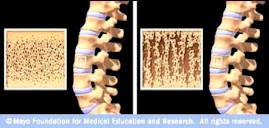
Osteoporotic Bone

Osteoporotic Bone
Source: www.mayoclinic.com

How Strontium Builds Bones

Strontium is a mineral that tends to accumulate in bone. Studies have shown that oral doses of strontium are a safe and effective way to prevent and reverse osteoporosis. Doses of 680 mg per day appear to be optimal. See my "For More Information About Strontium" links section.

Osteoporosis is caused by changes in bone production. In healthy young bones there is a constant cycle of new bone growth and bone removal. With age, more bone is removed and less new bone is produced. The bones become less dense and thus more fragile.

Scientists believe that strontium works in two ways. It may stimulate the replication of pre-osteoblasts, leading to an increase in osteoblasts (cells that build bone). Strontium also directly inhibits the activity of osteoclasts (cells that break down bone). The result is stronger bones.

When taking strontium, be sure to take 1200 mg calcium, 1000 IU vitamin D3, and 500 mg magnesium daily. It is best to take strontium late at night on an empty stomach. Calcium and strontium may compete with each other for absorption if taken together.