Human Skeleton

Human Skeleton

WELCOME TO STRONTIUM FOR BONES BLOG

Have you experienced negative, and even dangerous, side effects from Fosamax (alendronate), Boniva (ibandronate), Actonel (risedronate), Reclast (zoledronic acid), Prolia (denosumab), Forteo (teriparatide), Tymlos (abaloparatide), or other drugs prescribed for osteoporosis? If you have, then rest assured there is a safe, effective treatment for this condition. Strontium, primarily in the form of strontium citrate, is taken orally once a day.

Visitors to my blog can leave comments or ask questions and can remain anonymous, if they wish. Their comments are relayed to my g-mail inbox. Below each post, the number of comments for that post is cited and underlined because it is a link. By clicking on that link below any post, a window opens so that a visitor can leave a comment. Ideally, visitors leave comments on posts most relevant to their comments. All comments to my posts are moderated by me.

Browse the posts and visit the link library of references.


Blog Archive

Showing posts with label multivitamin. Show all posts

Monday, March 16, 2026

Slowing Biological Aging

Several studies have shown that it is possible to slow biological aging by taking certain supplements. Strength-training exercises may also help. 

One study gave participants 2000 IU/day of vitamin D and 1 g per day of omega-3s (330 mg EPA plus 660 mg DHA from marine algae) and asked them to follow an at-home, strength-training exercise program for 30 minutes 3X/week. To calculate biological ages, the team analysed five epigenetic ‘clocks’ in the blood samples. These clocks are biomarkers that measure DNA methylation — patterns of molecular tags on DNA — at specific sites in the genome. Methylation levels increase or decrease at particular sites in a relatively predictable manner with age. 

Omega-3 alone slowed the DNAm clocks, PhenoAge, GrimAge2 and DunedinPACE, and all three treatments had additive benefits on PhenoAge. 

https://www.nature.com/articles/s43587-024-00793-y

Another study showed that taking a daily multivitamin can slow signs of biological aging. Centrum Silver was used in the study. The supplement's anti-aging effect was greater in people who were already biologically older than their years.

https://www.nature.com/articles/s41591-026-04239-3 (original article)

https://www.nature.com/articles/d41586-026-00741-3 (summary article about the study)


Wednesday, January 1, 2025

Juggling Medications and Supplements

It is a juggling act with medications and supplements.


I take my levothyroxine in the early morning hours (usually 1-3 a.m.) when I wake up to use the bathroom. This hormone stopped my hair from falling out! 


I take my first dose of CBD and a probiotic with breakfast. 


I take most of my vitamins and minerals and my second dose of CBD with supper, my largest meal. These include my calcium/magnesium/vitamin D3 supplement, multivitamin, zinc, selenium, citrus bioflavonoids, vitamin C, vitamin D3, natural vitamin E, lutein with zeaxanthin and others. 


I take my SrC and simvastatin a couple of hours before bedtime and about 30 minutes apart. 


I get magnesium in my Ca/Mg/D supplement. I had been taking a magnesium glycinate capsule at lunch time for a while, but I stopped taking it due to multiple bowel movements. I still give it to my husband. It is best to take magnesium at bedtime, but lunch seems to fit in better for us.


I take sublingual methylcobalamin (Vitamin B12), 5000 mcg, one tablet per week. My husband takes this high dose every day around 3:00 p.m. to keep his canker sores from returning.  


Friday, August 5, 2022

My Current Supplements

My bone protocol consists of the following supplements. The dosage for each is  one capsule or tablet per day unless otherwise stated. 

AOR Strontium Support II, 341 mg strontium (from citrate) per capsule (two capsules daily)

Country Life, Gluten Free, Calcium Magnesium with Vitamin D Complex (250 mg Ca, 125 mg Mg, 100 I.U. Vitamin D per capsule) (two capsules daily)

Innate Vitality Magnesium Glycinate, 500 mg/capsule 

Nature Made Multi Men's 50+, No Iron (OK for men and women; contains 1000 IU vitamin D3 and 21 other nutrients) 

Nature Made D3, 1000 IU (one capsule three times/week)

I also take the following supplements for general health. The dosage for each is one capsule or tablet per day unless otherwise stated.

Solgar Citrus Bioflavonoid Complex, 1000 mg per tablet (Bioflavonoids are antioxidants.)

Solary Selenium, 100 mcg

Vitacost Chelated Zinc (zinc glycinate chelate), 30 mg

Doctor’s Best Lutein with Optilut (20 mg lutein, 4 mg zeaxanthin in two capsules)(2 capsules/day)

Nature Made Vitamin C, 500 mg

Solgar Natural Vitamin E (as d-Alpha Tocopherol plus d-Beta, d-Delta and d-Gamma Tocopherols), 400 IU

Horbaach Sublingual Methylcobalamin (Vitamin B12), 5000 mcg

I also take a couple of digestive aids: 

A probiotic (I am trying different brands.)

A multi-enzyme digestive (I am trying different brands.) 

Friday, July 3, 2020

My Current Supplements

I take one capsule/day of each of the following supplements, with the exception of strontium and lutein (two capsules/day) and D3 (one capsule three times/week). 

I do not take any supplements, except strontium, on Sundays to prevent getting too much of any one of them. I do not take strontium on Sundays if I feel I have not had sufficient calcium-containing foods that day. Vitamins, minerals, and other supplements taken in excess can cause problems.Too much calcium from supplements can contribute to the formation of kidney stones and has been implicated (inconclusively) in heart disease. Try to get most of your calcium from food. Excess amounts of water-soluble vitamins are eliminated in the urine. Supplemental vitamin C, a water-soluble vitamin, increases urinary oxalate concentrations, but whether an increase in urinary oxalate elevates the risk for kidney stones is not yet known. Those predisposed for kidney stone formation may consider avoiding high-dose (greater than or equal to 1 g/day) vitamin C supplementation. I am not predisposed to kidney stones but take only 500 mg/day vitamin C in pill form.

The fat-soluble vitamins are A, D, E and K. They are soluble in organic solvents and are absorbed and transported in a manner similar to that of fats. Excess amounts of fat-soluble vitamins accumulate in the liver, adipose (fat) tissue, and skeletal muscle. Because these vitamins are stored for long periods, dangerous levels can build up. Excess intake of fat-soluble vitamins is more likely to cause you harm than excess intake of water-soluble vitamins. For these reasons, I do not take extra vitamin A, except for the 750 mcg in my multivitamin. I do not take any K2 and only the 80 mcg K1 (as Phytonadione) in my multivitamin. I do take 400 IU natural vitamin E. I do take vitamin D (1000 IU) in my multivitamin. I recently added another D3 supplement with 1000 IU/capsule, but I am only taking it three times per week. If I add up the 1000 IU/day for six days/week in my multi and the 1000 IU for three days/week in the separate D3 supplement, I get 9000 IU vitamin D/week, or about 1286 IU/day. Unless you have a vitamin-D deficiency or insufficiency, as shown by a 25(OH)D blood test,1000 to 2000 IU/day of vitamin D should be plenty. 

Bioflavonoids (Antioxidants)

Solgar Citrus Bioflavonoid Complex, 1000 mg per tablet

Digestive Aids

Nature’s Way Primadophilus bifidus (probiotic)

NOW Super Enzymes (breaks down fats, carbs and protein)

Minerals

AOR Strontium Support II, 341 mg strontium (from citrate) per capsule (two capsules daily)

Country Life, Gluten Free, Calcium Magnesium Complex (500 mg Ca, 250 mg Mg per tablet)

KAL Magnesium Glycinate 400 (400 mg in 2 softgels; I take one.) 

Solary Selenium, 100 mcg

Vitacost Chelated Zinc (zinc glycinate chelate), 30 mg

Vitamins

Doctor’s Best Lutein with Optilut (20 mg lutein, 4 mg zeaxanthin in two capsules)

Nature Made D3, 1000 IU (one capsule three times/week)

Nature Made Multi Men's 50+, No Iron (OK for men and women; contains 1000 IU vitamin D3 and 21 other nutrients)

Nature Made Vitamin C, 500 m

Solgar Natural Vitamin E (as d-Alpha Tocopherol plus d-Beta, d-Delta and d-Gamma Tocopherols), 400 IU

Solgar Sublingual Methylcobalamin (Vitamin B12), 5000 mcg


Friday, January 11, 2019

Axial DXA 8 January 2019

The report of my axial DXA scan taken on 8 January 2019 appears below. I have been on 2 grams strontium citrate/day for 11 years. I also take a calcium/magnesium tablet (500 mg Ca/250 mg Mg), a multivitamin with 1000 IU vitamin D3, and several other supplements. I get plenty of protein in my diet. I exercise daily.

As you can see, my DXA results were excellent, except for my left femoral neck, which showed no change from the previous scan.

I am happy with my results, although I know the comparison of this year's results to those of 2.5 years ago contains some built-in error because two different brands of DXA machines were used. My 2016 scan was on a Hologic and the 2019 scan was on a GE Lunar Prodigy.

Changing testing sites, and, therefore, machines, was not my choice. I had been getting my scans in the outpatient radiology department of a large hospital medical center, but the provider is now pushing patients into its freestanding imaging centers. I was told my insurance would not pay for a DXA unless it was done at a freestanding center, but my insurance denied that assertion.

The risk factor for secondary osteoporosis mentioned, but not specified, in the report is early menopause.

INDICATION: Postmenopausal. Follow-up of osteopenia on prior DXA.
Patient reports risk factors for secondary osteoporosis.

COMPARISON: 8/4/2016

FINDINGS:

Spine: Total BMD of the spine (L1-4) is 1.108 g/cm2, with a T-score of
-0.7 and a Z-score of 1.0.

Left Femoral Neck: BMD is 0.883 g/cm2, with a T-score of -1.1 and a
Z-score of 0.6.

Left Total Hip: BMD is 0.928 g/cm2, with a T-score of -0.6 and a Z-score
of 0.9.

Right Femoral Neck: BMD is 0.919 g/cm2, with a T-score of -0.9 and a
Z-score of 0.9.

Right Total Hip: BMD is 0.963 g/cm2, with a T-score of -0.4 and a Z-score
of 1.1.

Compared to the prior study, there has been 9% increase in spine density, 6% increase in left total hip density, but no change in left femoral neck density.

FRAX evaluation calculates 10-year probability of fracture:

Major Osteoporotic: 7.8%

Hip: 1.0%

IMPRESSION:

Based on BMD, diagnosis is consistent with osteopenia.

FOLLOWUP: In 2 years is recommended.


Wednesday, December 21, 2016

My Daily Supplements Update


I take one of each supplement daily, except for strontium. I take two capsules of strontium per day.

  1. Bluebonnet Lecithin, 1365 mg in one softgel
  2. Solgar Citrus Bioflavonoid Complex, 1000 mg per tablet
  3. Country Life, Gluten Free, Calcium Magnesium Complex (500 mg Ca, 250 mg Mg per tablet)
  4. Doctor’s Best Lutein with Optilut, 20 mg lutein esters yielding 10 mg minimum of free lutein, 2 mg zeaxanthin per capsule
  5. AOR Strontium Support II, 341 mg strontium (from citrate) per capsule (two capsules daily)
  6. Nature Made Multi for Him, No Iron (Not a typo. My husband and I both take this multivitamin.)
  7. Nature Made Vitamin C, 500 mg
  8. Solgar Natural Vitamin E (as d-Alpha Tocopherol plus d-Beta, d-Delta and d-Gamma Tocopherols), 400 IU
  9. Nature’s Way Primadophilus bifidus (This is a probiotic.)
10. Solgar Sublingual Methylcobalamin, 5000 mcg
11. Solgar Zinc (as zinc gluconate), 50 mg

I have made a few changes since my last daily supplements update on June 11, 2015:

http://strontiumforbones.blogspot.com/2015/06/my-daily-supplements.html

The most significant change was the switch from Doctor’s Best Strontium Bone Maker to AOR Strontium Support II. I made this change after Doctor’s Best was sold to a Chinese company and before discovering that Doctor's Best Strontium was discontinued in July 2016 (60- and 120-count bottles) and September 2016 (360-count bottle).  

I reduced my dosage of Bluebonnet Lecithin from two to one softgel, which is a serving per the label. Many years earlier, I had been taking three softgels per day. The reason for my latest dosage reduction is that there is currently some controversy about the health benefits of lecithin. I’ve been taking it for many years for cardiovascular health.

https://en.wikipedia.org/wiki/Lecithin  See the introduction and the section on “Biology” in Wikipedia for an overview of lecithin, choline, and phospholipids, such as phosphatidylcholines, a class of phospholipids that incorporate choline as a head group.  

https://www.ncbi.nlm.nih.gov/pubmed/26108618  “Effects of choline on health across the life course: a systematic review.”

I also switched from Nature’s Bounty Vitamin E to Solgar Vitamin E, from Twin Labs Zinc to Solgar Zinc, and from Country Life Citrus Bioflavonoids and Rutin to Solgar Citrus Bioflavonoid Complex. These changes were due solely to unavailability at my online supplement distributor, iherb.com, which no longer stocks Nature’s Bounty Vitamin E or Twin Labs Zinc. Country Life Citrus Bioflavonoids and Rutin is out of stock at iherb.com until 12/25/2016. I may buy whichever bioflavonoid brand is available when I reorder.

I like my supplier’s next day air expedited shipping (at extra cost) because some vitamins and supplements are heat labile. I am unhappy with its current policy of giving a discount, based on total amount of current invoice, for my NEXT purchase rather than for my CURRENT purchase, as was previously done. This policy has raised my costs. 


Thursday, June 11, 2015

My Daily Supplements


I have written about my supplements in previous posts but have made several changes since then. The following list is an update of all my supplements. I have alphabetized them by brand name. I take one of each daily unless otherwise noted. The Ca/Mg (#3) and strontium (#5) are primarily for bone health. The multivitamin (#6) is for general health, as are most of the other supplements. The probiotic (#9) is for digestive health. I take lecithin (#1) as an aid in preventing cholesterol buildup in the arteries and to combat heart disease. I take a large dose (5000 mcg) of methylcobalamin (#10) (vitamin B12) daily because taking a statin drug to reduce cholesterol also reduces vitamin B12. My husband takes B12 to keep from getting the canker sores that once plagued him. Methylcobalamin is more effective than cyanocobalamin; he tried both.

No one should copy my supplement protocol because each person’s needs are unique to him or her. I hope publishing this list will give others a place to start in forming their own protocol.  
  
  1. Bluebonnet Lecithin, 1365 mg in one softgel (I take two softgels daily.)
  2. Country Life Citrus Bioflavonoids, 1000 mg
  3. Country Life, Gluten Free, Calcium Magnesium Complex (500 mg Ca, 250 mg Mg per tablet)
  4. Doctor’s Best Lutein, 20 mg lutein esters yielding 10 mg minimum free lutein, 2 mg zeaxanthin
  5. Doctor’s Best Strontium Bone Maker, 2194 mg strontium citrate, 680 mg elemental strontium in two capsules (two capsules daily)
  6. Nature Made Multi for Him, No Iron (Not a typo. My husband and I both take this multivitamin.)
  7. Nature Made Vitamin C, 500 mg
  8. Nature’s Bounty Vitamin E, 100 % Natural, 400 IU
  9. Nature’s Way Primadophilus bifidus (This is a probiotic.)
10. Solgar Sublingual Methylcobalamin, 5000 mcg
11. Twin Labs Zinc, 50 mg

Notes on My Supplements

I always keep a couple of bottles of Nature’s Bounty Ginger Root capsules, 550 mg, in my refrigerator and take them for nausea and upset stomach as needed. If I don’t have fresh ginger and need ginger for a recipe, I just open a few, usually three, capsules and use the ginger powder for cooking.

I don’t take a separate vitamin D supplement because my multivitamin contains 1000 IU. I also try to get some sun each week. Some people may need more vitamin D if a 25(OH)D test shows they have a deficiency or insufficiency of this vitamin.

I do not take vitamin K2. Many people take this vitamin for bone and cardiac health. There is some debate about which form (MK4 or MK7) and what dosage of this vitamin one should take. The Japanese studies used 45 mg MK4, and patients are prescribed this dosage by physicians in Japan. The MK7 is taken in microgram dosages. Some people experience sleeplessness when taking MK7. No RDA/RDI has been established for vitamin K2 of either form. Studies in the US and Europe have not confirmed the efficacy of vitamin K2 for bone or cardiac health.

Notes on My Multivitamin

Nature Made has a Multi for Her, Multi for Him, Multi for Her 50+, and Multi for Him 50+. All the formulations are similar except the Multi for Her, which I will not take because it contains iron. Supplemental iron is not needed by men and postmenopausal women unless they have been diagnosed with iron deficiency anemia. Excessive iron can lead to iron toxicity. I have taken the other three formulations at one time or another, depending on what was available. 

What I like about the Nature Made multivitamins is that they are USP-verified, and that is rare to find. It gives me assurance that the multis contain the vitamins and minerals in the dosages specified and have no impurities.  Nature Made Vitamin C is also USP-verified, as are many of that brand’s other vitamins.

My Supplement History

On 8/5/2010, I posted all my supplements on my blog.  http://strontiumforbones.blogspot.com/2010/08/my-daily-supplements.html
On 09/30/2011, I posted about the three supplements I was taking specifically for bone health.
On 03/2/2012, I posted an update on my calcium/magnesium supplement.

COMB Study

You might also be interested in the protocol used in the COMB study.

Friday, May 2, 2014

Should You Stop Taking Strontium and/or Calcium Before a Scan?


You should stop taking calcium and strontium supplements 24-48 hours prior to your bone density test. Calcium and strontium are very dense materials. If they do not dissolve, they could be seen in the intestines that cross over the area of the spine being measured and could affect the spine BMD results. Most calcium supplements (e.g. calcium citrate) will dissolve well, but others (e.g. calcium carbonate) may take longer to dissolve completely.

Here are two references that mention calcium and DXA scans. I don’t have a reference for strontium, but the same would hold true for it since it is even denser than calcium.

http://www.hopkinsmedicine.org/healthlibrary/test_procedures/orthopaedic/bo ne_densitometry_92,P07664/ See: “Before the procedure.” This article says, “…you may be advised to stop taking calcium supplements 24-48 hours prior to your bone density test.” Apparently, some testing centers provide this advice, but mine did not.  

Two days before my last DXA scan, I stopped taking my calcium/magnesium supplement, my strontium citrate, and my multivitamin. Don't forget that your multivitamin contains calcium, and it is usually calcium carbonate.

http://www.mmc.org/mmp_endodiabetes.cfm?id=5562 See: “Why can’t I take calcium before the test?” This article says, “These days most calcium supplements will dissolve well but you should notify the technologist if you took calcium so she can see whether it appears in the spine scan.” I say that it is better to avoid the problem altogether and not have to have a repeat DXA scan.


Friday, March 2, 2012

Update On My Calcium And Magnesium Intake

For many years, I have been taking one tablet per day of KAL Calcium Magnesium Extra Strength, which contains 500 mg calcium (as calcium carbonate and calcium amino acid chelate), 250 mg magnesium (as magnesium oxide and magnesium amino acid chelate), 15 mg sodium, and 50 mg betaine HCl.  I was buying it at my local health food store, but I found a replacement that I think is even better and will be ordering it soon from www.iherb.com, an online distributor I've been getting my strontium and a couple of other supplements from.

The new product is Country Life, Gluten Free, Calcium Magnesium Complex 1000 mg/500 mg in two tablets, 360 tablets, $20.23. The calcium is in the form of calcium hydroxyapatite, citrate, aspartate, alpha-ketoglutarate, and lysinate. The magnesium is in the form of magnesium oxide, citrate, taurinate, alpha-ketoglutarate, and aspartate. Each tablet contains 500 mg calcium, 250 mg magnesium, and 250 mg phosphorus (as calcium hydroxyapatite).

In addition to a calcium/magnesium supplement, I take a multivitamin, Nature Made Multi For Her 50+, which I buy online at www.walgreen.com when the company has one of their frequent “buy one, get one free” offers. This multivitamin contains 200 mg calcium, 100 mg magnesium, 1000 IU vitamin D3, 80 mcg vitamin K, and many other key nutrients.

For breakfast, I have 12 oz fat-free milk, which gives me 450 mg calcium. At lunch, I take the 500 mg calcium/250 mg magnesium supplement. With supper, I take my multivitamin for 200 mg calcium and 100 mg magnesium. That comes to 1150 mg calcium, without counting other food sources. The RDA for women 50+ is 1200 mg calcium per day. I may cut back to 8 oz milk (300 mg calcium) on days when I know I’ll be having something calcium rich for supper.  

Wandering Skeleton

Wandering Skeleton
Artist: Joel Hoekstra

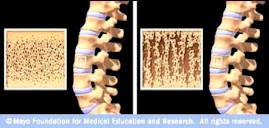
Osteoporotic Bone

Osteoporotic Bone
Source: www.mayoclinic.com

How Strontium Builds Bones

Strontium is a mineral that tends to accumulate in bone. Studies have shown that oral doses of strontium are a safe and effective way to prevent and reverse osteoporosis. Doses of 680 mg per day appear to be optimal. See my "For More Information About Strontium" links section.

Osteoporosis is caused by changes in bone production. In healthy young bones there is a constant cycle of new bone growth and bone removal. With age, more bone is removed and less new bone is produced. The bones become less dense and thus more fragile.

Scientists believe that strontium works in two ways. It may stimulate the replication of pre-osteoblasts, leading to an increase in osteoblasts (cells that build bone). Strontium also directly inhibits the activity of osteoclasts (cells that break down bone). The result is stronger bones.

When taking strontium, be sure to take 1200 mg calcium, 1000 IU vitamin D3, and 500 mg magnesium daily. It is best to take strontium late at night on an empty stomach. Calcium and strontium may compete with each other for absorption if taken together.