I take one capsule/day of each of the following supplements, with the exception of strontium and lutein (two capsules/day) and D3 (one capsule three times/week).
I do not take any supplements, except strontium, on Sundays to prevent getting too much of any one of them. I do not take strontium on Sundays if I feel I have not had sufficient calcium-containing foods that day. Vitamins, minerals, and other supplements taken in excess can cause problems.Too much calcium from supplements can contribute to the formation of kidney stones and has been implicated (inconclusively) in heart disease. Try to get most of your calcium from food. Excess amounts of water-soluble vitamins are eliminated in the urine. Supplemental vitamin C, a water-soluble vitamin, increases urinary oxalate concentrations, but whether an increase in urinary oxalate elevates the risk for kidney stones is not yet known. Those predisposed for kidney stone formation may consider avoiding high-dose (greater than or equal to 1 g/day) vitamin C supplementation. I am not predisposed to kidney stones but take only 500 mg/day vitamin C in pill form.
The fat-soluble vitamins are A, D, E and K. They are soluble in organic solvents and are absorbed and transported in a manner similar to that of fats. Excess amounts of fat-soluble vitamins accumulate in the liver, adipose (fat) tissue, and skeletal muscle. Because these vitamins are stored for long periods, dangerous levels can build up. Excess intake of fat-soluble vitamins is more likely to cause you harm than excess intake of water-soluble vitamins. For these reasons, I do not take extra vitamin A, except for the 750 mcg in my multivitamin. I do not take any K2 and only the 80 mcg K1 (as Phytonadione) in my multivitamin. I do take 400 IU natural vitamin E. I do take vitamin D (1000 IU) in my multivitamin. I recently added another D3 supplement with 1000 IU/capsule, but I am only taking it three times per week. If I add up the 1000 IU/day for six days/week in my multi and the 1000 IU for three days/week in the separate D3 supplement, I get 9000 IU vitamin D/week, or about 1286 IU/day. Unless you have a vitamin-D deficiency or insufficiency, as shown by a 25(OH)D blood test,1000 to 2000 IU/day of vitamin D should be plenty.
Bioflavonoids (Antioxidants)
Solgar Citrus Bioflavonoid Complex, 1000 mg per tablet
Digestive Aids
Nature’s Way Primadophilus bifidus (probiotic)
NOW Super Enzymes (breaks down fats, carbs and protein)
Minerals
AOR Strontium Support II, 341 mg strontium (from citrate) per capsule (two capsules daily)
Country Life, Gluten Free, Calcium Magnesium Complex (500 mg Ca, 250 mg Mg per tablet)
KAL Magnesium Glycinate 400 (400 mg in 2 softgels; I take one.)
Solary Selenium, 100 mcg
Vitacost Chelated Zinc (zinc glycinate chelate), 30 mg
Vitamins
Doctor’s Best Lutein with Optilut (20 mg lutein, 4 mg zeaxanthin in two capsules)
Nature Made D3, 1000 IU (one capsule three times/week)
Nature Made Multi Men's 50+, No Iron (OK for men and women; contains 1000 IU vitamin D3 and 21 other nutrients)
Nature Made Vitamin C, 500 m
Solgar Natural Vitamin E (as d-Alpha Tocopherol plus d-Beta, d-Delta and d-Gamma Tocopherols), 400 IU
Solgar Sublingual Methylcobalamin (Vitamin B12), 5000 mcg
Human Skeleton

Showing posts with label vitamin K1. Show all posts
Showing posts with label vitamin K1. Show all posts
Friday, July 3, 2020


Wednesday, November 26, 2014
Vitamin K2: The Missing Nutrient
"Chris Kresser, M.S., L.Ac is a globally recognized leader in the fields
of ancestral health, Paleo nutrition, and functional and integrative
medicine." The Paleo diet excludes dairy and grains. I eat both dairy and grains myself. I am not advocating the Paleo diet, but it may be beneficial for those with allergies or sensitivities to milk or grains or gluten intolerance.
In the following article, he discusses the benefits of vitamin K2.
"A study recently published by the European Prospective Investigation into Cancer and Nutrition (EPIC) has revealed that increased intake of vitamin K2 may reduce the risk of prostate cancer by 35 percent. The authors point out that the benefits of K2 were most pronounced for advanced prostate cancer, and, importantly, that vitamin K1 did not offer any prostate benefits.
The findings were based on data from more than 11,000 men taking part in the EPIC Heidelberg cohort. It adds to a small but fast-growing body of science supporting the potential health benefits of vitamin K2 for bone, cardiovascular, skin, brain, and now prostate health.
Unfortunately, many people are not aware of the health benefits of vitamin K2. The K vitamins have been underrated and misunderstood up until very recently in both the scientific community and the general public.
It has been commonly believed that the benefits of vitamin K are limited to its role in blood clotting. Another popular misconception is that vitamins K1 and K2 are simply different forms of the same vitamin – with the same physiological functions.
New evidence, however, has confirmed that vitamin K2’s role in the body extends far beyond blood clotting to include protecting us from heart disease, ensuring healthy skin, forming strong bones, promoting brain function, supporting growth and development and helping to prevent cancer – to name a few. In fact, vitamin K2 has so many functions not associated with vitamin K1 that many researchers insist that K1 and K2 are best seen as two different vitamins entirely.
A large epidemiological study from the Netherlands illustrates this point well. The researchers collected data on the vitamin K intakes of the subjects between 1990 and 1993 and measured the extent of heart disease in each subject, who had died from it and how this related to vitamin K2 intake and arterial calcification. They found that calcification of the arteries was the best predictor of heart disease. Those in the highest third of vitamin K2 intakes were 52 percent less likely to develop severe calcification of the arteries, 41 percent less likely to develop heart disease, and 57 percent less likely to die from it. (Geleijnse et al., 2004, pp. 3100-3105) However, intake of vitamin K1 had no effect on cardiovascular disease outcomes.
While K1 is preferentially used by the liver to activate blood clotting proteins, K2 is preferentially used by other tissues to deposit calcium in appropriate locations, such as in the bones and teeth, and prevent it from depositing in locations where it does not belong, such as the soft tissues.(Spronk et al., 2003, pp. 531-537) In an acknowledgment of the different roles played by vitamins K1 and K2, the United States Department of Agriculture (USDA) finally determined the vitamin K2 contents of foods in the U.S. diet for the first time in 2006. (Elder, Haytowitz, Howe, Peterson, & Booth, 2006, pp. 436-467)
Another common misconception is that human beings do not need vitamin K2 in their diet, since they have the capacity to convert vitamin K1 to vitamin K2. The amount of vitamin K1 in typical diets is ten times greater than that of vitamin K2, and researchers and physicians have largely dismissed the contribution of K2 to nutritional status as insignificant.
However, although animals can convert vitamin K1 to vitamin K2, a significant amount of evidence suggests that humans require preformed K2 in the diet to obtain and maintain optimal health. The strongest indication that humans require preformed vitamin K2 in the diet is that epidemiological and intervention studies both show its superiority over K1. Intake of K2 is inversely associated with heart disease in humans while intake of K1 is not (Geleijnse et al., 2004, pp. 3100-3105), and vitamin K2 is at least three times more effective than vitamin K1 at activating proteins related to skeletal metabolism. (Schurgers et al., 2007) And remember that in the study on vitamin K2’s role in treating prostate cancer, which I mentioned at the beginning of this article, vitamin K1 had no effect.
All of this evidence points to the possibility that vitamin K2 may be an essential nutrient in the human diet. So where does one find vitamin K2 in foods? The following is a list of the foods highest in vitamin K2, as measured by the USDA:
Unfortunately, precise values for some foods that are likely to be
high in K2 (such as organ meats) are not available at this time. The
pancreas and salivary glands would be richest; reproductive organs,
brains, cartilage and possibly kidneys would also be very rich; finally,
bone would be richer than muscle meat. Fish eggs are also likely to be
rich in K2.
It was once erroneously believed that intestinal bacteria are a major contributor to vitamin K status. However, the majority of evidence contradicts this view. Most of the vitamin K2 produced in the intestine are embedded within bacterial membranes and not available for absorption. Thus, intestinal production of K2 likely makes only a small contribution to vitamin K status. (Unden & Bongaerts, 1997, pp. 217-234)
On the other hand, fermented foods, however, such as sauerkraut, cheese and natto (a soy dish popular in Japan), contain substantial amounts of vitamin K2. Natto contains the highest concentration of K2 of any food measured; nearly all of it is present as MK-7, which research has shown to be a highly effective form. A recent study demonstrated that MK-7 increased the percentage of osteocalcin in humans three times more powerfully than did vitamin K1. (Schurgers & Vermeer, 2000, pp. 298-307)
It is important to note that commercial butter is not a significantly high source of vitamin K2. Dr. Weston A. Price, who was the first to elucidate the role of vitamin K2 in human health (though he called it “Activator X” at the time) analyzed over 20,000 samples of butter sent to him from various parts of the world. As mentioned previously in this paper, he found that the Activator X concentration varied 50-fold. Animals grazing on vitamin K-rich cereal grasses, especially wheat grass, and alfalfa in a lush green state of growth produced fat with the highest amounts of Activator X, but the soil in which the pasture was grown also influenced the quality of the butter. It was only the vitamin-rich butter grown in three feet or more of healthy top soil that had such dramatic curing properties when combined with cod liver oil in Dr. Price’s experiments and clinical practice.
Therefore, vitamin K2 levels will not be high in butter from grain-fed cows raised in confinement feedlots. Since the overwhelming majority of butter sold in the U.S. comes from such feedlots, butter is not a significant source of K2 in the diet for most people. This is yet another argument for obtaining raw butter from cows raised on green pasture.
New research which expands our understanding of the many important roles of vitamin K2 is being published at a rapid pace. Yet it is already clear that vitamin K2 is an important nutrient for human health – and one of the most poorly understood by medical authorities and the general public."
http://chriskresser.com/vitamin-k2-the-missing-nutrient
358 comments
In the following article, he discusses the benefits of vitamin K2.
"A study recently published by the European Prospective Investigation into Cancer and Nutrition (EPIC) has revealed that increased intake of vitamin K2 may reduce the risk of prostate cancer by 35 percent. The authors point out that the benefits of K2 were most pronounced for advanced prostate cancer, and, importantly, that vitamin K1 did not offer any prostate benefits.
The findings were based on data from more than 11,000 men taking part in the EPIC Heidelberg cohort. It adds to a small but fast-growing body of science supporting the potential health benefits of vitamin K2 for bone, cardiovascular, skin, brain, and now prostate health.
Unfortunately, many people are not aware of the health benefits of vitamin K2. The K vitamins have been underrated and misunderstood up until very recently in both the scientific community and the general public.
It has been commonly believed that the benefits of vitamin K are limited to its role in blood clotting. Another popular misconception is that vitamins K1 and K2 are simply different forms of the same vitamin – with the same physiological functions.
New evidence, however, has confirmed that vitamin K2’s role in the body extends far beyond blood clotting to include protecting us from heart disease, ensuring healthy skin, forming strong bones, promoting brain function, supporting growth and development and helping to prevent cancer – to name a few. In fact, vitamin K2 has so many functions not associated with vitamin K1 that many researchers insist that K1 and K2 are best seen as two different vitamins entirely.
A large epidemiological study from the Netherlands illustrates this point well. The researchers collected data on the vitamin K intakes of the subjects between 1990 and 1993 and measured the extent of heart disease in each subject, who had died from it and how this related to vitamin K2 intake and arterial calcification. They found that calcification of the arteries was the best predictor of heart disease. Those in the highest third of vitamin K2 intakes were 52 percent less likely to develop severe calcification of the arteries, 41 percent less likely to develop heart disease, and 57 percent less likely to die from it. (Geleijnse et al., 2004, pp. 3100-3105) However, intake of vitamin K1 had no effect on cardiovascular disease outcomes.
While K1 is preferentially used by the liver to activate blood clotting proteins, K2 is preferentially used by other tissues to deposit calcium in appropriate locations, such as in the bones and teeth, and prevent it from depositing in locations where it does not belong, such as the soft tissues.(Spronk et al., 2003, pp. 531-537) In an acknowledgment of the different roles played by vitamins K1 and K2, the United States Department of Agriculture (USDA) finally determined the vitamin K2 contents of foods in the U.S. diet for the first time in 2006. (Elder, Haytowitz, Howe, Peterson, & Booth, 2006, pp. 436-467)
Another common misconception is that human beings do not need vitamin K2 in their diet, since they have the capacity to convert vitamin K1 to vitamin K2. The amount of vitamin K1 in typical diets is ten times greater than that of vitamin K2, and researchers and physicians have largely dismissed the contribution of K2 to nutritional status as insignificant.
However, although animals can convert vitamin K1 to vitamin K2, a significant amount of evidence suggests that humans require preformed K2 in the diet to obtain and maintain optimal health. The strongest indication that humans require preformed vitamin K2 in the diet is that epidemiological and intervention studies both show its superiority over K1. Intake of K2 is inversely associated with heart disease in humans while intake of K1 is not (Geleijnse et al., 2004, pp. 3100-3105), and vitamin K2 is at least three times more effective than vitamin K1 at activating proteins related to skeletal metabolism. (Schurgers et al., 2007) And remember that in the study on vitamin K2’s role in treating prostate cancer, which I mentioned at the beginning of this article, vitamin K1 had no effect.
All of this evidence points to the possibility that vitamin K2 may be an essential nutrient in the human diet. So where does one find vitamin K2 in foods? The following is a list of the foods highest in vitamin K2, as measured by the USDA:
Foods high in vitamin K2
- Natto
- Hard cheese
- Soft cheese
- Egg yolk
- Butter
- Chicken liver
- Salami
- Chicken breast
- Ground beef
It was once erroneously believed that intestinal bacteria are a major contributor to vitamin K status. However, the majority of evidence contradicts this view. Most of the vitamin K2 produced in the intestine are embedded within bacterial membranes and not available for absorption. Thus, intestinal production of K2 likely makes only a small contribution to vitamin K status. (Unden & Bongaerts, 1997, pp. 217-234)
On the other hand, fermented foods, however, such as sauerkraut, cheese and natto (a soy dish popular in Japan), contain substantial amounts of vitamin K2. Natto contains the highest concentration of K2 of any food measured; nearly all of it is present as MK-7, which research has shown to be a highly effective form. A recent study demonstrated that MK-7 increased the percentage of osteocalcin in humans three times more powerfully than did vitamin K1. (Schurgers & Vermeer, 2000, pp. 298-307)
It is important to note that commercial butter is not a significantly high source of vitamin K2. Dr. Weston A. Price, who was the first to elucidate the role of vitamin K2 in human health (though he called it “Activator X” at the time) analyzed over 20,000 samples of butter sent to him from various parts of the world. As mentioned previously in this paper, he found that the Activator X concentration varied 50-fold. Animals grazing on vitamin K-rich cereal grasses, especially wheat grass, and alfalfa in a lush green state of growth produced fat with the highest amounts of Activator X, but the soil in which the pasture was grown also influenced the quality of the butter. It was only the vitamin-rich butter grown in three feet or more of healthy top soil that had such dramatic curing properties when combined with cod liver oil in Dr. Price’s experiments and clinical practice.
Therefore, vitamin K2 levels will not be high in butter from grain-fed cows raised in confinement feedlots. Since the overwhelming majority of butter sold in the U.S. comes from such feedlots, butter is not a significant source of K2 in the diet for most people. This is yet another argument for obtaining raw butter from cows raised on green pasture.
New research which expands our understanding of the many important roles of vitamin K2 is being published at a rapid pace. Yet it is already clear that vitamin K2 is an important nutrient for human health – and one of the most poorly understood by medical authorities and the general public."
http://chriskresser.com/vitamin-k2-the-missing-nutrient
358 comments
Is Vitamin K2 the New Vitamin D?
This article is dated November 18, 2014, and appeared on Medscape. It is the opinion of one doctor, who admits from the start that he knows nothing about nutrition as it relates to chronic illness. As pointed out by one commenter, he goes on to prove his ignorance by stating that green, leafy vegetables are a good source of vitamin K2. Wrong! They are a good source of vitamin K1. Because the doctor's article is controversial, there are many comments revealing various viewpoints. Be sure to drag and drop the link below and read the comments. There is also a video of the doctor giving his talk.
"Hello and welcome. I am Dr George Lundberg, and this is At Large at Medscape.
I do not know anything about nutrition as it relates to chronic illness, including obesity. I used to think that was because, probably like you, I was taught so little about nutrition in medical school. I have spent a medical lifetime reading articles about nutrition, before and after publication. But I am still woefully ignorant of "nutritional truth."
Take vitamin D. The minimum daily requirement prevents rickets. But then, just a few years ago, it became popular to check vitamin D blood levels. And many people were found to have "low" vitamin D levels. Then many diseases were found to be associated with "vitamin D deficiency," except it turns out that many labs were not doing the tests in equivalent ways.
After a whole lot of fuss and study, the Agency for Healthcare Research and Quality (AHRQ) issued a report this year that finds no consistent correlation between vitamin D and health outcomes such as cardiovascular disease, all-cause mortality, several types of cancer, or bone health.[1] Amazing.
Here are nine things every physician should know about vitamin K2:
Is vitamin K2 the ubiquitous disease-associated vitamin D-like deficiency, sans blood testing, all over again? A fad disease about to pop up, flourish, and disappear? Or is this a real, late-to-the-table, fundamental new understanding of possible causes of many common diseases, disability, and death? And if vitamin K2 is taken correctly, will it result in prevention and treatment of same? Look it up; check it out.
I do not know how this is going to work out, but I have a hunch that vitamin K2 will turn out to be a really big deal rather than only "the new vitamin D," with much fuss and little substance.
Most of this research is being done in Japan and Europe, especially The Netherlands, well away from the US Department of Agriculture and lobbyists for the American food industry and its captured government and academic partners.
I owe my current interest in this topic to a product of the Internet as the world's greatest library—a well-educated, nonscientist who got really interested in this topic and will not let up. Thank you, Micki Jacobs of Cincinnati.
That's my opinion. I am Dr George Lundberg, at large at Medscape."
http://www.medscape.com/viewarticle/834763?nlid=70845_1521&src=wnl_edit_medp_wir&uac=127701PY&spon=17
"Hello and welcome. I am Dr George Lundberg, and this is At Large at Medscape.
I do not know anything about nutrition as it relates to chronic illness, including obesity. I used to think that was because, probably like you, I was taught so little about nutrition in medical school. I have spent a medical lifetime reading articles about nutrition, before and after publication. But I am still woefully ignorant of "nutritional truth."
Take vitamin D. The minimum daily requirement prevents rickets. But then, just a few years ago, it became popular to check vitamin D blood levels. And many people were found to have "low" vitamin D levels. Then many diseases were found to be associated with "vitamin D deficiency," except it turns out that many labs were not doing the tests in equivalent ways.
After a whole lot of fuss and study, the Agency for Healthcare Research and Quality (AHRQ) issued a report this year that finds no consistent correlation between vitamin D and health outcomes such as cardiovascular disease, all-cause mortality, several types of cancer, or bone health.[1] Amazing.
Which Brings Us to Vitamin K
What do you know about vitamin K? It has something to do with blood coagulation, right? Yes, but that is vitamin K1. I am asking about vitamin K2. I bet you have not thought much about that vitamin.Here are nine things every physician should know about vitamin K2:
- It exists.
- It is essential for life and health.
- There is currently no reliable blood test to measure it.
- Your body makes a certain amount via menaquinone-4 (M-4) in your gut from vitamin K1.
- That may not be enough.
- Your body probably needs more vitamin K2 for disease prevention than it manufactures, so nutritional sources are important.
- Foods rich in vitamin K2 (often in the form of M-4 or M-7) include: natto (fermented soybeans); green, leafy vegetables; organ meats such as goose liver; grass-fed beef; dairy; eggs; and fish.
- Or you can take nutritional supplements to achieve healthy levels of vitamin K2.
- Deficiencies of vitamin K2 are now being reported in serious journals to be associated with—get this—all-cause mortality, cardiovascular disease, osteoporosis, diabetes, many forms of cancer, dementia, and chronic inflammation.
Is vitamin K2 the ubiquitous disease-associated vitamin D-like deficiency, sans blood testing, all over again? A fad disease about to pop up, flourish, and disappear? Or is this a real, late-to-the-table, fundamental new understanding of possible causes of many common diseases, disability, and death? And if vitamin K2 is taken correctly, will it result in prevention and treatment of same? Look it up; check it out.
I do not know how this is going to work out, but I have a hunch that vitamin K2 will turn out to be a really big deal rather than only "the new vitamin D," with much fuss and little substance.
Most of this research is being done in Japan and Europe, especially The Netherlands, well away from the US Department of Agriculture and lobbyists for the American food industry and its captured government and academic partners.
I owe my current interest in this topic to a product of the Internet as the world's greatest library—a well-educated, nonscientist who got really interested in this topic and will not let up. Thank you, Micki Jacobs of Cincinnati.
That's my opinion. I am Dr George Lundberg, at large at Medscape."
http://www.medscape.com/viewarticle/834763?nlid=70845_1521&src=wnl_edit_medp_wir&uac=127701PY&spon=17
Saturday, August 16, 2014
Natto - Fermented Soy Beans
Natto contains 20 to 40mcg of K1, NO MK-4, and 900 to 1200mcg of
MK-7,8,9.
This video shows you what it looks like and how to eat it.
This video shows you what it looks like and how to eat it.
Thursday, July 5, 2012
Vitamins B6 and B12 and Folic Acid
Readers of my blog know that I advocate taking strontium citrate along with a combination of vitamins, minerals, and other supplements for bone health. Most people understand that calcium, magnesium, and vitamin D are essential for strong bones. Some people are adding vitamin K1 and/or vitamin K2 (MK4 or MK7) to their supplement lists. But did you know that you may also need vitamins B6 and B12 and folic acid?
“Some studies suggest high blood levels of the amino acid homocysteine may be linked to lower bone density and higher risk of hip fracture in the elderly. Vitamins B6 and B12, as well as folic acid, play a role in changing homocysteine into other amino acids for use by the body; so, it is possible that they might play a protective role in osteoporosis. Research is ongoing as to whether supplementation with these B vitamins might reduce fracture risk.” This paragraph is quoted from:
http://www.iofbonehealth.org/nutrition
The studies referred to are:
1. McLean RR, Jacques PF, Selhub J, et al. (2004) Homocysteine as a predictive factor for hip fracture in older persons. N Engl J Med 350:2042-49
2. Morris MS, Jacques PF, Selhub J (2005) Relation between homocysteine and B-vitamin status indicators and bone mineral density in older Americans. Bone 37:234-42
I take Nature's Bounty Sublingual Vitamin B12, 5000 mcg (5 mg) per microlozenge. I was using it three times per week, but I have recently increased my intake to the recommended dosage of one microlozenge daily. You dissolve these under your tongue for maximum absorption.
My multivitamin, Nature Made Multi For Her 50+, contains 6 mg of vitamin B6,25 mcg of vitamin B12, and 400 mcg of folic acid.
“Some studies suggest high blood levels of the amino acid homocysteine may be linked to lower bone density and higher risk of hip fracture in the elderly. Vitamins B6 and B12, as well as folic acid, play a role in changing homocysteine into other amino acids for use by the body; so, it is possible that they might play a protective role in osteoporosis. Research is ongoing as to whether supplementation with these B vitamins might reduce fracture risk.” This paragraph is quoted from:
http://www.iofbonehealth.org/nutrition
The studies referred to are:
1. McLean RR, Jacques PF, Selhub J, et al. (2004) Homocysteine as a predictive factor for hip fracture in older persons. N Engl J Med 350:2042-49
2. Morris MS, Jacques PF, Selhub J (2005) Relation between homocysteine and B-vitamin status indicators and bone mineral density in older Americans. Bone 37:234-42
I take Nature's Bounty Sublingual Vitamin B12, 5000 mcg (5 mg) per microlozenge. I was using it three times per week, but I have recently increased my intake to the recommended dosage of one microlozenge daily. You dissolve these under your tongue for maximum absorption.
My multivitamin, Nature Made Multi For Her 50+, contains 6 mg of vitamin B6,25 mcg of vitamin B12, and 400 mcg of folic acid.
Subscribe to:
Posts (Atom)
Wandering Skeleton

Artist: Joel Hoekstra
Osteoporotic Bone
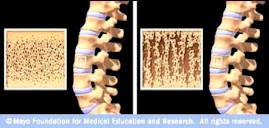
Source: www.mayoclinic.com