Human Skeleton

Human Skeleton

WELCOME TO STRONTIUM FOR BONES BLOG

Have you experienced negative, and even dangerous, side effects from Fosamax (alendronate), Boniva (ibandronate), Actonel (risedronate), Reclast (zoledronic acid), Prolia (denosumab), Forteo (teriparatide), Tymlos (abaloparatide), or other drugs prescribed for osteoporosis? If you have, then rest assured there is a safe, effective treatment for this condition. Strontium, primarily in the form of strontium citrate, is taken orally once a day.

Visitors to my blog can leave comments or ask questions and can remain anonymous, if they wish. Their comments are relayed to my g-mail inbox. Below each post, the number of comments for that post is cited and underlined because it is a link. By clicking on that link below any post, a window opens so that a visitor can leave a comment. Ideally, visitors leave comments on posts most relevant to their comments. All comments to my posts are moderated by me.

Browse the posts and visit the link library of references.


Blog Archive

Showing posts with label diabetes. Show all posts

Wednesday, November 26, 2014

Is Vitamin K2 the New Vitamin D?

This article is dated November 18, 2014, and appeared on Medscape. It is the opinion of one doctor, who admits from the start that he knows nothing about nutrition as it relates to chronic illness. As pointed out by one commenter, he goes on to prove his ignorance by stating that green, leafy vegetables are a good source of vitamin K2. Wrong! They are a good source of vitamin K1. Because the doctor's article is controversial, there are many comments revealing various viewpoints. Be sure to drag and drop the link below and read the comments. There is also a video of the doctor giving his talk.


"Hello and welcome. I am Dr George Lundberg, and this is At Large at Medscape.

I do not know anything about nutrition as it relates to chronic illness, including obesity. I used to think that was because, probably like you, I was taught so little about nutrition in medical school. I have spent a medical lifetime reading articles about nutrition, before and after publication. But I am still woefully ignorant of "nutritional truth."

Take vitamin D. The minimum daily requirement prevents rickets. But then, just a few years ago, it became popular to check vitamin D blood levels. And many people were found to have "low" vitamin D levels. Then many diseases were found to be associated with "vitamin D deficiency," except it turns out that many labs were not doing the tests in equivalent ways.

After a whole lot of fuss and study, the Agency for Healthcare Research and Quality (AHRQ) issued a report this year that finds no consistent correlation between vitamin D and health outcomes such as cardiovascular disease, all-cause mortality, several types of cancer, or bone health.[1] Amazing.

Which Brings Us to Vitamin K

What do you know about vitamin K? It has something to do with blood coagulation, right? Yes, but that is vitamin K1. I am asking about vitamin K2. I bet you have not thought much about that vitamin.
Here are nine things every physician should know about vitamin K2:
  1. It exists.
  2. It is essential for life and health.
  3. There is currently no reliable blood test to measure it.
  4. Your body makes a certain amount via menaquinone-4 (M-4) in your gut from vitamin K1.
  5. That may not be enough.
  6. Your body probably needs more vitamin K2 for disease prevention than it manufactures, so nutritional sources are important.
  7. Foods rich in vitamin K2 (often in the form of M-4 or M-7) include: natto (fermented soybeans); green, leafy vegetables; organ meats such as goose liver; grass-fed beef; dairy; eggs; and fish.
  8. Or you can take nutritional supplements to achieve healthy levels of vitamin K2.
  9. Deficiencies of vitamin K2 are now being reported in serious journals to be associated with—get this—all-cause mortality, cardiovascular disease, osteoporosis, diabetes, many forms of cancer, dementia, and chronic inflammation.
Sound familiar?
Is vitamin K2 the ubiquitous disease-associated vitamin D-like deficiency, sans blood testing, all over again? A fad disease about to pop up, flourish, and disappear? Or is this a real, late-to-the-table, fundamental new understanding of possible causes of many common diseases, disability, and death? And if vitamin K2 is taken correctly, will it result in prevention and treatment of same? Look it up; check it out.

I do not know how this is going to work out, but I have a hunch that vitamin K2 will turn out to be a really big deal rather than only "the new vitamin D," with much fuss and little substance.

Most of this research is being done in Japan and Europe, especially The Netherlands, well away from the US Department of Agriculture and lobbyists for the American food industry and its captured government and academic partners.

I owe my current interest in this topic to a product of the Internet as the world's greatest library—a well-educated, nonscientist who got really interested in this topic and will not let up. Thank you, Micki Jacobs of Cincinnati.

That's my opinion. I am Dr George Lundberg, at large at Medscape."

 http://www.medscape.com/viewarticle/834763?nlid=70845_1521&src=wnl_edit_medp_wir&uac=127701PY&spon=17


Sunday, August 10, 2014

The D-Lightful Vitamin D for Good Health


Adequate vitamin D nutrition has been known to prevent rickets in children, but, until fairly recently, little thought has been given to the consequences of vitamin D deficiency in adults. It is now becoming clear that vitamin D plays an important role in maintaining bone health from birth until death. Of equal importance is that vitamin D has a multitude of other biologic functions in the body that may be important for the prevention of common cancers, hypertension, type-1 diabetes, as well as a host of other common maladies that afflict elders.

Dr. Holick has established global recommendations advising sunlight exposure as an integral source of vitamin D. He has helped increase awareness in the pediatric and medical communities regarding the vitamin D deficiency pandemic, and its role in causing not only metabolic bone disease, and osteoporosis in adults, but increasing risk of children and adults developing pre-eclampsia, common deadly cancers, schizophrenia, infectious diseases including TB and influenza, autoimmune diseases including type 1 diabetes and multiple sclerosis, type 2 diabetes, stroke and heart disease.

Michael F. Holick, Ph.D., M.D. is a Professor of Medicine, Physiology and Biophysics; Director of the General Clinical Research Unit; Director of the Bone Health Care Clinic and the Director of the Vitamin D, Skin and Bone Research Laboratory at Boston University Medical Center. Dr. Holick has made numerous contributions to the field of the biochemistry, physiology, metabolism, and photobiology of vitamin D for human nutrition. He has acted as editor and/or co-editor on 10 books, and has written The UV Advantage, and The Vitamin D Solution.

This video is entertaining and informative.

Wandering Skeleton

Wandering Skeleton
Artist: Joel Hoekstra

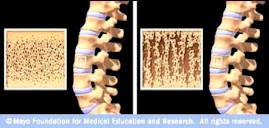
Osteoporotic Bone

Osteoporotic Bone
Source: www.mayoclinic.com

How Strontium Builds Bones

Strontium is a mineral that tends to accumulate in bone. Studies have shown that oral doses of strontium are a safe and effective way to prevent and reverse osteoporosis. Doses of 680 mg per day appear to be optimal. See my "For More Information About Strontium" links section.

Osteoporosis is caused by changes in bone production. In healthy young bones there is a constant cycle of new bone growth and bone removal. With age, more bone is removed and less new bone is produced. The bones become less dense and thus more fragile.

Scientists believe that strontium works in two ways. It may stimulate the replication of pre-osteoblasts, leading to an increase in osteoblasts (cells that build bone). Strontium also directly inhibits the activity of osteoclasts (cells that break down bone). The result is stronger bones.

When taking strontium, be sure to take 1200 mg calcium, 1000 IU vitamin D3, and 500 mg magnesium daily. It is best to take strontium late at night on an empty stomach. Calcium and strontium may compete with each other for absorption if taken together.