Human Skeleton

Human Skeleton

WELCOME TO STRONTIUM FOR BONES BLOG

Have you experienced negative, and even dangerous, side effects from Fosamax (alendronate), Boniva (ibandronate), Actonel (risedronate), Reclast (zoledronic acid), Prolia (denosumab), Forteo (teriparatide), Tymlos (abaloparatide), or other drugs prescribed for osteoporosis? If you have, then rest assured there is a safe, effective treatment for this condition. Strontium, primarily in the form of strontium citrate, is taken orally once a day.

Visitors to my blog can leave comments or ask questions and can remain anonymous, if they wish. Their comments are relayed to my g-mail inbox. Below each post, the number of comments for that post is cited and underlined because it is a link. By clicking on that link below any post, a window opens so that a visitor can leave a comment. Ideally, visitors leave comments on posts most relevant to their comments. All comments to my posts are moderated by me.

Browse the posts and visit the link library of references.


Blog Archive

Showing posts with label strontium. Show all posts

Thursday, September 8, 2022

TBS, Strontium, and Prof. Didier Hans

Prof. Didier Hans, PhD, MBA co-founded Med-Imaps SA in 2006 and became CEO of Medimaps Group in 2012. He currently drives the company’s global strategy, orientation and business objectives, and oversees its Quality Management framework and policies.He holds a PhD in Medical Physics and an Executive MBA from HEC Geneva. https://www.medimapsgroup.com/team/didier-hans/

One of Medimaps Group's products, TBS iNsight™ (Osteo), is an advanced imaging software application for bone densitometers (DXA). It provides a way to better predict a patient’s risk for bone fracture, to fine-tune therapy decisions, and to improve patient management.

TBS iNsight™ is a Medical Device that is CE 2797 marked & has been cleared to be sold in the US.


https://www.medimapsgroup.com/tbs-osteo/


I recently had the opportunity to ask Prof. Hans a question by email. He graciously answered. 


My question:


Will a TBS score be affected by the bone strontium effect, as the BMD by DXA scan is?


His answer, paraphrased and confirmed: 


In our study of TBS and strontium ranelate, TBS was less affected by the larger atomic number of strontium than the BMD was affected. So, the study showed that strontium improved bone microarchitecture. 

Monday, September 28, 2020

The Effect of Bone Strontium on BMD for Different Manufacturers' DXA Systems

Osteoporotic patients treated with strontium ranelate show relatively large increases in bone mineral density (BMD) measured by dual-energy X-ray absorptiometry (DXA) due to the replacement of some of the calcium atoms in bone by strontium. A study published by Pors Nielsen and colleagues reported that replacement of 1% of calcium atoms by strontium causes a 10% increase in BMD. 

We refer to the ratio of the percentage increase in BMD to the molar percentage of strontium in bone as the strontium ratio. Theoretically it is expected that the strontium ratio should vary between different manufacturers' DXA equipment depending on the effective photon energy of the device, an effect that arises because of the proximity of the X-ray energies produced by lower energy devices to the strontium K-edge at 16 keV. 

In this study we report theoretical estimates of the strontium ratio for two axial DXA systems and two peripheral DXA devices based on their broad spectrum X-ray emission. The theoretical figures were verified in an experimental study in which the strontium ratio for each device was measured using phantoms containing mixtures of hydroxyapatite and strontium hydrogen-phosphate. 

The theoretical values/experimental results of the strontium ratio were: 

11.0/11.2 for the Hologic Discovery,

9.9/9.9 for the GE-Lunar Prodigy, 

9.1/8.6 for the Demetech Calscan, and 

8.5/6.3 for the Osteometer Dexacare G4. 

The results confirm both theoretically and experimentally that the effect of bone strontium on BMD measurements is different for different DXA systems. In the future it might be possible to exploit this effect to make a non-invasive estimate of average bone strontium content in groups of patients receiving strontium medication for osteoporosis.

https://pubmed.ncbi.nlm.nih.gov/20699129/


Friday, July 3, 2020

My Current Supplements

I take one capsule/day of each of the following supplements, with the exception of strontium and lutein (two capsules/day) and D3 (one capsule three times/week). 

I do not take any supplements, except strontium, on Sundays to prevent getting too much of any one of them. I do not take strontium on Sundays if I feel I have not had sufficient calcium-containing foods that day. Vitamins, minerals, and other supplements taken in excess can cause problems.Too much calcium from supplements can contribute to the formation of kidney stones and has been implicated (inconclusively) in heart disease. Try to get most of your calcium from food. Excess amounts of water-soluble vitamins are eliminated in the urine. Supplemental vitamin C, a water-soluble vitamin, increases urinary oxalate concentrations, but whether an increase in urinary oxalate elevates the risk for kidney stones is not yet known. Those predisposed for kidney stone formation may consider avoiding high-dose (greater than or equal to 1 g/day) vitamin C supplementation. I am not predisposed to kidney stones but take only 500 mg/day vitamin C in pill form.

The fat-soluble vitamins are A, D, E and K. They are soluble in organic solvents and are absorbed and transported in a manner similar to that of fats. Excess amounts of fat-soluble vitamins accumulate in the liver, adipose (fat) tissue, and skeletal muscle. Because these vitamins are stored for long periods, dangerous levels can build up. Excess intake of fat-soluble vitamins is more likely to cause you harm than excess intake of water-soluble vitamins. For these reasons, I do not take extra vitamin A, except for the 750 mcg in my multivitamin. I do not take any K2 and only the 80 mcg K1 (as Phytonadione) in my multivitamin. I do take 400 IU natural vitamin E. I do take vitamin D (1000 IU) in my multivitamin. I recently added another D3 supplement with 1000 IU/capsule, but I am only taking it three times per week. If I add up the 1000 IU/day for six days/week in my multi and the 1000 IU for three days/week in the separate D3 supplement, I get 9000 IU vitamin D/week, or about 1286 IU/day. Unless you have a vitamin-D deficiency or insufficiency, as shown by a 25(OH)D blood test,1000 to 2000 IU/day of vitamin D should be plenty. 

Bioflavonoids (Antioxidants)

Solgar Citrus Bioflavonoid Complex, 1000 mg per tablet

Digestive Aids

Nature’s Way Primadophilus bifidus (probiotic)

NOW Super Enzymes (breaks down fats, carbs and protein)

Minerals

AOR Strontium Support II, 341 mg strontium (from citrate) per capsule (two capsules daily)

Country Life, Gluten Free, Calcium Magnesium Complex (500 mg Ca, 250 mg Mg per tablet)

KAL Magnesium Glycinate 400 (400 mg in 2 softgels; I take one.) 

Solary Selenium, 100 mcg

Vitacost Chelated Zinc (zinc glycinate chelate), 30 mg

Vitamins

Doctor’s Best Lutein with Optilut (20 mg lutein, 4 mg zeaxanthin in two capsules)

Nature Made D3, 1000 IU (one capsule three times/week)

Nature Made Multi Men's 50+, No Iron (OK for men and women; contains 1000 IU vitamin D3 and 21 other nutrients)

Nature Made Vitamin C, 500 m

Solgar Natural Vitamin E (as d-Alpha Tocopherol plus d-Beta, d-Delta and d-Gamma Tocopherols), 400 IU

Solgar Sublingual Methylcobalamin (Vitamin B12), 5000 mcg


Thursday, January 9, 2020

A Picture Is Worth a Thousand Words in Describing the Effects of Strontium on Bone

Micro computed tomography or "micro-CT" is x-ray imaging in 3D, by the same method used in hospital CT (or "CAT") scans, but on a small scale with massively increased resolution. It really represents 3D microscopy, where very fine scale internal structure of objects is imaged non-destructively.

“3D analysis of 3‐yr biopsies with treatment (20 biopsies) and placebo (21 biopsies) using μCT showed significant changes in microarchitecture with, in the strontium ranelate group, higher cortical thickness (+18%, p = 0.008) and trabecular number (+14%, p = 0.05), and lower structure model index (SMI) (−22%, p = 0.01) and trabecular separation (−16%, p = 0.04), with no change in cortical porosity. The changes in 3D microarchitecture may enhance bone biomechanical competence and explain the decreased fracture rate with strontium ranelate.”
“Postmenopausal osteoporosis is a chronic skeletal disorder involving compromised bone strength leading to an increased rate of fracture. Bone strength and therefore fracture risk depends on microarchitecture, matrix volume, and mineralization. Both cortical and trabecular bone are affected by the disease, with progressive considerable alterations in microarchitecture. The imbalance in bone remodeling in osteoporosis, in which bone formation is not able to compensate for bone resorption, leads to trabecular thinning and a loss of connectivity. As the disease progresses through years, continued increase remodeling rates lead to deep resorption cavities, the trabecular plates become perforated, and the connecting rods dissolve. As a consequence, there is a continuous shift from a plate‐like structure to a rod‐like structure. Simultaneously, in cortical bone, extensive remodeling at the endocortical surfaces “trabecularizes” (makes similar to trabecular bone) the inner part of cortical bone.” 
“Cortical bone is the major component of long bone, for example, in the femoral shaft, in which rigidity to withstand load and movement is favored over flexibility. On the other hand, bone with a large proportion of trabecular bone is lighter and more flexible and can absorb more energy, for example, in the vertebrae. Both types of bone are susceptible to osteoporotic fracture at rates dependent on a number of variables, including microarchitecture.”

“The 3D analysis from the μCT studies goes beyond the histomorphometric results by showing differences on the trabecular and cortical microarchitecture of bone in favor of strontium ranelate compared with placebo (Fig. 1). In trabecular bone, Tb.N (trabecular number) was higher and Tb.Sp (trabecular separation) was lower in the treated group, indicating a thickening of the trabecular elements. The 22% reduction in trabecular SMI toward a value closer to zero means that 3‐yr treatment has shifted the structure of the cancellous bone away from a rod‐like structure (SMI = 3) toward a normal structure based on plates (SMI = 0). The significant improvement in two of these parameters with strontium ranelate is in line with an overall improvement in bone strength with this agent.”

“An increase in porosity or thinning in cortical bone reduces the resistance of bone to the propagation of cracks, which is one of the underlying defects in osteoporosis. Our 3D results showed that strontium ranelate significantly increases Ct.Th (cortical thickness) but had no effect on Ct.Po (cortical porosity). The anabolic agent teriparatide may actually increase Ct.Po.


Figure 1. 3D microstructure from μCT of transiliac bone biopsies from postmenopausal osteoporotic 
women receiving strontium ranelate (2 g/d) or placebo for 3 yr.


Wandering Skeleton

Wandering Skeleton
Artist: Joel Hoekstra

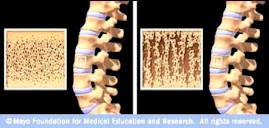
Osteoporotic Bone

Osteoporotic Bone
Source: www.mayoclinic.com

How Strontium Builds Bones

Strontium is a mineral that tends to accumulate in bone. Studies have shown that oral doses of strontium are a safe and effective way to prevent and reverse osteoporosis. Doses of 680 mg per day appear to be optimal. See my "For More Information About Strontium" links section.

Osteoporosis is caused by changes in bone production. In healthy young bones there is a constant cycle of new bone growth and bone removal. With age, more bone is removed and less new bone is produced. The bones become less dense and thus more fragile.

Scientists believe that strontium works in two ways. It may stimulate the replication of pre-osteoblasts, leading to an increase in osteoblasts (cells that build bone). Strontium also directly inhibits the activity of osteoclasts (cells that break down bone). The result is stronger bones.

When taking strontium, be sure to take 1200 mg calcium, 1000 IU vitamin D3, and 500 mg magnesium daily. It is best to take strontium late at night on an empty stomach. Calcium and strontium may compete with each other for absorption if taken together.