Human Skeleton

Human Skeleton

WELCOME TO STRONTIUM FOR BONES BLOG

Have you experienced negative, and even dangerous, side effects from Fosamax (alendronate), Boniva (ibandronate), Actonel (risedronate), Reclast (zoledronic acid), Prolia (denosumab), Forteo (teriparatide), Tymlos (abaloparatide), or other drugs prescribed for osteoporosis? If you have, then rest assured there is a safe, effective treatment for this condition. Strontium, primarily in the form of strontium citrate, is taken orally once a day.

Visitors to my blog can leave comments or ask questions and can remain anonymous, if they wish. Their comments are relayed to my g-mail inbox. Below each post, the number of comments for that post is cited and underlined because it is a link. By clicking on that link below any post, a window opens so that a visitor can leave a comment. Ideally, visitors leave comments on posts most relevant to their comments. All comments to my posts are moderated by me.

Browse the posts and visit the link library of references.


Blog Archive

Showing posts with label bone. Show all posts

Tuesday, February 14, 2017

MOTS and COMB Study Comparison


A one-year study on strontium citrate combined with melatonin and other supplements and named the Melatonin-micronutrients Osteopenia Treatment Study (MOTS) was recently published (January 26, 2017). I’d like to compare it to the Combination of Micronutrients for Bone (COMB) Study published in 2012. See the following chart:
        
    COMB Study                                                               MOTS

Study size                        114                                                                                  20
Baseline BMD status      osteoporosis                                                                   osteopenia
Strontium (citrate)               680 mg                                                                          450 mg
Vitamin K2 (MK7)               100 mcg                                                                         60 mcg
Melatonin                              none                                                                                5 mg                        
Vitamin D3                         2000 IU                                                                          2000 IU
Docosahexanoic acid (DHA)   250 mg                                                                      none
Magnesium                             25 mg                                                                          none
Lumbar spine BMD             6% increase                                                             4.3% increase
Femoral neck BMD             4% increase                                                             2.2% increase
Total hip BMD               3% increase                                                             No sign. diff., pos. trend

I could have predicted the results on BMD. How? Well, it had previously been shown, from studies on strontium ranelate, that strontium increased BMD at all dosages studied, but the optimum increases were gained with 680 mg strontium. Also, melatonin has been used for years as a sleep aid, but there is little evidence for it as a bone supplement. The authors of MOTS named two studies on melatonin listed below.         

“Limitations to this study include low number of subjects, lack of a diverse cohort and lack of different micronutrient combinations on primary and secondary endpoints in MOTS clinical trial.”

Despite the limitations of MOTS, there is valuable information to be gained from it:

MOTS increased awareness of the importance of preventative care in patients with osteopenia. “Over half of all women in the U.S. above age 50 have osteopenia with a prevalence of approximately 3.4 times more than osteoporosis. Consequently, twice the number of fractures arises from women with osteopenia as they represent almost 50% of the total population at risk.”

“The 10-year vertebral fracture risk probability decreased by 6.48% in response to MSDK (melatonin, strontium, vitamins D and K) therapy compared to 10.8% increase in placebo.”

“MSDK reduced bone marker turnover primarily by increasing the bone formation marker P1NP and maintaining healthy bone turnover.”

“MSDK demonstrated positive effects on inflammatory status and improved quality of life especially related to sleep.”

MOTS confirmed that dosages lower than 680 mg strontium will increase BMD by lower percentages.


Kotlarczyk MP, Lassila HC, O’Neil CK, D’Amico F, Enderby LT, Witt‐Enderby PA, Balk JL. Melatonin osteoporosis prevention study (MOPS): a randomized, double‐blind, placebo‐controlled study examining the effects of melatonin on bone health and quality of life in perimenopausal women. J Pineal Res. 2012; 52:414–26. doi: 10.1111/j.1600‐079X.2011.00956.x

Amstrup AK, Sikjaer T, Heickendorff L, Mosekilde L, Rejnmark L. Melatonin improves bone mineral density at the femoral neck in postmenopausal women with osteopenia: a randomized controlled trial. J Pineal Res. 2015; 59:221–29. doi:10.1111/jpi.12252

Saturday, September 12, 2015

Fracture Warnings for Invokana and Invokamet Diabetes Drugs


“The US Food and Drug Administration (FDA) has strengthened its warning for canagliflozin (Invokana, Invokamet, Johnson & Johnson/Janssen) related to the increased risk for bone fractures.”

“The …product label for canagliflozin had already mentioned the risk for bone fractures. Now, based on new confirmatory information from several clinical trials, the FDA has added further warning and precaution information. In the trials, the fractures affected the upper extremities, occurred as early as 12 weeks after starting the drug, and typically arose from minor trauma such as falling from a standing height.”

“The FDA has also added new information to the label about decreased bone mineral density at the hip and lower spine.”

“The FDA is also evaluating the possible risk for bone fractures for other drugs in the sodium glucose cotransporter 2 (SGLT2) inhibitor class, including dapagliflozin (Farxiga, Xigduo XR, AstraZeneca) and empagliflozin (Jardiance, Glyxambi, Synjardy, Lilly/Boehringer Ingelheim), to determine whether additional label changes or studies are needed. The label for Farxiga mentions a small number of cases of fractures in patients with renal impairment; the Jardiance prescribing information does not mention bone effects.”

“…SGLT2 inhibitors increase concentrations of phosphate in serum, probably via increased tubular reabsorption, which has the potential to adversely affect bone.”

“Furthermore…SGLT2 inhibitors increase concentrations of parathyroid hormone (PTH). Sustained increases in PTH concentration enhance bone resorption and increase the risk for bone fractures.”

"Although canagliflozin causes a small increase in mean PTH concentration (7.9%), the standard deviation is large. Thus, a substantial number of patients treated with canagliflozin might have a 50% or greater increase in PTH concentrations — a change that could be clinically significant…"

Simeon I. Taylor, MD, professor of medicine at University of Maryland School of Medicine in Baltimore, said, "Although not proven, I believe that increased risk of bone fracture is likely a class effect. Nevertheless, individual drugs differ with respect to selectivity for SGLT2 vs. SGLT1, and also with respect to where on the dose-response curve the approved dose falls. So, it is certainly possible that the magnitude of the risk could vary among individual SGLT2 inhibitors."


Thursday, December 11, 2014

FRAX Identifies Women with Prevalent Asymptomatic Vertebral Fractures


Abstract

Background
A Moroccan model for the FRAX tool to determine the absolute risk of osteoporotic fracture at 10 years has been established recently. The study aimed to assess the discriminative capacity of FRAX in identifying women with prevalent asymptomatic vertebral fractures (VFs).

Methods
We enrolled in this cross-sectional study 908 post-menopausal women with a mean age of 60.9 years ±7.7 (50 to 91) with no prior known diagnosis of osteoporosis. Subjects were recruited from asymptomatic women selected from the general population. Lateral VFA (vertebral fracture assessment) images and scans of the lumbar spine and proximal femur were obtained using a GE Healthcare Lunar Prodigy densitometer. VFs were defined using a combination of Genantsemiquantitative (SQ) approach and morphometry. We calculated the absolute risk of major fracture and hip fracture with and without bone mineral density (BMD)using the FRAX website.The overall discriminative value of the different risk scores was assessed by calculating the areas under the ROC curve (AUC).

Results
VFA images showed that 179 of the participants (19.7%) had at least one grade 2/3 VF. The group of women with VFs had a statistically significant higher FRAX scores for major and hip fractures with and without BMD, and lower weight, height, and lumbar spine and hip BMD and T-scores than those without a VFA-identified VF. The AUC ROC of FRAX for major fracture without BMD was 0.757 (CI 95%; 0.718-0.797) and 0.736 (CI 95%; 0.695-0.777) with BMD, being 0.756 (CI 95%; 0.716-0.796) and 0.747 (CI 95%; 0.709-0.785), respectively for FRAX hip fracture without and with BMD. The AUC ROC of lumbar spine T-score and femoral neck T-score were 0.660 (CI 95%; 0.611-0.708) and 0.707 (CI 95%; 0.664-0.751) respectively.

Conclusion
In asymptomatic post-menopausal women, the FRAX risk for major fracture without BMD had a better discriminative capacity in identifying the women with prevalent VFs than lumbar spine and femoral neck T-scores suggesting its usefulness in identifying women in whom VFA could be indicated. 

To read the full research article by Abdellah El Maghraoui, Siham Sadni, Nabil Jbili, Asmaa Rezqi, Aziza Mounach and Imad Ghozlani click on this link:

 http://www.biomedcentral.com/1471-2474/15/365


Wandering Skeleton

Wandering Skeleton
Artist: Joel Hoekstra

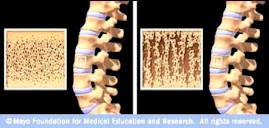
Osteoporotic Bone

Osteoporotic Bone
Source: www.mayoclinic.com

How Strontium Builds Bones

Strontium is a mineral that tends to accumulate in bone. Studies have shown that oral doses of strontium are a safe and effective way to prevent and reverse osteoporosis. Doses of 680 mg per day appear to be optimal. See my "For More Information About Strontium" links section.

Osteoporosis is caused by changes in bone production. In healthy young bones there is a constant cycle of new bone growth and bone removal. With age, more bone is removed and less new bone is produced. The bones become less dense and thus more fragile.

Scientists believe that strontium works in two ways. It may stimulate the replication of pre-osteoblasts, leading to an increase in osteoblasts (cells that build bone). Strontium also directly inhibits the activity of osteoclasts (cells that break down bone). The result is stronger bones.

When taking strontium, be sure to take 1200 mg calcium, 1000 IU vitamin D3, and 500 mg magnesium daily. It is best to take strontium late at night on an empty stomach. Calcium and strontium may compete with each other for absorption if taken together.