Human Skeleton

Human Skeleton

WELCOME TO STRONTIUM FOR BONES BLOG

Have you experienced negative, and even dangerous, side effects from Fosamax (alendronate), Boniva (ibandronate), Actonel (risedronate), Reclast (zoledronic acid), Prolia (denosumab), Forteo (teriparatide), Tymlos (abaloparatide), or other drugs prescribed for osteoporosis? If you have, then rest assured there is a safe, effective treatment for this condition. Strontium, primarily in the form of strontium citrate, is taken orally once a day.

Visitors to my blog can leave comments or ask questions and can remain anonymous, if they wish. Their comments are relayed to my g-mail inbox. Below each post, the number of comments for that post is cited and underlined because it is a link. By clicking on that link below any post, a window opens so that a visitor can leave a comment. Ideally, visitors leave comments on posts most relevant to their comments. All comments to my posts are moderated by me.

Browse the posts and visit the link library of references.


Blog Archive

Showing posts with label 25(OH)D. Show all posts

Thursday, June 11, 2015

My Daily Supplements


I have written about my supplements in previous posts but have made several changes since then. The following list is an update of all my supplements. I have alphabetized them by brand name. I take one of each daily unless otherwise noted. The Ca/Mg (#3) and strontium (#5) are primarily for bone health. The multivitamin (#6) is for general health, as are most of the other supplements. The probiotic (#9) is for digestive health. I take lecithin (#1) as an aid in preventing cholesterol buildup in the arteries and to combat heart disease. I take a large dose (5000 mcg) of methylcobalamin (#10) (vitamin B12) daily because taking a statin drug to reduce cholesterol also reduces vitamin B12. My husband takes B12 to keep from getting the canker sores that once plagued him. Methylcobalamin is more effective than cyanocobalamin; he tried both.

No one should copy my supplement protocol because each person’s needs are unique to him or her. I hope publishing this list will give others a place to start in forming their own protocol.  
  
  1. Bluebonnet Lecithin, 1365 mg in one softgel (I take two softgels daily.)
  2. Country Life Citrus Bioflavonoids, 1000 mg
  3. Country Life, Gluten Free, Calcium Magnesium Complex (500 mg Ca, 250 mg Mg per tablet)
  4. Doctor’s Best Lutein, 20 mg lutein esters yielding 10 mg minimum free lutein, 2 mg zeaxanthin
  5. Doctor’s Best Strontium Bone Maker, 2194 mg strontium citrate, 680 mg elemental strontium in two capsules (two capsules daily)
  6. Nature Made Multi for Him, No Iron (Not a typo. My husband and I both take this multivitamin.)
  7. Nature Made Vitamin C, 500 mg
  8. Nature’s Bounty Vitamin E, 100 % Natural, 400 IU
  9. Nature’s Way Primadophilus bifidus (This is a probiotic.)
10. Solgar Sublingual Methylcobalamin, 5000 mcg
11. Twin Labs Zinc, 50 mg

Notes on My Supplements

I always keep a couple of bottles of Nature’s Bounty Ginger Root capsules, 550 mg, in my refrigerator and take them for nausea and upset stomach as needed. If I don’t have fresh ginger and need ginger for a recipe, I just open a few, usually three, capsules and use the ginger powder for cooking.

I don’t take a separate vitamin D supplement because my multivitamin contains 1000 IU. I also try to get some sun each week. Some people may need more vitamin D if a 25(OH)D test shows they have a deficiency or insufficiency of this vitamin.

I do not take vitamin K2. Many people take this vitamin for bone and cardiac health. There is some debate about which form (MK4 or MK7) and what dosage of this vitamin one should take. The Japanese studies used 45 mg MK4, and patients are prescribed this dosage by physicians in Japan. The MK7 is taken in microgram dosages. Some people experience sleeplessness when taking MK7. No RDA/RDI has been established for vitamin K2 of either form. Studies in the US and Europe have not confirmed the efficacy of vitamin K2 for bone or cardiac health.

Notes on My Multivitamin

Nature Made has a Multi for Her, Multi for Him, Multi for Her 50+, and Multi for Him 50+. All the formulations are similar except the Multi for Her, which I will not take because it contains iron. Supplemental iron is not needed by men and postmenopausal women unless they have been diagnosed with iron deficiency anemia. Excessive iron can lead to iron toxicity. I have taken the other three formulations at one time or another, depending on what was available. 

What I like about the Nature Made multivitamins is that they are USP-verified, and that is rare to find. It gives me assurance that the multis contain the vitamins and minerals in the dosages specified and have no impurities.  Nature Made Vitamin C is also USP-verified, as are many of that brand’s other vitamins.

My Supplement History

On 8/5/2010, I posted all my supplements on my blog.  http://strontiumforbones.blogspot.com/2010/08/my-daily-supplements.html
On 09/30/2011, I posted about the three supplements I was taking specifically for bone health.
On 03/2/2012, I posted an update on my calcium/magnesium supplement.

COMB Study

You might also be interested in the protocol used in the COMB study.

Friday, March 13, 2015

Women's Mid-Life Non-Traumatic Fracture Risk Higher With Low Vitamin D


The lower a woman's vitamin D levels as she transitions to menopause, the greater her risk of sustaining a non-traumatic fracture. 

"Women who have levels less than 20 nanograms per milliliter would need some type of vitamin D supplementation," Dr. Jane A. Cauley of the University of Pittsburgh, who worked on the study, told Reuters Health. The findings back up the Institute of Medicine's conclusion that levels lower than 20 ng/ml are insufficient for skeletal health, she added.

Bone loss is known to accelerate during the menopausal transition, and postmenopausal women require significantly more calcium to reach neutral calcium balance than perimenopausal women, Dr. Cauley and her team note in their report, online February 23 in the Journal of Clinical Endocrinology and Metabolism.

To determine if serum 25(OH)D levels would be associated with changes in bone mineral density (BMD) and fracture risk, the researchers looked at data from the Study of Women's Health Across the Nation (SWAN) on 124 women with an incident traumatic fracture, 88 with an incident non-traumatic fracture, and 1,532 who did not sustain fractures during the study's average follow-up period of 9.5 years. 

Each woman had her serum 25(OH)D level checked at her third annual visit, while her BMD was assessed annually. The women's mean age at the study's outset was 48.5.

The study participants' mean 25(OH)D levels were 21.8 ng/ml, and 43% had levels below 20 ng/mL. While multivariate analysis found no association between 25(OH)D levels and traumatic fracture risk, the risk of non-traumatic fractures decreased by 28% for every 10 ng/ml increase in serum 25(OH)D. [Referring to Table 3 of the original article, “For every 10 ng/ml increase in 25(OH)D, the hazard ratio (HR) for nontraumatic fracture was 0.72 (0.54, 0.95).”; 1.00 minus 0.72 equals 0.28, or 28%]

Women with levels of 20 ng/ml or higher had a 46% lower risk of fracture during follow-up than women with lower levels of 25(OH)D. However, there was no association between baseline 25(OH)D and changes in BMD at the lumbar spine or femoral neck across menopause.

Roughly 22% of the women in the study had vitamin D levels greater than 30 ng/ml, Dr. Cauley said, so the study lacked power to determine if these women's non-traumatic fracture risk was further reduced.
"We didn't see any relationship between 25(OH)D and these bone changes, but we were somewhat limited in that we didn't have any information on how vitamin D changed across menopause," she added.


http://www.nutrition411.com/news/womens-mid-life-non-traumatic-fracture-risk-higher-low-vitamin-d
http://www.medscape.com/viewarticle/841028?src=wnl_edit_tpal&uac=127701PY:
http://press.endocrine.org/doi/pdf/10.1210/jc.2014-4367

Friday, March 6, 2015

Too Much Vitamin D Can Be Bad for You


Context:
Optimal levels of vitamin D have been a topic of heavy debate, and the correlation between 25-hydroxyvitamin D [25(OH)D] levels and mortality still remains to be established.

Objective:
The aim of the study was to determine the association between all-cause mortality and serum levels of 25(OH)D, calcium, and PTH.

Design and Setting:
We conducted a retrospective, observational cohort study, the CopD Study, in a single laboratory center in Copenhagen, Denmark.

Participants:
Serum 25(OH)D was analyzed from 247,574 subjects from the Copenhagen general practice sector. In addition, serum levels of calcium, albumin-adjusted calcium, PTH, and creatinine were measured in 111,536; 20,512; 34,996; and 189,496 of the subjects, respectively.

Main Outcome Measures:
Multivariate Cox regression analysis was used to compute hazard ratios for all-cause mortality.

Results:
During follow-up (median, 3.07 yr), 15,198 (6.1%) subjects died. A reverse J-shaped association between serum level of 25(OH)D and mortality was observed. A serum 25(OH)D level of 50–60 nmol/liter was associated with the lowest mortality risk. Compared to 50 nmol/liter, the hazard ratios (95% confidence intervals) of all-cause mortality at very low (10 nmol/liter) and high (140 nmol/liter) serum levels of 25(OH)D were 2.13 (2.02–2.24) and 1.42 (1.31–1.53), respectively. Similarly, both high and low levels of albumin-adjusted serum calcium and serum PTH were associated with an increased mortality, and secondary hyperparathyroidism was associated with higher mortality (P < 0.0001).

Conclusion:
In this study from the general practice sector, a reverse J-shaped relation between the serum level of 25(OH)D and all-cause mortality was observed, indicating not only a lower limit but also an upper limit. The lowest mortality risk was at 50–60 nmol/liter. The study did not allow inference of causality, and further studies are needed to elucidate a possible causal relationship between 25(OH)D levels, especially higher levels, and mortality.

Note: 50-60 nmol/L equals 20-24 ng/ml. To convert nmol/L to ng/ml, divide by 2.5. To convert ng/ml to nmol/L, multiply by 2.5.  

The full article is available here:


Wednesday, September 10, 2014

Vitamin D and Mortality Risk: Should Clinical Practice Change?


An Expert Interview With Cedric F. Garland, DrPH

Traditionally associated with skeletal disease, including osteoporosis and fractures, low levels of serum 25-hydroxyvitamin D (25[OH]D) more recently have been linked to a wide range of nonskeletal diseases, including some cancers and autoimmune, cardiometabolic, and neurologic diseases.

Medscape: Should everyone aim for a vitamin D level over 30 ng/mL?

Dr. Garland: Yes. No one should run a serum 25(OH)D less than 30 ng/mL. This means that two thirds of the US population needs supplementation. You may have noticed that President Obama was recently tested for his vitamin D, and it was 22.9 ng/mL. His physicians wisely decided to treat him, and he is now taking vitamin D. I salute the President's physicians for their clinical acumen in performing this good and noble deed to ensure the health of President Obama. It makes me burst with pride and admiration when physicians act in this way with their patients.

Medscape: Would you say that everyone should be tested like the President?

Dr. Garland: Yes, in my judgment. And without delay. We should introduce the population to a new Golden Era of Medicine, based on contemporary scientific discoveries of vitamin D's profound health benefits today rather than waiting for yet another minor increment of confirmation.

http://www.medscape.com/viewarticle/829677

Wandering Skeleton

Wandering Skeleton
Artist: Joel Hoekstra

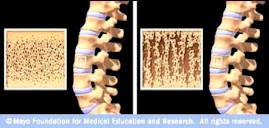
Osteoporotic Bone

Osteoporotic Bone
Source: www.mayoclinic.com

How Strontium Builds Bones

Strontium is a mineral that tends to accumulate in bone. Studies have shown that oral doses of strontium are a safe and effective way to prevent and reverse osteoporosis. Doses of 680 mg per day appear to be optimal. See my "For More Information About Strontium" links section.

Osteoporosis is caused by changes in bone production. In healthy young bones there is a constant cycle of new bone growth and bone removal. With age, more bone is removed and less new bone is produced. The bones become less dense and thus more fragile.

Scientists believe that strontium works in two ways. It may stimulate the replication of pre-osteoblasts, leading to an increase in osteoblasts (cells that build bone). Strontium also directly inhibits the activity of osteoclasts (cells that break down bone). The result is stronger bones.

When taking strontium, be sure to take 1200 mg calcium, 1000 IU vitamin D3, and 500 mg magnesium daily. It is best to take strontium late at night on an empty stomach. Calcium and strontium may compete with each other for absorption if taken together.