Human Skeleton

Human Skeleton

WELCOME TO STRONTIUM FOR BONES BLOG

Have you experienced negative, and even dangerous, side effects from Fosamax (alendronate), Boniva (ibandronate), Actonel (risedronate), Reclast (zoledronic acid), Prolia (denosumab), Forteo (teriparatide), Tymlos (abaloparatide), or other drugs prescribed for osteoporosis? If you have, then rest assured there is a safe, effective treatment for this condition. Strontium, primarily in the form of strontium citrate, is taken orally once a day.

Visitors to my blog can leave comments or ask questions and can remain anonymous, if they wish. Their comments are relayed to my g-mail inbox. Below each post, the number of comments for that post is cited and underlined because it is a link. By clicking on that link below any post, a window opens so that a visitor can leave a comment. Ideally, visitors leave comments on posts most relevant to their comments. All comments to my posts are moderated by me.

Browse the posts and visit the link library of references.


Blog Archive

Showing posts with label T-scores. Show all posts

Monday, February 15, 2016

My Progress with Strontium Citrate


I’ve been taking Doctor’s Best Strontium Bone Maker (680 mg strontium) once daily since January 2008. That’s eight years of taking strontium continuously. My back is stronger than it’s been in years. This morning I did yard work—pulling up oak seedlings and weeds and burying a cable that keeps being uncovered by the rain. I bent over numerous times with no pain. I should have taken a work bench and not bent over, but, sometimes I forget to avoid forward bending because I feel well. I’ve had no fractures, although I keep getting older. My BMD has continued to improve. I love strontium citrate!

My lumbar spine T-scores went from -3.0 (osteoporosis) in May 2007 to -2.7 (still osteoporosis but better) in July 2009 to -1.6 (osteopenia) in August 2013. I documented my scores on this blog:


I have orders for another DXA scan this year (2016). I haven’t made an appointment yet. I’m hoping for normal (-1.0 and above) T-scores this time. I’ll keep you posted.

Tuesday, June 17, 2014

When to Stop Taking Strontium


When to stop taking strontium after having taken it successfully for a number of years is a good question. Once you reach normal bone mineral density (BMD), it makes sense to stop taking strontium and just monitor your BMD. If your BMD readings are at the osteopenia stage, defined as a T-score between -1.0 and -2.5, the decision becomes more complicated. As I see it, the choice, at that point, is either to reduce the dosage or continue with the full dose until normal BMD is reached. I would definitely not stop taking it altogether after reaching a BMD in the osteopenia range.

I have been taking 680 mg strontium from strontium citrate for osteoporosis for six and a half years. My lowest T-scores have always been at the spine. Last year (2013), my T-score at the spine from L1-L4 was -1.6, which is in the range of osteopenia. I have continued taking the same dosage since then. I may wait another year until my next DXA before deciding on any change.


One person I know from an osteoporosis forum says she had osteoporosis and achieved normal BMD after 4.5 years on strontium citrate (lucky lady!). She says she took 680 mg strontium for 3.5 years and then 340 mg for the final year. She then stopped taking strontium but had yearly DXA scans. Two years later, her BMD is still at the normal range. Don’t be discouraged if your results aren’t quite as spectacular; mine aren’t compared to hers. What is really encouraging to me is that she has retained most of her gains in BMD after two years!


http://www.inspire.com/groups/national-osteoporosis-foundation/discussion/strontium-citrate-25/?ref=as&asat=172752721 (Charella’s update after two years off strontium is nestled within a discussion started by another forum member.)

http://www.inspire.com/groups/national-osteoporosis-foundation/discussion/success-with-strontium-continues-to-be-great/ (Charella’s update after more than one year off strontium citrate is featured in a discussion she initiated.)


Tuesday, August 10, 2010

Another Strontium Citrate Success

Most of my posts are about my own experience with strontium citrate and about research on the various strontium salts. This post is about Sara S. DeHart's strontium success story, which she wrote about herself in two articles, the most recent one published online just a few days ago. In 2006, she was taking Actonel and developed a fracture at T-9. Later, that same year, she switched to strontium citrate (750 mg strontium/day) and has had no further vertebral fractures. Here are her T-scores from 2006 to the present:

Left Hip Lumbar Spine

2006 -1.2 -1.4
2008 -0.6 -0.2
2010 -0.5 +0.2

Here is the original article: http://onlinejournal.com/artman/publish/printer_6185.shtml

Monday, September 14, 2009

Measuring Risk Of Fracture

An individual's risk of fracture over a given period of years can be predicted using one of two models. Both are simple to use by individuals with no medical training. A patient simply answers a few questions.

The FRAX tool was developed by the World Health Organization (WHO) and gives the 10-year probability of hip fracture and the 10-year probability of a major osteoporotic fracture (spine, forearm, hip or shoulder fracture). It includes height, weight, personal history of fracture, family history of fracture, smoking, alcohol consumption, use of corticosteroids, rheumatoid arthritis and secondary osteoporosis. This model ignores falls. It is the most commonly used fracture-risk algorithm worldwide. To access it, follow this link, click on "Calculation Tool," and select your location and race/ethnicity:

http://www.shef.ac.uk/FRAX/

A second model is used in Australia to determine whether Pharmaceutical Benefits Scheme reimbursements for osteoporosis therapy apply. It was developed by the Garvan Institute of Medical Research in Sydney. The Garvan fracture risk calculator is based on gender, bone mineral density, age, history of personal fracture, and history of falls over the last 12 months. It is incredibly simple but is believed to incorporate the most critical risk factors. It provides five and 10 year risk assessments for hip fracture and for any osteoporosis/fragility fracture. The T-score and BMD in g/cm2 used in this tool refer to the values at the femoral neck, which will read Hip (neck) on most DXA scan reports. To access this calculator:

http://www.garvan.org.au/promotions/bone-fracture-risk/

Saturday, July 11, 2009

Improved T-Scores After Treatment

My first DEXA scan on 05/08/07 diagnosed me with osteoporosis. My second scan was done 07/06/09 after the following treatment: Fosamax 70 mg weekly from 06/18/07 to 12/24/07, two capsules Doctor's Best Strontium Bone Maker daily from 01/21/08 to 07/06/09. Here are my BMD results in g/cm2 and my T-scores for my second scan:


Spine (L1-L4): BMD 0.749, T-Score -2.7

Lt. Hip (neck): BMD 0.563, T-Score -2.6

Lt. Hip (total): BMD 0.739, T-Score -1.7

Despite my best efforts, my scores were not corrected for strontium intake by the radiologist. My first and second scans were not on the same DEXA machine, but they were both on DXA Hologic scanners. Even so, I am very happy with my results. My T-scores improved 10.0% at the spine, 7.1% at the left hip (neck), and 22.7% at the left hip (total). I plan to continue taking strontium citrate.

Monday, May 4, 2009

Poll Results On T-Scores After Strontium Citrate

Here are the results of my latest poll: Did your DEXA scan T-scores improve after taking strontium citrate?

12 (75%) YES
4 (25%) NO

Wandering Skeleton

Wandering Skeleton
Artist: Joel Hoekstra

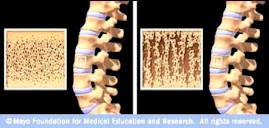
Osteoporotic Bone

Osteoporotic Bone
Source: www.mayoclinic.com

How Strontium Builds Bones

Strontium is a mineral that tends to accumulate in bone. Studies have shown that oral doses of strontium are a safe and effective way to prevent and reverse osteoporosis. Doses of 680 mg per day appear to be optimal. See my "For More Information About Strontium" links section.

Osteoporosis is caused by changes in bone production. In healthy young bones there is a constant cycle of new bone growth and bone removal. With age, more bone is removed and less new bone is produced. The bones become less dense and thus more fragile.

Scientists believe that strontium works in two ways. It may stimulate the replication of pre-osteoblasts, leading to an increase in osteoblasts (cells that build bone). Strontium also directly inhibits the activity of osteoclasts (cells that break down bone). The result is stronger bones.

When taking strontium, be sure to take 1200 mg calcium, 1000 IU vitamin D3, and 500 mg magnesium daily. It is best to take strontium late at night on an empty stomach. Calcium and strontium may compete with each other for absorption if taken together.