Skeleton Pirate

Skeleton Pirate
Artist: LindaB

WELCOME TO STRONTIUM FOR BONES BLOG

Have you experienced or read about negative, and even dangerous, side effects from Fosamax (alendronate), Boniva (ibandronate), Actonel (risedronate), and other bisphosphonates prescribed for osteoporosis? If you have, then rest assured there is a safe, effective treatment for this condition. Strontium, primarily in the form of strontium citrate, is taken orally once a day. Studies have shown the bones it rebuilds may be stronger than those rebuilt by the bisphosphonates.

My blog offers visitors useful posts, which you may reply to, information concerning the use of strontium for osteoporosis, and an extensive link library of references. Your participation in occasional polls is welcome.

All comments to my posts are moderated by me.

Blog Archive

Wednesday, May 9, 2012

Effects of Strontium Citrate on Osteoblasts

The objective of this study was to assess the effects of strontium citrate on the proliferation and differentiation of osteoblastic cells obtained from human alveolar bone. Primary osteoblasts, obtained from human alveolar bone residues at the time of third molar extractions and explanted in culture, were seeded in BGJb media containing 10% FCS. After the cells reached a semiconfluent stage, strontium citrate (bibasic anhydrous, pure grade from Jost Chemical) at various concentrations (0.05-1.0 mM) was added.

The MTT test showed the cells to be responsive to strontium citrate with significant increases in cellular activity/proliferation at 24 and 48 hrs. Alkaline phosphatase activity was significantly enhanced at 48 and 72 hrs with strontium citrate concentrations in the test range.
The data support the hypothesis that strontium citrate increases the proliferative/alkaline phosphatase activity of human osteoblastic cells from alveolar bone. The results validate previous research that has been done with other forms of strontium in clinical studies and rodent calvarial cells and indicates that strontium citrate could be a promising agent in treating oral as well as systemic bone disorders.


Tuesday, April 24, 2012

Interpretation of BMD Scans in Patients Stopping Strontium Ranelate Treatment

“The oral administration of strontium ranelate causes a clinically significant overestimation of BMD because of the high attenuation of X-rays by strontium atoms in bone." GM Blake and I. Fogelman “performed a theoretical study to calculate the long-term effect of strontium treatment on BMD and establish the duration of past treatment for which the remaining bone strontium content (BSC) has a negligible effect on BMD.” “Estimates of the strontium BMD artefact after treatment has stopped were performed on the assumption that the BSC effect accounts for 75% of the total measured BMD change at 3 years.” “If 75% of the BMD changes are explained by BSC, in the average patient, 3-year treatment leads to a spine BMD artefact of 11.2%, decreasing to 3.8% 10 years after stopping treatment. The BMD artefacts at the total hip and femoral neck sites are smaller by factors of 0.65 and 0.53, respectively.” “On average, 6-month treatment is required for the spine BMD artefact to exceed 3%, the figure adopted as the maximum BMD change caused by bone strontium that has a negligible effect on scan interpretation.” The researchers concluded that “strontium ranelate treatment lasting for > 6 months can affect BMD measurements for many years afterward.” http://www.ncbi.nlm.nih.gov/pubmed/16939400 J Bone Miner Res. 2006 Sep;21(9):1417-24.

Thursday, April 5, 2012

Minimum Effective Doses of Strontium


The aim of the PREVOS study (PREVention Of early postmenopausal bone loss by Strontium ranelate) and the STRATOS study (STRontium Administration for Treatment of OSteoporosis) was to determine the minimum dose at which strontium ranelate (SR) is effective in, respectively, the prevention of bone loss in early postmenopausal nonosteoporotic women and the treatment of postmenopausal vertebral osteoporosis.
The minimum dose at which SR is effective in preventing bone loss in early postmenopausal nonosteoporotic women and in the treatment of postmenopausal osteoporosis is 1 g/day and 2 g/day, respectively.

Strontium ranelate phase 2 dose-ranging studies: PREVOS and STRATOS studies, J. Y. Reginster and P. J. Meunier, Osteoporosis International, Volume 14, Supplement 3, 56-65, DOI: 10.1007/s00198-002-1349-0

The chemical structure of strontium ranelate is composed of two atoms of stable strontium combined with organic ranelic acid. Strontium is the bone active component and makes up 34% by weight of the whole molecule, so each 2 g dose of strontium ranelate delivers 680 mg of elemental strontium.

 Strontium ranelate: a novel treatment for postmenopausal osteoporosis: a review of safety and efficacy, Glen M Blake and Ignac Fogelman, Clinical Interventions in Aging, Dec. 2006, 1(4): 367-375


Friday, March 2, 2012

Update On My Calcium And Magnesium Intake

For many years, I have been taking one tablet per day of KAL Calcium Magnesium Extra Strength, which contains 500 mg calcium (as calcium carbonate and calcium amino acid chelate), 250 mg magnesium (as magnesium oxide and magnesium amino acid chelate), 15 mg sodium, and 50 mg betaine HCl.  I was buying it at my local health food store, but I found a replacement that I think is even better and will be ordering it soon from www.iherb.com, an online distributor I've been getting my strontium and a couple of other supplements from.

The new product is Country Life, Gluten Free, Calcium Magnesium Complex 1000 mg/500 mg in two tablets, 360 tablets, $20.23. The calcium is in the form of calcium hydroxyapatite, citrate, aspartate, alpha-ketoglutarate, and lysinate. The magnesium is in the form of magnesium oxide, citrate, taurinate, alpha-ketoglutarate, and aspartate. Each tablet contains 500 mg calcium, 250 mg magnesium, and 250 mg phosphorus (as calcium hydroxyapatite).

In addition to a calcium/magnesium supplement, I take a multivitamin, Nature Made Multi For Her 50+, which I buy online at www.walgreen.com when the company has one of their frequent “buy one, get one free” offers. This multivitamin contains 200 mg calcium, 100 mg magnesium, 1000 IU vitamin D3, 80 mcg vitamin K, and many other key nutrients.

For breakfast, I have 12 oz fat-free milk, which gives me 450 mg calcium. At lunch, I take the 500 mg calcium/250 mg magnesium supplement. With supper, I take my multivitamin for 200 mg calcium and 100 mg magnesium. That comes to 1150 mg calcium, without counting other food sources. The RDA for women 50+ is 1200 mg calcium per day. I may cut back to 8 oz milk (300 mg calcium) on days when I know I’ll be having something calcium rich for supper.  

Thursday, February 9, 2012

Combination of Micronutrients for Bone (COMB) Study

After 12 months of consecutive supplemental micronutrient therapy,repeat bone densitometry was performed. The results were analyzed in a group of compliant patients and demonstrate improved BMD in patients classified with normal, osteopenic and osteoporotic bone density.

Combination of Micronutrients (COMB) Protocol for Bone Health

1. Docosahexanoic acid or DHA (from Purified Fish Oil): 250 mg/day
2. Vitamin D3: 2000 IU/day
3. Vitamin K2 (non-synthetic MK7 form): 100 ug/day
4. Strontium citrate: 680 mg/day
5. Elemental magnesium: 25 mg/day
6. Dietary sources of calcium recommended
7. Daily impact exercising encouraged

After one year of therapy with the COMB protocol compared to published results for strontium ranelate and bisphosphonate medications, the percent changes in bone mineral density (z values) were as follows:

Femoral neck: 4% increase for the group on the COMB protocol vs. 2% for strontium ranelate, alendronate, and risedronate

Total hip: 3% increase for the COMB protocol vs. 3-4% for strontium ranelate, 2% for alendronate, and not calculated for risedronate

Total spine: 6% increase for COMB protocol vs. 5-6% for strontium ranelate, 4% for both alendronate and risedronate

This combined micronutrient supplementation regimen appears to be at least as effective as bisphosphonates or strontium ranelate in raising BMD levels in hip, spine, and femoral neck sites. No fractures occurred in the group taking the micronutrient protocol. This micronutrient regimen also appears to show efficacy in individuals for whom bisphosphonate therapy was previously unsuccessful in maintaining or raising BMD. Prospective clinical trials are required to confirm efficacy.

This study by Stephen J. Genuis and Thomas P. Bouchard was published in the Journal of Environmental and Public Health, Volume 2012 (2012), Article ID 354151,doi:10.1155/2012/354151 COMB Protocol

Friday, January 6, 2012

Spinal BMD And Scoliosis

On June 15, 2006, Ioannis P. Pappou, MD et al published a retrospective study entitled “Discordantly High Spinal Bone Mineral Density Values in Patients With Adult Lumbar Scoliosis.” The purposes of this study were: 1) to investigate the validity of bone mineral density measurements with DEXA in patients with adult lumbar scoliosis and 2) to investigate the association between osteoporosis and adult lumbar scoliosis. The study concluded the following: Cobb’s angle measurements on DEXA scans are reliable and comparable to conventional radiographs. Spinal BMD values are less valuable for monitoring osteoporosis than hip values in scoliotic patients; an increasing discrepancy with age was noted. Scoliotic patients exhibited discordantly high spinal BMD values, despite significant hip osteoporosis. The discrepancy correlated with aging and curve magnitude. Scoliosis was common among the osteoporotic population (9.47%). Lumbar scoliosis is a useful clinical marker for osteoporosis, irrespective of scoliosis history and magnitude. Viable alternatives for osteoporosis evaluation of adult patients with lumbar scoliosis are hip DEXA values, in conjunction with other BMD measurements. http://journals.lww.com/spinejournal/Abstract/2006/06150/Discordantly_High_Spinal_Bone_Mineral_Density.19.aspx

Wandering Skeleton

Wandering Skeleton
Artist: Joel Hoekstra

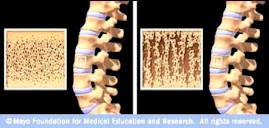
Osteoporotic Bone

Osteoporotic Bone
Source: www.mayoclinic.com

How Strontium Builds Bones

Strontium is a mineral that tends to accumulate in bone. Studies have shown that oral doses of strontium are a safe and effective way to prevent and reverse osteoporosis. Doses of 680 mg per day appear to be optimal. See my "For More Information About Strontium" links section.

Osteoporosis is caused by changes in bone production. In healthy young bones there is a constant cycle of new bone growth and bone removal. With age, more bone is removed and less new bone is produced. The bones become less dense and thus more fragile.

Scientists believe that strontium works in two ways. It may stimulate the replication of pre-osteoblasts, leading to an increase in osteoblasts (cells that build bone). Strontium also directly inhibits the activity of osteoclasts (cells that break down bone). The result is stronger bones.

When taking strontium, be sure to take 1200 mg calcium, 1000 IU vitamin D3, and 500 mg magnesium daily. It is best to take strontium late at night on an empty stomach. Calcium and strontium may compete with each other for absorption if taken together.