Human Skeleton

Human Skeleton

WELCOME TO STRONTIUM FOR BONES BLOG

Have you experienced negative, and even dangerous, side effects from Fosamax (alendronate), Boniva (ibandronate), Actonel (risedronate), Reclast (zoledronic acid), Prolia (denosumab), Forteo (teriparatide), Tymlos (abaloparatide), or other drugs prescribed for osteoporosis? If you have, then rest assured there is a safe, effective treatment for this condition. Strontium, primarily in the form of strontium citrate, is taken orally once a day.

Visitors to my blog can leave comments or ask questions and can remain anonymous, if they wish. Their comments are relayed to my g-mail inbox. Below each post, the number of comments for that post is cited and underlined because it is a link. By clicking on that link below any post, a window opens so that a visitor can leave a comment. Ideally, visitors leave comments on posts most relevant to their comments. All comments to my posts are moderated by me.

Browse the posts and visit the link library of references.


Blog Archive

Showing posts with label TBS. Show all posts

Thursday, September 8, 2022

TBS, Strontium, and Prof. Didier Hans

Prof. Didier Hans, PhD, MBA co-founded Med-Imaps SA in 2006 and became CEO of Medimaps Group in 2012. He currently drives the company’s global strategy, orientation and business objectives, and oversees its Quality Management framework and policies.He holds a PhD in Medical Physics and an Executive MBA from HEC Geneva. https://www.medimapsgroup.com/team/didier-hans/

One of Medimaps Group's products, TBS iNsight™ (Osteo), is an advanced imaging software application for bone densitometers (DXA). It provides a way to better predict a patient’s risk for bone fracture, to fine-tune therapy decisions, and to improve patient management.

TBS iNsight™ is a Medical Device that is CE 2797 marked & has been cleared to be sold in the US.


https://www.medimapsgroup.com/tbs-osteo/


I recently had the opportunity to ask Prof. Hans a question by email. He graciously answered. 


My question:


Will a TBS score be affected by the bone strontium effect, as the BMD by DXA scan is?


His answer, paraphrased and confirmed: 


In our study of TBS and strontium ranelate, TBS was less affected by the larger atomic number of strontium than the BMD was affected. So, the study showed that strontium improved bone microarchitecture. 

Sunday, August 21, 2022

DXA Scan of 18 August 2022 Showing Normal Density

Below is my recent axial DXA performed on a Horizon Prologic Wi DXA scanner and showing NORMAL BONE DENSITY! Even if my scores are lower by half due to strontium use, the changes are phenomenal. Fifteen years ago, I was diagnosed with osteoporosis. My scans have gotten progressively better since I began taking strontium citrate 14 years ago. For my next DXA scan, I will ask that a Trebecular Bone Score (TBS) be included.Trabecular bone score (TBS) uses standard lumbar spine DXA imaging to assess bone texture inhomogeneity (that is, the number of filled versus unfilled voxels) in order to gauge bone quality and fracture risk. Strontium will not affect TBS as it does DXA. 


EXAM:  DXA AXIAL 8/18/2022

 INDICATION:  Postmenopausal.

 COMPARISON: 1/8/2018


FINDINGS:


Spine:  Total BMD of the spine L1-4 is 1.030 g/cm2, with a T-score of -0.2 and a Z-score of 2.2.


Left Femoral Neck: BMD is 0.741 g/cm2, with a T-score of -1.0  and a Z-score of 1.1.


Left Total Hip: BMD is 0.856 g/cm2, with a T-score of -0.7 and a Z-score of 1.0.


Right Femoral Neck: BMD is 0.752 g/cm2, with a T-score of -0.9 and a Z-score of 1.2.


Right Total Hip: BMD is 0.907 g/cm2, with a T-score of -0.3 and a Z-score of 1.5.


Spine density increased 5.2%. Left hip density decreased 1%. Right hip density increased 0.9%. These percent change findings may be inaccurate as exam was performed with different technique.


FRAX evaluation calculates 10-year probability of fracture:

 Major Osteoporotic: 7.9%%

 Hip: 1.3%%


IMPRESSION:

 Based on BMD, diagnosis is consistent with normal density.

 Follow up with DEXA and TBS: As needed.


WHO CRITERIA FOR T-SCORES:

 < or = -2.5 = osteoporosis

 < -1.0 and -2.5 = osteopenia

 > or = -1.0 = normal density

Wandering Skeleton

Wandering Skeleton
Artist: Joel Hoekstra

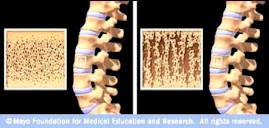
Osteoporotic Bone

Osteoporotic Bone
Source: www.mayoclinic.com

How Strontium Builds Bones

Strontium is a mineral that tends to accumulate in bone. Studies have shown that oral doses of strontium are a safe and effective way to prevent and reverse osteoporosis. Doses of 680 mg per day appear to be optimal. See my "For More Information About Strontium" links section.

Osteoporosis is caused by changes in bone production. In healthy young bones there is a constant cycle of new bone growth and bone removal. With age, more bone is removed and less new bone is produced. The bones become less dense and thus more fragile.

Scientists believe that strontium works in two ways. It may stimulate the replication of pre-osteoblasts, leading to an increase in osteoblasts (cells that build bone). Strontium also directly inhibits the activity of osteoclasts (cells that break down bone). The result is stronger bones.

When taking strontium, be sure to take 1200 mg calcium, 1000 IU vitamin D3, and 500 mg magnesium daily. It is best to take strontium late at night on an empty stomach. Calcium and strontium may compete with each other for absorption if taken together.