Human Skeleton

Human Skeleton

WELCOME TO STRONTIUM FOR BONES BLOG

Have you experienced negative, and even dangerous, side effects from Fosamax (alendronate), Boniva (ibandronate), Actonel (risedronate), Reclast (zoledronic acid), Prolia (denosumab), Forteo (teriparatide), Tymlos (abaloparatide), or other drugs prescribed for osteoporosis? If you have, then rest assured there is a safe, effective treatment for this condition. Strontium, primarily in the form of strontium citrate, is taken orally once a day.

Visitors to my blog can leave comments or ask questions and can remain anonymous, if they wish. Their comments are relayed to my g-mail inbox. Below each post, the number of comments for that post is cited and underlined because it is a link. By clicking on that link below any post, a window opens so that a visitor can leave a comment. Ideally, visitors leave comments on posts most relevant to their comments. All comments to my posts are moderated by me.

Browse the posts and visit the link library of references.


Blog Archive

Showing posts with label postmenopausal women. Show all posts

Saturday, December 22, 2018

Strontium Ranelate Returns to UK January 2019


The osteoporosis medication strontium ranelate (SR) will once again be available in the UK from January 2019.

The drug was previously available under the brand Protelos but was pulled from the UK market in August 2017.

Servier, the manufacturer of the drug at the time, decided to cease supplying it to the UK due to loss of sales. Use of the drug in the UK had been limited by the health authorities due to safety concerns about cardiovascular risks. A continuous decline in the number of people being treated with it led to the company's decision.

Pharmaceutical company Aristo has now taken on the manufacturing of strontium ranelate, which will be available for prescription beginning January 2019, for the treatment of severe osteoporosis in postmenopausal women and adult men who are at high risk of fracture.


This is good news for UK patients who wish to take SR. It is also good news for those of us in the USA and Canada, where SR is not available, but strontium citrate (SC) is. Some people taking SC got scared when SR was pulled from the UK and the EU. I have continuously taken SC for 11 years. Below is a link to the package information for Aristo.

Package leaflet: Information for the patient
Strontium ranelate Aristo 2 g
granules for oral suspension

Marketing Authorisation Holder
Aristo Pharma GmbH
Wallenroder StraĂźe 8-10
13435 Berlin
Germany

Manufacturer
Lindopharm GmbH
NeustraĂźe 82
40721 Hilden
Germany


Monday, April 17, 2017

Strontium Ranelate Withdrawal from European Countries


Cessation of marketing of Protelos/Osseor: Extract of the letter sent to European Medicine Agency (EMA) and national European Agencies on 10 February 2017

14/03/2017

Similar letters, adapted to local regulations, have been sent to all countries worldwide where Protelos/Osseor® is marketed

PROTELOS/OSSEOR® - Cessation of marketing

On 21 September 2004, Protelos/Osseor® (strontium ranelate), centrally authorised medicinal product, was granted a Marketing Authorisation by the European Commission for the European Union (EU).

Protelos/Osseor® is indicated in the treatment of severe osteoporosis in postmenopausal women and in adult men at high risk of fracture, for whom treatment with other medicinal products approved for the treatment of osteoporosis is not possible due to, for example, contraindications or intolerance.

Les Laboratoires Servier hereby notify the cease of the marketing, permanently, in the European countries where it is currently marketed.
This worldwide and strategic decision is taken for commercial reasons based on the following grounds:
  • The restricted indication/limited use of Protelos/Osseor®,
  • The continuous decrease of patients treated with Protelos/Osseor®.
Les Laboratoires Servier will cease the distribution of Protelos/Osseor® in August 2017.
Servier, founded in 1954, is the first independent pharmaceutical group. We are present in 140 countries, with more than 21 000 employees, including close to 3000 in R&D.


My note: Those who will no longer be prescribed strontium ranelate can buy nonprescription strontium citrate. 

Thursday, May 7, 2015

TBS Result Not Affected by Lumbar Spine Osteoarthritis

Abstract

The effect of lumbar osteoarthritis on bone density and trabecular bone score (TBS) was evaluated cross-sectionally and prospectively in postmenopausal women. Lumbar spine osteoarthritis was graded according to Kellgren and Lawrence grades. Lumbar osteoarthritis was found to increase lumbar spine bone density, but not TBS.

INTRODUCTION:

Lumbar osteoarthritis overestimates lumbar bone density (areal bone mineral density (aBMD)). A new texture parameter, the TBS, has been proposed. Calculation of aBMD uses grey level value, while TBS uses grey level variation. Therefore, our hypothesis was that TBS is not influenced by lumbar spine osteoarthritis.

METHODS:

Menopausal women participating in osteoporosis and ultrasound (OPUS) study were included. They had an aBMD measurement of the spine and hip at baseline and 6-year visit. TBS was calculated on lumbar spine dual-energy X-ray absorptiometry (DXA) scans in an automated manner. The presence of lumbar osteoarthritis was evaluated on baseline radiographs using Kellgren and Lawrence (K&L) classification. Grades range from 0 to 4. In our study, osteoarthritis was defined by at least K&L grade 2.

RESULTS:

This study included 1,254 menopausal women (66.7 ± 7.1 years). Among them, 727 attended the 6-year follow-up visit. Patients with lumbar osteoarthritis had an aBMD higher than those without lumbar osteoarthritis at the lumbar spine, but not at the hip. However, the aBMD significantly increased in all sites with the grade of K&L. In contrast, spine TBS was not different between patients with and without lumbar osteoarthritis (p = 0.70), and it was not correlated with K&L grade. Spine TBS and aBMD at all sites were negatively correlated with age (p < 0.0001). Body mass index was correlated positively with aBMD and negatively with spine TBS (p < 0.0001). The 6-year change of aBMD was significant in the hip and nonsignificant in the lumbar spine. That of TBS was significant, with a 3.3 % decrease (p < 0.0001), independent of K&L grade (p = 0.28).

CONCLUSION:

In postmenopausal women, lumbar osteoarthritis leads to an increase in lumbar spine aBMD. In contrast, spine TBS is not affected by lumbar osteoarthritis.

 http://www.ncbi.nlm.nih.gov/pubmed/24687386

Wednesday, May 6, 2015

Trabecular Bone Score

"The trabecular bone score (TBS) is a gray-level textural metric that can be extracted from the two-dimensional lumbar spine dual-energy X-ray absorptiometry (DXA) image. TBS is related to bone microarchitecture and provides skeletal information that is not captured from the standard bone mineral density (BMD) measurement. Based on experimental variograms of the projected DXA image, TBS has the potential to discern differences between DXA scans that show similar BMD measurements. An elevated TBS value correlates with better skeletal microstructure; a low TBS value correlates with weaker skeletal microstructure. Lumbar spine TBS has been evaluated in cross-sectional and longitudinal studies."

"The following conclusions are based upon publications reviewed in this article:
1) TBS gives lower values in postmenopausal women and in men with previous fragility fractures than their nonfractured counterparts;
2) TBS is complementary to data available by lumbar spine DXA measurements;
3) TBS results are lower in women who have sustained a fragility fracture but in whom DXA does not indicate osteoporosis or even osteopenia;
4) TBS predicts fracture risk as well as lumbar spine BMD measurements in postmenopausal women;
5) efficacious therapies for osteoporosis differ in the extent to which they influence the TBS;
6) TBS is associated with fracture risk in individuals with conditions related to reduced bone mass or bone quality."

"Based on these data, lumbar spine TBS holds promise as an emerging technology that could well become a valuable clinical tool in the diagnosis of osteoporosis and in fracture risk assessment."
http://www.ncbi.nlm.nih.gov/pubmed/24443324

Friday, March 13, 2015

Women's Mid-Life Non-Traumatic Fracture Risk Higher With Low Vitamin D


The lower a woman's vitamin D levels as she transitions to menopause, the greater her risk of sustaining a non-traumatic fracture. 

"Women who have levels less than 20 nanograms per milliliter would need some type of vitamin D supplementation," Dr. Jane A. Cauley of the University of Pittsburgh, who worked on the study, told Reuters Health. The findings back up the Institute of Medicine's conclusion that levels lower than 20 ng/ml are insufficient for skeletal health, she added.

Bone loss is known to accelerate during the menopausal transition, and postmenopausal women require significantly more calcium to reach neutral calcium balance than perimenopausal women, Dr. Cauley and her team note in their report, online February 23 in the Journal of Clinical Endocrinology and Metabolism.

To determine if serum 25(OH)D levels would be associated with changes in bone mineral density (BMD) and fracture risk, the researchers looked at data from the Study of Women's Health Across the Nation (SWAN) on 124 women with an incident traumatic fracture, 88 with an incident non-traumatic fracture, and 1,532 who did not sustain fractures during the study's average follow-up period of 9.5 years. 

Each woman had her serum 25(OH)D level checked at her third annual visit, while her BMD was assessed annually. The women's mean age at the study's outset was 48.5.

The study participants' mean 25(OH)D levels were 21.8 ng/ml, and 43% had levels below 20 ng/mL. While multivariate analysis found no association between 25(OH)D levels and traumatic fracture risk, the risk of non-traumatic fractures decreased by 28% for every 10 ng/ml increase in serum 25(OH)D. [Referring to Table 3 of the original article, “For every 10 ng/ml increase in 25(OH)D, the hazard ratio (HR) for nontraumatic fracture was 0.72 (0.54, 0.95).”; 1.00 minus 0.72 equals 0.28, or 28%]

Women with levels of 20 ng/ml or higher had a 46% lower risk of fracture during follow-up than women with lower levels of 25(OH)D. However, there was no association between baseline 25(OH)D and changes in BMD at the lumbar spine or femoral neck across menopause.

Roughly 22% of the women in the study had vitamin D levels greater than 30 ng/ml, Dr. Cauley said, so the study lacked power to determine if these women's non-traumatic fracture risk was further reduced.
"We didn't see any relationship between 25(OH)D and these bone changes, but we were somewhat limited in that we didn't have any information on how vitamin D changed across menopause," she added.


http://www.nutrition411.com/news/womens-mid-life-non-traumatic-fracture-risk-higher-low-vitamin-d
http://www.medscape.com/viewarticle/841028?src=wnl_edit_tpal&uac=127701PY:
http://press.endocrine.org/doi/pdf/10.1210/jc.2014-4367

Friday, December 5, 2014

Similarities in Acquired Factors Related to Postmenopausal Osteoporosis and Sarcopenia


“Sarcopenia, that is, muscle wasting, and osteoporosis,
that is, fragile bone disease, are significant health burdens
among the postmenopausal women. The prevalence of sarcopenia
has been reported to be 10% to 40% in postmenopausal
population depending on the reference method used and the population.
Osteoporosis affects approximately 30% of (the) female population
over 50 years (of age). Sarcopenia results in decline in activities of
daily living, quality of life, and self-rated health and increases falls and related
skeletal fractures which have been estimated to have deep impact of social
and healthcare-related costs of the postmenopausal population.”

“The present paper focuses on similarities in acquired
factors associated with postmenopausal osteoporosis and
sarcopenia concentrating on decades after the menopausal
transition. Consequently, essential aspects on the effects of
aging on sarcopenia and osteoporosis will be covered.”

“Postmenopausal women are at risk of both osteoporosis
and sarcopenia. There is evidence that these two conditions
coexists and share similar risk factors. Both sarcopenia
and osteoporosis are strongly linked not only to aging
but also to estrogen depletion and thereby to menopausal
transition. This makes the postmenopausal population a
significant target group for prevention of both sarcopenia
and osteoporosis.”

“While the associations between muscle strength, muscle
mass, and functional capacity with clinically relevant endpoint
of osteoporosis, that is, BMD and fractures, have been
reported, there are no studies addressing the associations
between three stages of clinical sarcopenia, that is, presarcopenia,
sarcopenia, and severe sarcopenia. The associations
of the three modalities of sarcopenia with osteopenia,
osteoporosis, and severe osteoporosis remain unexplored.
An essential part of the diagnosis of both osteoporosis
and sarcopenia includes DXA, which allows simultaneous
assessment of both conditions. The future research should
concentrate on exploring the clinically relevant dimensions
and interactions of sarcopenia and osteoporosis.”


To read the full review article by Joonas Sirola and Heikki Kröger:


Wandering Skeleton

Wandering Skeleton
Artist: Joel Hoekstra

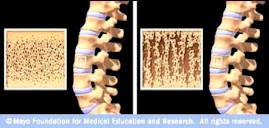
Osteoporotic Bone

Osteoporotic Bone
Source: www.mayoclinic.com

How Strontium Builds Bones

Strontium is a mineral that tends to accumulate in bone. Studies have shown that oral doses of strontium are a safe and effective way to prevent and reverse osteoporosis. Doses of 680 mg per day appear to be optimal. See my "For More Information About Strontium" links section.

Osteoporosis is caused by changes in bone production. In healthy young bones there is a constant cycle of new bone growth and bone removal. With age, more bone is removed and less new bone is produced. The bones become less dense and thus more fragile.

Scientists believe that strontium works in two ways. It may stimulate the replication of pre-osteoblasts, leading to an increase in osteoblasts (cells that build bone). Strontium also directly inhibits the activity of osteoclasts (cells that break down bone). The result is stronger bones.

When taking strontium, be sure to take 1200 mg calcium, 1000 IU vitamin D3, and 500 mg magnesium daily. It is best to take strontium late at night on an empty stomach. Calcium and strontium may compete with each other for absorption if taken together.