Human Skeleton

Human Skeleton

WELCOME TO STRONTIUM FOR BONES BLOG

Have you experienced negative, and even dangerous, side effects from Fosamax (alendronate), Boniva (ibandronate), Actonel (risedronate), Reclast (zoledronic acid), Prolia (denosumab), Forteo (teriparatide), Tymlos (abaloparatide), or other drugs prescribed for osteoporosis? If you have, then rest assured there is a safe, effective treatment for this condition. Strontium, primarily in the form of strontium citrate, is taken orally once a day.

Visitors to my blog can leave comments or ask questions and can remain anonymous, if they wish. Their comments are relayed to my g-mail inbox. Below each post, the number of comments for that post is cited and underlined because it is a link. By clicking on that link below any post, a window opens so that a visitor can leave a comment. Ideally, visitors leave comments on posts most relevant to their comments. All comments to my posts are moderated by me.

Browse the posts and visit the link library of references.


Blog Archive

Showing posts with label sarcopenia. Show all posts

Friday, July 3, 2015

Treating Sarcopenia


Sarcopenia is, in its most literal sense, the loss of muscle mass, strength and function related to aging.  Most commonly seen in inactive people, sarcopenia also affects those who remain physically active throughout their lives. This indicates although a sedentary lifestyle contributes to this disease, it's not the only factor. In addition, as we age:
  • hormone levels change
  • protein requirements alter
  • motor neurons die
  • and we tend to become more sedentary 
 Sarcopenia

These factors in combination are thought to cause sarcopenia. The figure shows normal muscle mass on left, muscle wasting on right.

 
There are currently no approved drug treatments for sarcopenia. Research is now focusing on the role of physical activity, nutrition, supplements, and potential future medications that may be used to treat or prevent sarcopenia.


In a review of literature, worsening sarcopenia followed trends in losses of muscle strength as well as impairment of daily functioning. In one study, the prevalence of sarcopenia increased dramatically with age from 4 % of men and 3 % of women aged 70-75 to 16 % of men and 13 % of women aged 85 or older.

More importantly, when sarcopenia is coupled with other diseases associated with aging, its effects can be even more pronounced. Loss of muscle mass and strength is a significant risk factor for disability in the aging population. When patients suffer from both sarcopenia and osteoporosis, the risk of falling and subsequent fracture incidence is higher. Therefore, treating sarcopenia will in turn help to lessen its burden on co-existing diseases.

 Exercise
After a program of resistance training is introduced, research shows that motor neuron firing and protein synthesis (both of which are needed in building muscle mass) increase even in the elderly. These changes indicate it is possible to rebuild muscle strength even at an advanced age.

Aerobic exercise also appears to aid in the fight against sarcopenia.

Nutrition
Adequate nutrition plays a major role in treating sarcopenia. Research has shown older adults may need more protein per kilogram than their younger counterparts to maintain proper levels that reinforce muscle mass. Protein intake of 1.0-1.2 g/kg of body weight per day is probably optimum for older adults. This theory, coupled with the fact that older adults tend to take in fewer calories in general, may lead to pronounced protein deficiency as well as deficiency of other important nutrients. Therefore, maintaining adequate protein intake as well as adequate caloric intake is an important facet of the treatment of this disease.

Diets rich in acid producing foods (meat and cereal grains) and low in non-acid producing foods (fruits and vegetables) have been shown to have negative effects on muscle mass. As mentioned above, protein is important, but a diet high in meat and cereal grains should be balanced with a diet high in fruits and vegetable (nonacid-producing foods) in order to be effective in treating sarcopenia.

Supplements
There is some evidence to support that creatine supplements can also aid in muscle development for older adults that are following a resistance training program.

Maintaining appropriate blood levels of vitamin D may also aid in maintaining muscle strength and physical performance.


Friday, December 5, 2014

Similarities in Acquired Factors Related to Postmenopausal Osteoporosis and Sarcopenia


“Sarcopenia, that is, muscle wasting, and osteoporosis,
that is, fragile bone disease, are significant health burdens
among the postmenopausal women. The prevalence of sarcopenia
has been reported to be 10% to 40% in postmenopausal
population depending on the reference method used and the population.
Osteoporosis affects approximately 30% of (the) female population
over 50 years (of age). Sarcopenia results in decline in activities of
daily living, quality of life, and self-rated health and increases falls and related
skeletal fractures which have been estimated to have deep impact of social
and healthcare-related costs of the postmenopausal population.”

“The present paper focuses on similarities in acquired
factors associated with postmenopausal osteoporosis and
sarcopenia concentrating on decades after the menopausal
transition. Consequently, essential aspects on the effects of
aging on sarcopenia and osteoporosis will be covered.”

“Postmenopausal women are at risk of both osteoporosis
and sarcopenia. There is evidence that these two conditions
coexists and share similar risk factors. Both sarcopenia
and osteoporosis are strongly linked not only to aging
but also to estrogen depletion and thereby to menopausal
transition. This makes the postmenopausal population a
significant target group for prevention of both sarcopenia
and osteoporosis.”

“While the associations between muscle strength, muscle
mass, and functional capacity with clinically relevant endpoint
of osteoporosis, that is, BMD and fractures, have been
reported, there are no studies addressing the associations
between three stages of clinical sarcopenia, that is, presarcopenia,
sarcopenia, and severe sarcopenia. The associations
of the three modalities of sarcopenia with osteopenia,
osteoporosis, and severe osteoporosis remain unexplored.
An essential part of the diagnosis of both osteoporosis
and sarcopenia includes DXA, which allows simultaneous
assessment of both conditions. The future research should
concentrate on exploring the clinically relevant dimensions
and interactions of sarcopenia and osteoporosis.”


To read the full review article by Joonas Sirola and Heikki Kröger:


Wandering Skeleton

Wandering Skeleton
Artist: Joel Hoekstra

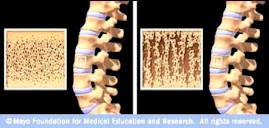
Osteoporotic Bone

Osteoporotic Bone
Source: www.mayoclinic.com

How Strontium Builds Bones

Strontium is a mineral that tends to accumulate in bone. Studies have shown that oral doses of strontium are a safe and effective way to prevent and reverse osteoporosis. Doses of 680 mg per day appear to be optimal. See my "For More Information About Strontium" links section.

Osteoporosis is caused by changes in bone production. In healthy young bones there is a constant cycle of new bone growth and bone removal. With age, more bone is removed and less new bone is produced. The bones become less dense and thus more fragile.

Scientists believe that strontium works in two ways. It may stimulate the replication of pre-osteoblasts, leading to an increase in osteoblasts (cells that build bone). Strontium also directly inhibits the activity of osteoclasts (cells that break down bone). The result is stronger bones.

When taking strontium, be sure to take 1200 mg calcium, 1000 IU vitamin D3, and 500 mg magnesium daily. It is best to take strontium late at night on an empty stomach. Calcium and strontium may compete with each other for absorption if taken together.