After five and a half years of taking strontium citrate (680
mg strontium daily), I went from osteoporosis to osteopenia. I was probably at
the osteopenia stage much earlier, but I waited four years between my previous
DEXA scan, which showed improvement at all sites but still left me with
osteoporosis, and this one. My density increased 34% in the lumbar spine and
55% in the left hip! These numbers are phenomenal! Even if up to 50% of the
change in BMD were attributed to the effect of strontium, which has a higher
atomic number than calcium and will affect DEXA measurements, the numbers would
still be great. My BMD is now 0.871 g/cm2 at the spine from L1- L4 (T-score -1.6),
0.692 g/cm2 at the left femoral neck (-1.4 T-score), and 0.775 g/cm2 at the
left total hip (-1.4 T-score). Osteopenia is defined as T-scores < -1.0 and
-2.5.
Human Skeleton

Showing posts with label DEXA scan. Show all posts
Showing posts with label DEXA scan. Show all posts
Sunday, September 1, 2013


Friday, January 6, 2012
Spinal BMD And Scoliosis
On June 15, 2006, Ioannis P. Pappou, MD et al published a retrospective study entitled “Discordantly High Spinal Bone Mineral Density Values in Patients With Adult Lumbar Scoliosis.” The purposes of this study were: 1) to investigate the validity of bone mineral density measurements with DEXA in patients with adult lumbar scoliosis and 2) to investigate the association between osteoporosis and adult lumbar scoliosis.
The study concluded the following:
Cobb’s angle measurements on DEXA scans are reliable and comparable to conventional radiographs.
Spinal BMD values are less valuable for monitoring osteoporosis than hip values in scoliotic patients; an increasing discrepancy with age was noted. Scoliotic patients exhibited discordantly high spinal BMD values, despite significant hip osteoporosis. The discrepancy correlated with aging and curve magnitude.
Scoliosis was common among the osteoporotic population (9.47%). Lumbar scoliosis is a useful clinical marker for osteoporosis, irrespective of scoliosis history and magnitude.
Viable alternatives for osteoporosis evaluation of adult patients with lumbar scoliosis are hip DEXA values, in conjunction with other BMD measurements.
http://journals.lww.com/spinejournal/Abstract/2006/06150/Discordantly_High_Spinal_Bone_Mineral_Density.19.aspx
Saturday, July 11, 2009
Improved T-Scores After Treatment
My first DEXA scan on 05/08/07 diagnosed me with osteoporosis. My second scan was done 07/06/09 after the following treatment: Fosamax 70 mg weekly from 06/18/07 to 12/24/07, two capsules Doctor's Best Strontium Bone Maker daily from 01/21/08 to 07/06/09. Here are my BMD results in g/cm2 and my T-scores for my second scan:
Spine (L1-L4): BMD 0.749, T-Score -2.7
Lt. Hip (neck): BMD 0.563, T-Score -2.6
Lt. Hip (total): BMD 0.739, T-Score -1.7
Despite my best efforts, my scores were not corrected for strontium intake by the radiologist. My first and second scans were not on the same DEXA machine, but they were both on DXA Hologic scanners. Even so, I am very happy with my results. My T-scores improved 10.0% at the spine, 7.1% at the left hip (neck), and 22.7% at the left hip (total). I plan to continue taking strontium citrate.
Spine (L1-L4): BMD 0.749, T-Score -2.7
Lt. Hip (neck): BMD 0.563, T-Score -2.6
Lt. Hip (total): BMD 0.739, T-Score -1.7
Despite my best efforts, my scores were not corrected for strontium intake by the radiologist. My first and second scans were not on the same DEXA machine, but they were both on DXA Hologic scanners. Even so, I am very happy with my results. My T-scores improved 10.0% at the spine, 7.1% at the left hip (neck), and 22.7% at the left hip (total). I plan to continue taking strontium citrate.
Monday, May 4, 2009
Poll Results On T-Scores After Strontium Citrate
Here are the results of my latest poll: Did your DEXA scan T-scores improve after taking strontium citrate?
12 (75%) YES
4 (25%) NO
12 (75%) YES
4 (25%) NO
Tuesday, November 4, 2008
Effect Of Strontium on DEXA Scan
The presence of strontium in bone influences bone mineral density (BMD) and bone mineral content (BMC) measurements by dual-energy X-ray absorptiometry (DEXA). DEXA scans are usually read based on calcium as the main component of bone. Since strontium is heavier than calcium, its presence in bone will change the results of the scan.
When you go for your next DEXA scan, be sure to inform the radiologist, in writing, about your daily dose of strontium and how long you have been taking it. He can make a correction, or at least note on your results, that you have been taking strontium. Without an adjustment in the interpretation, BMD can be read as artificially high. You might be wise to give the clinician a copy of "Strontium DEXA Scan Effect," which you can print out at www.osteopenia3.com/Strontium-dexa-scan.html.
When you go for your next DEXA scan, be sure to inform the radiologist, in writing, about your daily dose of strontium and how long you have been taking it. He can make a correction, or at least note on your results, that you have been taking strontium. Without an adjustment in the interpretation, BMD can be read as artificially high. You might be wise to give the clinician a copy of "Strontium DEXA Scan Effect," which you can print out at www.osteopenia3.com/Strontium-dexa-scan.html.
Subscribe to:
Posts (Atom)
Wandering Skeleton

Artist: Joel Hoekstra
Osteoporotic Bone
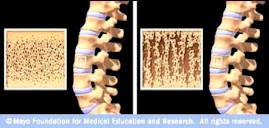
Source: www.mayoclinic.com