Human Skeleton

Monday, September 28, 2020


Sunday, September 27, 2020
What Determines How Much Strontium Is in Your Bones?
It is generally said that, for every 1% of strontium incorporated into bone crystal, BMD is overestimated by 10%. However, we do not know how much strontium has been incorporated into each of your bones.
The amount of strontium in your bones will depend on several factors:
(1) the dosage (680 mg, as in the COMB study; 340 mg, which is a half dose; or 450 mg, the dosage used in the MOTS study;
(2) the length of time you have been taking strontium (The COMB and MOTS studies lasted only one year. Therefore, the strontium effect on those DXA scans was less than had the subjects been studied for three years or longer.
(3) how well you absorb the strontium (Absorption of strontium salts is about 25% for most people with normal absorption, but, as we age, our ability to absorb nutrients, supplements, and medications is often reduced.);
(4) the individual bones (Some bones absorb strontium better than others.);
(5) the DXA equipment used to measure BMD.
Friday, July 3, 2020
My Current Supplements
I take one capsule/day of each of the following supplements, with the exception of strontium and lutein (two capsules/day) and D3 (one capsule three times/week).
I do not take any supplements, except strontium, on Sundays to prevent getting too much of any one of them. I do not take strontium on Sundays if I feel I have not had sufficient calcium-containing foods that day. Vitamins, minerals, and other supplements taken in excess can cause problems.Too much calcium from supplements can contribute to the formation of kidney stones and has been implicated (inconclusively) in heart disease. Try to get most of your calcium from food. Excess amounts of water-soluble vitamins are eliminated in the urine. Supplemental vitamin C, a water-soluble vitamin, increases urinary oxalate concentrations, but whether an increase in urinary oxalate elevates the risk for kidney stones is not yet known. Those predisposed for kidney stone formation may consider avoiding high-dose (greater than or equal to 1 g/day) vitamin C supplementation. I am not predisposed to kidney stones but take only 500 mg/day vitamin C in pill form.
The fat-soluble vitamins are A, D, E and K. They are soluble in organic solvents and are absorbed and transported in a manner similar to that of fats. Excess amounts of fat-soluble vitamins accumulate in the liver, adipose (fat) tissue, and skeletal muscle. Because these vitamins are stored for long periods, dangerous levels can build up. Excess intake of fat-soluble vitamins is more likely to cause you harm than excess intake of water-soluble vitamins. For these reasons, I do not take extra vitamin A, except for the 750 mcg in my multivitamin. I do not take any K2 and only the 80 mcg K1 (as Phytonadione) in my multivitamin. I do take 400 IU natural vitamin E. I do take vitamin D (1000 IU) in my multivitamin. I recently added another D3 supplement with 1000 IU/capsule, but I am only taking it three times per week. If I add up the 1000 IU/day for six days/week in my multi and the 1000 IU for three days/week in the separate D3 supplement, I get 9000 IU vitamin D/week, or about 1286 IU/day. Unless you have a vitamin-D deficiency or insufficiency, as shown by a 25(OH)D blood test,1000 to 2000 IU/day of vitamin D should be plenty.
Bioflavonoids (Antioxidants)
Solgar Citrus Bioflavonoid Complex, 1000 mg per tablet
Digestive Aids
Nature’s Way Primadophilus bifidus (probiotic)
NOW Super Enzymes (breaks down fats, carbs and protein)
Minerals
AOR Strontium Support II, 341 mg strontium (from citrate) per capsule (two capsules daily)
Country Life, Gluten Free, Calcium Magnesium Complex (500 mg Ca, 250 mg Mg per tablet)
KAL Magnesium Glycinate 400 (400 mg in 2 softgels; I take one.)
Solary Selenium, 100 mcg
Vitacost Chelated Zinc (zinc glycinate chelate), 30 mg
Vitamins
Doctor’s Best Lutein with Optilut (20 mg lutein, 4 mg zeaxanthin in two capsules)
Nature Made D3, 1000 IU (one capsule three times/week)
Nature Made Multi Men's 50+, No Iron (OK for men and women; contains 1000 IU vitamin D3 and 21 other nutrients)
Nature Made Vitamin C, 500 m
Solgar Natural Vitamin E (as d-Alpha Tocopherol plus d-Beta, d-Delta and d-Gamma Tocopherols), 400 IU
Solgar Sublingual Methylcobalamin (Vitamin B12), 5000 mcg
Saturday, February 8, 2020
Calculating Body Frame Size
Having a small, thin frame is a risk factor for osteoporosis. So, how do you determine if you have a small, medium, or large frame?
Overview
Body frame size is determined by a person's wrist circumference in relation to
his height. For example, a man whose height is over 5' 5" and wrist is 6"
would fall into the small-boned category.
his height. For example, a man whose height is over 5' 5" and wrist is 6"
would fall into the small-boned category.
Determining frame size: To determine the body frame size, measure the
wrist with a tape measure and use the following chart to determine whether
the person is small, medium, or large boned.
wrist with a tape measure and use the following chart to determine whether
the person is small, medium, or large boned.
Women:
- Height under 5'2"
- Small = wrist size less than 5.5"
- Medium = wrist size 5.5" to 5.75"
- Large = wrist size over 5.75"
- Height 5'2" to 5' 5"
- Small = wrist size less than 6"
- Medium = wrist size 6" to 6.25"
- Large = wrist size over 6.25"
- Height over 5' 5"
- Small = wrist size less than 6.25"
- Medium = wrist size 6.25" to 6.5"
- Large = wrist size over 6.5"
Men:
- Height over 5' 5"
- Small = wrist size 5.5" to 6.5"
- Medium = wrist size 6.5" to 7.5"
- Large = wrist size over 7.5"
Thursday, January 9, 2020
A Picture Is Worth a Thousand Words in Describing the Effects of Strontium on Bone
Micro computed tomography or "micro-CT" is x-ray imaging in 3D, by the same method used in hospital CT (or "CAT") scans, but on a small scale with massively increased resolution. It really represents 3D microscopy, where very fine scale internal structure of objects is imaged non-destructively.
“Postmenopausal osteoporosis is a chronic skeletal disorder involving compromised bone strength leading to an increased rate of fracture. Bone strength and therefore fracture risk depends on microarchitecture, matrix volume, and mineralization. Both cortical and trabecular bone are affected by the disease, with progressive considerable alterations in microarchitecture. The imbalance in bone remodeling in osteoporosis, in which bone formation is not able to compensate for bone resorption, leads to trabecular thinning and a loss of connectivity. As the disease progresses through years, continued increase remodeling rates lead to deep resorption cavities, the trabecular plates become perforated, and the connecting rods dissolve. As a consequence, there is a continuous shift from a plate‐like structure to a rod‐like structure. Simultaneously, in cortical bone, extensive remodeling at the endocortical surfaces “trabecularizes” (makes similar to trabecular bone) the inner part of cortical bone.”
“Cortical bone is the major component of long bone, for example, in the femoral shaft, in which rigidity to withstand load and movement is favored over flexibility. On the other hand, bone with a large proportion of trabecular bone is lighter and more flexible and can absorb more energy, for example, in the vertebrae. Both types of bone are susceptible to osteoporotic fracture at rates dependent on a number of variables, including microarchitecture.”
“The 3D analysis from the μCT studies goes beyond the histomorphometric results by showing differences on the trabecular and cortical microarchitecture of bone in favor of strontium ranelate compared with placebo (Fig. 1). In trabecular bone, Tb.N (trabecular number) was higher and Tb.Sp (trabecular separation) was lower in the treated group, indicating a thickening of the trabecular elements. The 22% reduction in trabecular SMI toward a value closer to zero means that 3‐yr treatment has shifted the structure of the cancellous bone away from a rod‐like structure (SMI = 3) toward a normal structure based on plates (SMI = 0). The significant improvement in two of these parameters with strontium ranelate is in line with an overall improvement in bone strength with this agent.”
“An increase in porosity or thinning in cortical bone reduces the resistance of bone to the propagation of cracks, which is one of the underlying defects in osteoporosis. Our 3D results showed that strontium ranelate significantly increases Ct.Th (cortical thickness) but had no effect on Ct.Po (cortical porosity). The anabolic agent teriparatide may actually increase Ct.Po.”

Figure 1. 3D microstructure from μCT of transiliac bone biopsies from postmenopausal osteoporotic
women receiving strontium ranelate (2 g/d) or placebo for 3 yr.
Subscribe to:
Posts (Atom)
Wandering Skeleton

Artist: Joel Hoekstra
Osteoporotic Bone
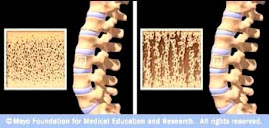
Source: www.mayoclinic.com