I will be asking that a Trabecular Bone Score (TBS) be included with my next DXA scan. The doctor who read my latest scan wrote, "Follow up with DEXA and TBS: As needed."
I found a review of TBS. The review includes a section on "Changes in TBS with Treatment of Osteoporosis." Below is the paragraph comparing the effects of strontium ranelate and alendronate (Fosamax) on TBS.
"The effects of strontium ranelate (SrRan) and alendronate on TBS were evaluated in a post hoc analysis performed in 79 women with postmenopausal osteoporosis of 189 included in a double‐blind, double‐dummy, randomized study. Women were randomized to either SrRan 2 g/day or alendronate 70 mg/week for 2 years. TBS and BMD parameters were assessed in the LS after 12 and 24 months of treatment. Over 1 and 2 years, LS BMD increased significantly by 5.6% and 9.0% in the SrRan group and by 5.2% and 7.6%, respectively, in the alendronate group. LS TBS increased by 2.3% (p < 0.001) and 3.1% (p < 0.001) in the SrRan group, but the change in the alendronate group was not significant (0.5% and 1.0%, respectively). There was a significant between‐group difference with SrRan showing larger TBS increases than alendronate."
Let me reiterate: Over one and two years, Lumbar Spine (LS) BMD increased in both the SrRan (5.6%, 9.0%) and alendronate groups (5.2%, 7.6%). You will note that the SrRan BMD numbers are higher, especially after the second year, than the alendronate numbers. The results are as expected because strontium results in an overestimation of BMD.
HERE IS THE KICKER: LS TBS increased by 2.3% and 3.1% in the SrRan group, but the change in the alendronate group was not significant (0.5% and 1.0%, respectively). There was a significant between‐group difference with SrRan showing larger TBS increases than alendronate.
Keep in mind that TBS is related to bone microarchitecture and provides skeletal information that is not captured from the standard BMD measurement. TBS may be a better predictor of fracture risk than BMD alone.
https://www.panoramaortho.com/wp-content/uploads/2019/03/TBS-Rev...
Human Skeleton

Showing posts with label postmenopausal osteoporosis. Show all posts
Showing posts with label postmenopausal osteoporosis. Show all posts
Tuesday, August 23, 2022
Trabecular Bone Score (TBS)


Thursday, March 12, 2015
Strontium Prevents the Progression of Thoracic Kyphosis
Background: Thoracic kyphosis (a frequent feature in the elderly and in post menopausal osteoporosis) can be caused by vertebral fractures. This exaggerated curvature of the spine is also related to degenerative changes including intervertebral disc space narrowing, deformities of the anterior part of the vertebrae and reduced spinal muscles strength. An increase over time in thoracic kyphosis has been associated with impairment in global health due to increased body sway and risk of falls, impairments in pulmonary function, presence of esophagial hiatal hernia, and an increase in risk of mortality in older women.
Objectives: The objective of this study was to assess the effect on thoracic kyphosis progression over a 3-year treatment with strontium ranelate, a treatment against osteoporosis that reduces the risk of vertebral, nonvertebral and hip fractures.
Methods: This study was performed in women with postmenopausal osteoporosis from SOTI 1 and TROPOS 2 studies, aiming to demonstrate the efficacy of strontium ranelate against vertebral and non-vertebral fractures. Patients underwent lateral radiographs of the thoracic and lumbar spine at baseline and annually over 3 years (standardized procedures). The level of thoracic kyphosis was reflected by a kyphosis index, defined on lateral thoracic radiographs as the ratio BD/AC (AC= line from the anterior superior edge of T4 to the anterior inferior edge of T12; BD= perpendicular line from the furthest superior or inferior posterior point of T7, T8 or T9 vertebrae to AC line) expressed as a %. The highest the KI, the more severe the thoracic kyphotic curvature.
Results: The population consisted of 4055 women with postmenopausal osteoporosis (2038 patients randomised to strontium ranelate and 2017 randomised to placebo). Baseline characteristics were similar: mean age 73.5; Spine BMD T-score (L2-L4): -3.06; Femoral neck T-score: -2.97; KI: 25.4. Over 3 years, there was a significant increase from baseline in kyphotic index for all patients. However, this increase was significantly lower (p=0.003) in patients treated with strontium ranelate: +3.71±7.69% than in the placebo group:+4.70±7.32%.
The same calculations were repeated after exclusion of patients having either prevalent or incident thoracic vertebral fractures. In this subset of 1193 patients (634 in the strontium ranelate group and 559 in the placebo group), the change in the strontium ranelate group was still lower than in the placebo group (+ 2.72±7.17% versus 4.34±6.54%, respectively).
Conclusion: These prospective results demonstrate that thoracic kyphosis increases over time in postmenopausal women with osteoporosis. Strontium ranelate decreased the progression of this thoracic kyphosis over 3 years, regardless of the presence or not of vertebral fractures. This new effect of strontium ranelate possibly reflects additional benefit on spinal components besides its efficacy in decreasing vertebral fractures.
References: 1 Meunier PJ et al. N Engl J Med 2004; 2 Reginster J.Y et al. JCEM 2005
Ann Rheum Dis 2008;67(Suppl II):541
http://www.abstracts2view.com/eular/view.php?nu=EULAR08L_SAT0344
Thursday, September 4, 2014
Therapy for Patients with CKD and Low Bone Mineral Density
http://www.ncbi.nlm.nih.gov/pubmed/24100401
Nat Rev Nephrol. 2013 Nov;9(11):681-92. doi: 10.1038/nrneph.2013.182. Epub 2013 Oct 8.
Patients with chronic kidney disease (CKD) have a high risk of bone fracture owing to their low bone mineral density, which resembles that of postmenopausal osteoporosis. However, the mineral and bone disorder associated with CKD (CKD-MBD) is more complex than osteoporosis and the same treatments might not be appropriate. In particular, vascular calcifications are strongly associated with CKD-MBD, and must be taken into consideration. Post hoc analyses of data from pivotal osteoporosis studies suggest that in patients with mild stage 3 CKD and normal parathyroid hormone (PTH), calcium and phosphate measurements, conventional medications for osteoporosis (such as raloxifene, bisphosphonates, teriparatide and denosumab) are effective at reducing fracture rates. However, for patients with stage 4-5 CKD, or those with abnormal PTH and mineral values, the available data are insufficient to determine whether these commonly used medications are effective against fractures. Moreover, all medications used to treat osteoporosis have known or potential adverse effects in patients with CKD. Medicines that increase bone formation by upregulating Wnt signalling have shown promise in patients with osteoporosis and might be used to treat CKD-MBD in the future, but off-target effects could limit their use in in this setting.
Nat Rev Nephrol. 2013 Nov;9(11):681-92. doi: 10.1038/nrneph.2013.182. Epub 2013 Oct 8.
Patients with chronic kidney disease (CKD) have a high risk of bone fracture owing to their low bone mineral density, which resembles that of postmenopausal osteoporosis. However, the mineral and bone disorder associated with CKD (CKD-MBD) is more complex than osteoporosis and the same treatments might not be appropriate. In particular, vascular calcifications are strongly associated with CKD-MBD, and must be taken into consideration. Post hoc analyses of data from pivotal osteoporosis studies suggest that in patients with mild stage 3 CKD and normal parathyroid hormone (PTH), calcium and phosphate measurements, conventional medications for osteoporosis (such as raloxifene, bisphosphonates, teriparatide and denosumab) are effective at reducing fracture rates. However, for patients with stage 4-5 CKD, or those with abnormal PTH and mineral values, the available data are insufficient to determine whether these commonly used medications are effective against fractures. Moreover, all medications used to treat osteoporosis have known or potential adverse effects in patients with CKD. Medicines that increase bone formation by upregulating Wnt signalling have shown promise in patients with osteoporosis and might be used to treat CKD-MBD in the future, but off-target effects could limit their use in in this setting.
Friday, April 4, 2014
Strontium Basics
What is the recommended amount of strontium?
The amount of a strontium salt (e.g. strontium citrate) for
prevention of bone loss in early postmenopausal non-osteoporotic women is roughly
1 gram per day to get about 340 mg of elemental strontium.
The amount of a strontium salt for treatment of
postmenopausal osteoporosis is roughly 2 grams per day to get about 680 mg of
elemental strontium.
When should you take strontium as per time of day and how
far apart from calcium?
You can take strontium at any time as long as you take it at
least 2-3 hours after taking food, milk or milk products, or calcium
supplements. Calcium competes with strontium for absorption; so, you will
absorb less strontium if you take calcium and strontium too close together. You
will absorb strontium better on an empty stomach. I take my strontium at night
shortly before bedtime. Take it when it is most convenient for you.
In what ratio to calcium should you take strontium?
You do not need to worry about a ratio of calcium to
strontium. The amount of calcium you need, whether you take strontium or not,
depends on your age and sex. Adult men (51-70 years old) need 1000 mg daily.
Adult women (51-70 years old) need 1200 mg per day. These are total amounts of
calcium. So, what you need to do first is figure out how much calcium you are
getting from food, and then supplement the rest, if needed. You should strive
to get all, or most, of your calcium from food.
Monday, August 16, 2010
Strontium Malonate Licensing Agreement
On August 2, 2010, Osteologix and Servier announced an ex-U.S. licensing agreement for NB S101 (strontium malonate). Osteologix has granted Servier an exclusive royalty-bearing license to develop and commercialize NB S101 to treat postmenopausal osteoporosis, other bone and joint disorders and dental indications worldwide, except in the United States. Under the terms of the agreement, Osteologix will receive up to €12 million in upfront and milestone payments. Additionally, Osteologix is eligible to receive up to €30 million in minimum royalty payments creditable against mid to low single digit royalties on sales. Osteologix will also be eligible to receive milestone payments and royalties on product development and sales in Japan. Servier will be responsible for all costs outside of the U.S. associated with development, regulatory approval and commercialization of NB S101. Osteologix will continue to own intellectual property rights for development in the U.S. This information is from a press release issued by Osteologix at http://www.osteologix.com/wb0005.php?oid=12.
Monday, March 22, 2010
Strontium And Calcium
For patients taking any strontium salt (e.g., strontium ranelate, strontium citrate) for osteoporosis, it is recommended that you obtain an adequate calcium intake as part of a well balanced diet. If you have difficulties obtaining adequate calcium from your diet, a calcium supplement may also be required. (All patients participating in the strontium ranelate research trials had an adequate calcium intake.) Take your calcium supplement or calcium-rich food at least two hours before or two hours after you have taken the strontium because calcium will prevent the absorption of strontium.
There is an upper limit to the amount of calcium that can be taken safely. It is recommended that you do not exceed 2000 - 2500 mg of calcium per day included in your food, drink and supplements. Consistently exceeding the upper limit may increase your risk of medical problems, including a high level of calcium in the blood (milk alkali syndrome), and may interfere with the absorption of other minerals such as iron. If you have a history of kidney stones, consuming a diet rich in calcium will not increase your risk of further stone formation. Most renal doctors do not restrict calcium intake for their patients these days.
Splitting your calcium intake into 500-mg doses is advisable, as the gut would not be able to absorb 1000 mg all at once. To maximize the absorption of your calcium tablet, take it at meal times with or after food. If you take iron tablets for other health reasons, avoid taking calcium at the same time by staggering the tablets throughout the day. This will ensure that both minerals are fully absorbed.
This information is from the National Osteoporosis Society, located in the United Kingdom, where strontium ranelate (Protelos) is an approved prescription drug for the treatment of postmenopausal osteoporosis. To obtain NOS publications and Information Sheets, go to www.nos.org.uk.
There is an upper limit to the amount of calcium that can be taken safely. It is recommended that you do not exceed 2000 - 2500 mg of calcium per day included in your food, drink and supplements. Consistently exceeding the upper limit may increase your risk of medical problems, including a high level of calcium in the blood (milk alkali syndrome), and may interfere with the absorption of other minerals such as iron. If you have a history of kidney stones, consuming a diet rich in calcium will not increase your risk of further stone formation. Most renal doctors do not restrict calcium intake for their patients these days.
Splitting your calcium intake into 500-mg doses is advisable, as the gut would not be able to absorb 1000 mg all at once. To maximize the absorption of your calcium tablet, take it at meal times with or after food. If you take iron tablets for other health reasons, avoid taking calcium at the same time by staggering the tablets throughout the day. This will ensure that both minerals are fully absorbed.
This information is from the National Osteoporosis Society, located in the United Kingdom, where strontium ranelate (Protelos) is an approved prescription drug for the treatment of postmenopausal osteoporosis. To obtain NOS publications and Information Sheets, go to www.nos.org.uk.
Subscribe to:
Posts (Atom)
Wandering Skeleton
Artist: Joel Hoekstra
Osteoporotic Bone
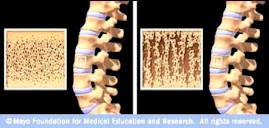
Source: www.mayoclinic.com