http://www.ncbi.nlm.nih.gov/pubmed/24100401
Nat Rev Nephrol. 2013 Nov;9(11):681-92. doi: 10.1038/nrneph.2013.182. Epub 2013 Oct 8.
Patients with chronic kidney disease (CKD) have a high risk of bone
fracture owing to their low bone mineral density, which resembles that
of postmenopausal osteoporosis. However, the mineral and bone disorder
associated with CKD (CKD-MBD) is more complex than osteoporosis and the
same treatments might not be appropriate. In particular, vascular
calcifications are strongly associated with CKD-MBD, and must be taken
into consideration. Post hoc analyses of data from pivotal osteoporosis
studies suggest that in patients with mild stage 3 CKD and normal
parathyroid hormone (PTH), calcium and phosphate measurements,
conventional medications for osteoporosis (such as raloxifene,
bisphosphonates, teriparatide and denosumab) are effective at reducing
fracture rates. However, for patients with stage 4-5 CKD, or those with
abnormal PTH and mineral values, the available data are insufficient to
determine whether these commonly used medications are effective against
fractures. Moreover, all medications used to treat osteoporosis have
known or potential adverse effects in patients with CKD. Medicines that
increase bone formation by upregulating Wnt signalling have shown
promise in patients with osteoporosis and might be used to treat CKD-MBD
in the future, but off-target effects could limit their use in in this
setting.
Human Skeleton

Showing posts with label bone fracture risk. Show all posts
Showing posts with label bone fracture risk. Show all posts
Thursday, September 4, 2014


Friday, November 23, 2012
Hip Fracture Risk and Antihypertensive Drugs
Are you taking strontium citrate or one of the osteoporosis medications to increase your BMD and decrease your bone fracture risk? Here is something else to consider if you are at least 66 years of age.
Initiating antihypertensive drugs in the elderly has been associated with an immediate increased risk of falls. The most likely mechanism is orthostatic hypotension, which is associated with dizziness and fainting. The effect is acute, occurs over a relatively short time, and may lead to falls, some of which can result in hip fractures.
Initiating antihypertensive drugs in the elderly has been associated with an immediate increased risk of falls. The most likely mechanism is orthostatic hypotension, which is associated with dizziness and fainting. The effect is acute, occurs over a relatively short time, and may lead to falls, some of which can result in hip fractures.
The following study was undertaken to determine whether
initiation of antihypertensive drugs (e.g., thiazide diuretics, angiotensin II
converting–enzyme inhibitors, angiotensin II receptor blockers, calcium channel
blockers, or β-adrenergic blockers) was associated with an immediate increased
risk of hip fractures. Health care
administrative databases were used to identify patients initiating an
antihypertensive drug in Ontario, Canada. Elderly people who began receiving an antihypertensive
drug had a 43% increased risk of having a hip fracture during the first 45 days
following treatment initiation.
Subscribe to:
Posts (Atom)
Wandering Skeleton
Artist: Joel Hoekstra
Osteoporotic Bone
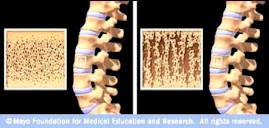
Source: www.mayoclinic.com