Dublin, 3 March 2014
http://www.osteologix.com/wb0005.php?oid=0
Les Laboratoires Servier has terminated its licensing agreement with
Osteologix for developing and commercializing NB S101 (strontium
malonate) to treat post-menopausal osteoporosis,
other bone and joint disorders and dental indications. As a result,
Osteologix regains all rights to continue the development and
commercialization of its improved formulation once day tablet of
Strontium Succinate either independently or in collaboration with third
parties. The company is currently assessing the most favorable way to
move forward and will evaluate all options.
Human Skeleton

Showing posts with label strontium malonate. Show all posts
Showing posts with label strontium malonate. Show all posts
Sunday, September 21, 2014


Sunday, January 12, 2014
Strontium Ranelate Prescriptions May Be Suspended in the European Union
The
European Medicines Agency's Pharmacovigilance Risk Assessment Committee (PRAC)
has recommended that strontium ranelate (Protelos/Osseor)
no longer be used to treat osteoporosis. The PRAC recommendation will now be
sent to the Agency's Committee for Medicinal Products for Human Use (CHMP), which
is expected to issue the Agency's final opinion at its meeting on January 20-23,
2014.
After further examination of the data, the PRAC noted that
there were four or more cases of both cardiac events and thromboembolism with
strontium ranelate for every 1000 patient-years compared with placebo. Moreover,
the drug is also associated with other adverse events, including serious skin
reactions, disturbances in consciousness, seizures, liver inflammation, and
reduced numbers of red blood cells.Although strontium ranelate does prevent about five nonspinal fractures, 15 spinal fractures, and 0.4 hip fractures for every 1000 patient-years, the committee decided that these benefits did not outweigh the potential risks and therefore the product's use should be suspended until further data support a benefit in a defined patient group.
In April 2013, the PRAC advised restrictions on use of the product, and those restrictions were endorsed by CHMP.
Servier, the manufacturer of strontium ranelate, acquired
the patent rights to market strontium malonate everywhere except in the United
States, where Osteologix retained the rights. Perhaps, now, Servier will be
more inclined to develop and market strontium malonate, which may not have the
problems associated with strontium ranelate. However, this is a possibility for
the future, not the present.
Strontium citrate, which also may not have the problems
associated with strontium ranelate, is currently an option for any patient in
the EU who wants to continue taking strontium, if strontium ranelate use is
suspended. I have been taking strontium
citrate continuously for six years with no problems. Friday, August 20, 2010
Development Plan for Strontium Malonate in U.S.
On August 16, 2010, Osteologix, Inc., filed its quarterly Q-10, a required financial statement. Part of the report is quoted here: "We believe that our available existing resources will provide liquidity to fund our planned operations, excluding any clinical trials, into the second quarter of 2011. Because the business of developing pharmaceutical products is time-consuming and expensive, and NB S101 (strontium malonate), our most advanced investigational drug, still must complete pivotal human clinical trials before it can be marketed, we will require additional financial resources to carry out our business strategy. The development plan for NB S101 will require a larger phase 2 and/or phase 3 clinical trial that we estimate will take at least two years to complete. After or possibly concurrent with our next clinical trial, either one or two similar or potentially larger phase 3 trials will be required. We are seeking a third party development partner with substantially more resources than us for further clinical development in the United States, and we do not expect to proceed with further U.S. clinical development until we enter into a development agreement with such a partner Off-Balance Sheet Arrangements."
Monday, August 16, 2010
Strontium Malonate Licensing Agreement
On August 2, 2010, Osteologix and Servier announced an ex-U.S. licensing agreement for NB S101 (strontium malonate). Osteologix has granted Servier an exclusive royalty-bearing license to develop and commercialize NB S101 to treat postmenopausal osteoporosis, other bone and joint disorders and dental indications worldwide, except in the United States. Under the terms of the agreement, Osteologix will receive up to €12 million in upfront and milestone payments. Additionally, Osteologix is eligible to receive up to €30 million in minimum royalty payments creditable against mid to low single digit royalties on sales. Osteologix will also be eligible to receive milestone payments and royalties on product development and sales in Japan. Servier will be responsible for all costs outside of the U.S. associated with development, regulatory approval and commercialization of NB S101. Osteologix will continue to own intellectual property rights for development in the U.S. This information is from a press release issued by Osteologix at http://www.osteologix.com/wb0005.php?oid=12.
Tuesday, December 29, 2009
Osteologix To Market Strontium Malonate In EU By 2012
On December 09, 2009, Osteologix Inc. (OLGX.OB) announced that it should be prepared to file a marketing application in 2011 in the European Union for its proprietary strontium therapy, NB S101 (strontium malonate). If successful, this will be Osteologix' first marketing approval of NB S101 for the treatment of postmenopausal osteoporosis. Following the successful completion of the company's initial Phase 2 study comparing NB S101 (strontium malonate) to Protelos (strontium ranelate), which is marketed by Les Laboratoires Servier (Servier), Osteologix sought feedback on its development program from various regulatory authorities. Osteologix has determined that the company will be positioned to pursue a European Marketing Application for NB S101 as a treatment for post-menopausal osteoporosis. The company expects that it can complete the additional development work in 2010 and will be prepared to file a marketing application during the first half of 2011. This pathway is in keeping with the Company's overall strategy of developing its once-daily strontium tablet for the osteoporosis market. Osteologix has initiated discussion with potential regional and global partners and believes that the selected partner(s) will be able to begin marketing the product by 2012, providing them with at least 12 years of patent protection in the European Union.
This is an abbreviated version of a press release by Osteologix. See the original at www.osteologix.com.
This is an abbreviated version of a press release by Osteologix. See the original at www.osteologix.com.
Thursday, November 5, 2009
BMD Improvements With Strontium
Research indicates that over three years, strontium can improve bone mineral density by 8-14%, depending on the site. These findings come from three studies on strontium ranelate (STRATOS, SOTI, and TROPOS). One study on strontium malonate (Strong study) showed a 2.66% increase in BMD at the lumbar spine after just three months. The University of California at Davis (UCD) is conducting a three-month clinical trial on strontium citrate, but the results may not be available before May, 2010.
The STRATOS trial (2002) of strontium ranelate determined that 680 mg strontium was the optimum dose. It was followed by a much larger study (SOTI study, 2004) of 1,649 osteoporotic postmenopausal women over a three-year period. Participants that received 680 mg of strontium daily, along with calcium and vitamin D supplements, increased lumbar bone mineral density by an average of 14.4% and femoral neck BMD an average of 8.3%.
The TROPOS study in 2005 focused on non-vertebral fractures in 5,091 postmenopausal women with osteoporosis. After five years, this double-blind, placebo-controlled study found an 8.2% improvement in the femoral neck and a 9.8% improvement in the total hip bone density.
In 2007, Osteologix, Inc. announced the results of its phase II clinical trial (Strong study) involving 289 postmenopausal women with low bone mineral density. The company reported that after three months, a 680 mg dose of strontium malonate increased lumbar spine BMD by 2.66%.
The STRATOS trial (2002) of strontium ranelate determined that 680 mg strontium was the optimum dose. It was followed by a much larger study (SOTI study, 2004) of 1,649 osteoporotic postmenopausal women over a three-year period. Participants that received 680 mg of strontium daily, along with calcium and vitamin D supplements, increased lumbar bone mineral density by an average of 14.4% and femoral neck BMD an average of 8.3%.
The TROPOS study in 2005 focused on non-vertebral fractures in 5,091 postmenopausal women with osteoporosis. After five years, this double-blind, placebo-controlled study found an 8.2% improvement in the femoral neck and a 9.8% improvement in the total hip bone density.
In 2007, Osteologix, Inc. announced the results of its phase II clinical trial (Strong study) involving 289 postmenopausal women with low bone mineral density. The company reported that after three months, a 680 mg dose of strontium malonate increased lumbar spine BMD by 2.66%.
Wednesday, August 19, 2009
Comparison of Strontium Malonate to Strontium Ranelate
Currently, Osteologix’s primary goal is to obtain approval for NB S101 (strontium malonate) for the treatment and prevention of osteoporosis. Their phase I study of the pharmacokinetic, or PK, properties of NB S101 revealed that a one gram tablet dose of NB S101 resulted in approximately the same level of strontium in human serum as a European company's approved product containing two grams of strontium ranelate in sachet formulation, which must be mixed with water before ingestion. Thus, at a significantly lower dose, their tablet formulation of strontium has shown bioequivalent levels of strontium to a marketed sachet product that has been proven safe and effective in osteoporotic patients in Europe.
More importantly, the recent results of their phase II study demonstrated that NB S101 decreased an established biomarker of bone resorption, CTX-1, in a dose-dependent manner by an amount statistically equivalent to or superior to the product approved in Europe. The phase II results also showed that NB S101 significantly increased bone mineral density at the lumbar spine and hip with only 12 weeks of treatment, and no significant side effects were noted in the trial.
More importantly, the recent results of their phase II study demonstrated that NB S101 decreased an established biomarker of bone resorption, CTX-1, in a dose-dependent manner by an amount statistically equivalent to or superior to the product approved in Europe. The phase II results also showed that NB S101 significantly increased bone mineral density at the lumbar spine and hip with only 12 weeks of treatment, and no significant side effects were noted in the trial.
Thursday, May 28, 2009
Update On Strontium Malonate For Osteoporosis
Osteologix, Inc. has received a key U.S. Patent Allowance for its osteoporosis drug, NB S101 (strontium malonate). This brings the company closer to its goal of manufacturing and marketing a prescription strontium drug in the U.S.
The Notice of Allowance from the U.S. Patent and Trademark Office is for U.S. Patent Application Number 11/269,289 titled "Water-Soluble Strontium Salts for Use in Treatment of Cartilage and/or Bone Conditions." It allows claims covering the treatment of osteoporosis and related bone conditions using NB S101 (strontium malonate). The patent will most likely issue in the second half of 2009 and expire in 2024.
The company has a number of other pending patent applications covering various aspects of the NB S101 drug program, including composition, manufacturing and method of use patent applications. "Based on the Notice of Allowance and the claims allowed by the USPTO, we believe the intellectual property protections established by this US patent allowance, coupled with our recently upheld European equivalent, will significantly enhance our ability to finalize strong development collaborations with potential partners to complete the Phase III development of NB S101 in osteoporosis," stated Philip J. Young, President and Chief Executive Officer of Osteologix. This is from the company's website at http://www.osteologix.com/.
The Notice of Allowance from the U.S. Patent and Trademark Office is for U.S. Patent Application Number 11/269,289 titled "Water-Soluble Strontium Salts for Use in Treatment of Cartilage and/or Bone Conditions." It allows claims covering the treatment of osteoporosis and related bone conditions using NB S101 (strontium malonate). The patent will most likely issue in the second half of 2009 and expire in 2024.
The company has a number of other pending patent applications covering various aspects of the NB S101 drug program, including composition, manufacturing and method of use patent applications. "Based on the Notice of Allowance and the claims allowed by the USPTO, we believe the intellectual property protections established by this US patent allowance, coupled with our recently upheld European equivalent, will significantly enhance our ability to finalize strong development collaborations with potential partners to complete the Phase III development of NB S101 in osteoporosis," stated Philip J. Young, President and Chief Executive Officer of Osteologix. This is from the company's website at http://www.osteologix.com/.
Wednesday, April 8, 2009
A Dose-Response Study With Strontium Malonate
Osteologix, Inc. is conducting a Phase II clinical trial with strontium malonate in postmenopausal women. The study's primary objective is to compare dose-response effect of three levels of strontium malonate to placebo on bone resorption quantified by S-CTX-1 following 12 weeks of treatment. The four parallel groups in this trial will take 750 mg strontium malonate, 1000 mg strontium malonate, 2000 mg strontium malonate, 2 grams Protelos (strontium ranelate), and placebo. For more details, visit http://clinicaltrials.gov/ct2/show/NCT00409032
Monday, September 1, 2008
Strontium Malonate
Osteologix, Inc., a specialty biopharmaceutical company headquartered in San Francisco, CA, announced in May, 2008, that the FDA has accepted its investigational new drug (IND) application for NB S101 (strontium malonate) to treat and prevent osteoporosis. See links to three articles on this topic at the end of this blog.
Subscribe to:
Posts (Atom)
Wandering Skeleton

Artist: Joel Hoekstra
Osteoporotic Bone
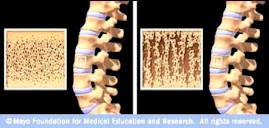
Source: www.mayoclinic.com