Human Skeleton

Human Skeleton

WELCOME TO STRONTIUM FOR BONES BLOG

Have you experienced negative, and even dangerous, side effects from Fosamax (alendronate), Boniva (ibandronate), Actonel (risedronate), Reclast (zoledronic acid), Prolia (denosumab), Forteo (teriparatide), Tymlos (abaloparatide), or other drugs prescribed for osteoporosis? If you have, then rest assured there is a safe, effective treatment for this condition. Strontium, primarily in the form of strontium citrate, is taken orally once a day.

Visitors to my blog can leave comments or ask questions and can remain anonymous, if they wish. Their comments are relayed to my g-mail inbox. Below each post, the number of comments for that post is cited and underlined because it is a link. By clicking on that link below any post, a window opens so that a visitor can leave a comment. Ideally, visitors leave comments on posts most relevant to their comments. All comments to my posts are moderated by me.

Browse the posts and visit the link library of references.


Blog Archive

Showing posts with label PTH. Show all posts

Saturday, September 12, 2015

Fracture Warnings for Invokana and Invokamet Diabetes Drugs


“The US Food and Drug Administration (FDA) has strengthened its warning for canagliflozin (Invokana, Invokamet, Johnson & Johnson/Janssen) related to the increased risk for bone fractures.”

“The …product label for canagliflozin had already mentioned the risk for bone fractures. Now, based on new confirmatory information from several clinical trials, the FDA has added further warning and precaution information. In the trials, the fractures affected the upper extremities, occurred as early as 12 weeks after starting the drug, and typically arose from minor trauma such as falling from a standing height.”

“The FDA has also added new information to the label about decreased bone mineral density at the hip and lower spine.”

“The FDA is also evaluating the possible risk for bone fractures for other drugs in the sodium glucose cotransporter 2 (SGLT2) inhibitor class, including dapagliflozin (Farxiga, Xigduo XR, AstraZeneca) and empagliflozin (Jardiance, Glyxambi, Synjardy, Lilly/Boehringer Ingelheim), to determine whether additional label changes or studies are needed. The label for Farxiga mentions a small number of cases of fractures in patients with renal impairment; the Jardiance prescribing information does not mention bone effects.”

“…SGLT2 inhibitors increase concentrations of phosphate in serum, probably via increased tubular reabsorption, which has the potential to adversely affect bone.”

“Furthermore…SGLT2 inhibitors increase concentrations of parathyroid hormone (PTH). Sustained increases in PTH concentration enhance bone resorption and increase the risk for bone fractures.”

"Although canagliflozin causes a small increase in mean PTH concentration (7.9%), the standard deviation is large. Thus, a substantial number of patients treated with canagliflozin might have a 50% or greater increase in PTH concentrations — a change that could be clinically significant…"

Simeon I. Taylor, MD, professor of medicine at University of Maryland School of Medicine in Baltimore, said, "Although not proven, I believe that increased risk of bone fracture is likely a class effect. Nevertheless, individual drugs differ with respect to selectivity for SGLT2 vs. SGLT1, and also with respect to where on the dose-response curve the approved dose falls. So, it is certainly possible that the magnitude of the risk could vary among individual SGLT2 inhibitors."


Friday, March 6, 2015

Too Much Vitamin D Can Be Bad for You


Context:
Optimal levels of vitamin D have been a topic of heavy debate, and the correlation between 25-hydroxyvitamin D [25(OH)D] levels and mortality still remains to be established.

Objective:
The aim of the study was to determine the association between all-cause mortality and serum levels of 25(OH)D, calcium, and PTH.

Design and Setting:
We conducted a retrospective, observational cohort study, the CopD Study, in a single laboratory center in Copenhagen, Denmark.

Participants:
Serum 25(OH)D was analyzed from 247,574 subjects from the Copenhagen general practice sector. In addition, serum levels of calcium, albumin-adjusted calcium, PTH, and creatinine were measured in 111,536; 20,512; 34,996; and 189,496 of the subjects, respectively.

Main Outcome Measures:
Multivariate Cox regression analysis was used to compute hazard ratios for all-cause mortality.

Results:
During follow-up (median, 3.07 yr), 15,198 (6.1%) subjects died. A reverse J-shaped association between serum level of 25(OH)D and mortality was observed. A serum 25(OH)D level of 50–60 nmol/liter was associated with the lowest mortality risk. Compared to 50 nmol/liter, the hazard ratios (95% confidence intervals) of all-cause mortality at very low (10 nmol/liter) and high (140 nmol/liter) serum levels of 25(OH)D were 2.13 (2.02–2.24) and 1.42 (1.31–1.53), respectively. Similarly, both high and low levels of albumin-adjusted serum calcium and serum PTH were associated with an increased mortality, and secondary hyperparathyroidism was associated with higher mortality (P < 0.0001).

Conclusion:
In this study from the general practice sector, a reverse J-shaped relation between the serum level of 25(OH)D and all-cause mortality was observed, indicating not only a lower limit but also an upper limit. The lowest mortality risk was at 50–60 nmol/liter. The study did not allow inference of causality, and further studies are needed to elucidate a possible causal relationship between 25(OH)D levels, especially higher levels, and mortality.

Note: 50-60 nmol/L equals 20-24 ng/ml. To convert nmol/L to ng/ml, divide by 2.5. To convert ng/ml to nmol/L, multiply by 2.5.  

The full article is available here:


Thursday, December 11, 2014

Three Quarters of Hip Fracture Patients are Vitamin D Deficient


New Delhi researchers show that vitamin D levels may be a useful index for the assessment of hip fracture risk in elderly people.

A study in New Delhi India has revealed high rates of vitamin D deficiency among hip fracture patients, confirming the conclusions of similar international studies which point to vitamin D deficiency as a risk factor for hip fracture.

A group of 90 hip fracture patients was compared to a matched control group of similar age, sex and co-morbidity. Of the patients who had suffered hip fractures, 76.7% were shown to be vitamin D deficient as measured by serum 25(OH)D levels of less than 20 ng/ml. In addition, 68.9% had elevated PTH levels. In comparison, only 32.3% of the controls had vitamin D deficiency and 42.2% had elevated PTH levels (secondary hyperparathyroidism).

Vitamin D deficiency has been linked to the pathogenesis of osteoporosis and is increasingly thought to play a role in muscle strength, certain cancers, multiple sclerosis and diabetes. Vitamin D levels are very low in the Indian population in all age groups, and could be explained by skin pigmentation, traditional clothing and the avoidance of sunlight.

The results of the New Delhi study confirm that serum 25 (OH)D levels may be a useful index for the assessment of risk of hip fracture in elderly people.

The study (OC13) was presented at the IOF Regionals – 1st Asia-Pacific Regional Osteoporosis Meeting being held in Singapore from December 10-13, 2010.
 
All abstracts from the meeting have been published in Osteoporosis International, Vol. 21, Suppl. 5, 2010.
http://www.iofbonehealth.org/news/indian-study-reveals-three-quarters-hip-fracture-patients-are-vitamin-d-deficient

Monday, February 28, 2011

Systematic Treatment After Successful Surgical Treatment for Primary Hyperparathyroidism With Strontium Ranelate

Patients with primary hyperparathyroidism (pHPT) with osteopenia or osteoporosis are treated with strontium ranelate/Ca+Vitamin-D or placebo/Ca+Vitamin D after successful surgical treatment of pHPT. This clinical trial is currently recruiting participants. ClinicalTrials.gov processed this record on February 27, 2011.

The chronic excessive hypersecretion of parathyroid hormone (PTH) has significant impact on bone remodeling. In primary hyperparathyroidism (pHPT) bone turnover is increased, resulting in a higher resorption of bone and thus loss of bone density.

After successful surgical treatment of pHPT, bone metabolism switches from catabolic state to anabolic state again. However, studies show that postmenopausal women in particular regain significantly less BMD and often suffer from osteopenia or osteoporosis. The hypothesis is that strontium ranelate/Ca + Vitamin-D helps to regain bone mass in patients with osteopenia or osteoporosis after successful parathyroidectomy for pHPT and results in higher gain of BMD than placebo-treated patients.

Eligibility Requirements: 18 Years and older, either gender, biochemically proven pHPT and PTX planned, osteopenia (t-score < -1 and > -2.5) or osteoporosis (t-score ≤ -2.5) according to WHO Criteria

Medical University Vienna, General Hospital Vienna, Vienna, Austria, 1090
Contact: Bruno Niederle, Prof., MD. at chir-endokrin@meduniwien.ac.at

Contact: Christian Scheuba, Prof., MD at christian.scheuba@meduniwien.ac.at

There is a long list of exclusion criteria and more information at:

http://www.clinicaltrials.gov/ct2/show/NCT01222026?term=strontium+AND+osteoporosis&rank=1

Wandering Skeleton

Wandering Skeleton
Artist: Joel Hoekstra

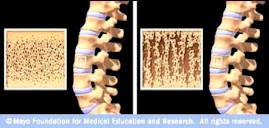
Osteoporotic Bone

Osteoporotic Bone
Source: www.mayoclinic.com

How Strontium Builds Bones

Strontium is a mineral that tends to accumulate in bone. Studies have shown that oral doses of strontium are a safe and effective way to prevent and reverse osteoporosis. Doses of 680 mg per day appear to be optimal. See my "For More Information About Strontium" links section.

Osteoporosis is caused by changes in bone production. In healthy young bones there is a constant cycle of new bone growth and bone removal. With age, more bone is removed and less new bone is produced. The bones become less dense and thus more fragile.

Scientists believe that strontium works in two ways. It may stimulate the replication of pre-osteoblasts, leading to an increase in osteoblasts (cells that build bone). Strontium also directly inhibits the activity of osteoclasts (cells that break down bone). The result is stronger bones.

When taking strontium, be sure to take 1200 mg calcium, 1000 IU vitamin D3, and 500 mg magnesium daily. It is best to take strontium late at night on an empty stomach. Calcium and strontium may compete with each other for absorption if taken together.