The report of my axial DXA scan taken on 8 January 2019 appears below. I have been on 2 grams strontium citrate/day for 11 years. I also take a calcium/magnesium tablet (500 mg Ca/250 mg Mg), a multivitamin with 1000 IU vitamin D3, and several other supplements. I get plenty of protein in my diet. I exercise daily.
As you can see, my DXA results were excellent, except for my left femoral neck, which showed no change from the previous scan.
I am happy with my results, although I know the comparison of this year's results to those of 2.5 years ago contains some built-in error because two different brands of DXA machines were used. My 2016 scan was on a Hologic and the 2019 scan was on a GE Lunar Prodigy.
Changing testing sites, and, therefore, machines, was not my choice. I had been getting my scans in the outpatient radiology department of a large hospital medical center, but the provider is now pushing patients into its freestanding imaging centers. I was told my insurance would not pay for a DXA unless it was done at a freestanding center, but my insurance denied that assertion.
The risk factor for secondary osteoporosis mentioned, but not specified, in the report is early menopause.
INDICATION: Postmenopausal. Follow-up of osteopenia on prior DXA.
Patient reports risk factors for secondary osteoporosis.
COMPARISON: 8/4/2016
FINDINGS:
Spine: Total BMD of the spine (L1-4) is 1.108 g/cm2, with a T-score of
-0.7 and a Z-score of 1.0.
Left Femoral Neck: BMD is 0.883 g/cm2, with a T-score of -1.1 and a
Z-score of 0.6.
Left Total Hip: BMD is 0.928 g/cm2, with a T-score of -0.6 and a Z-score
of 0.9.
Right Femoral Neck: BMD is 0.919 g/cm2, with a T-score of -0.9 and a
Z-score of 0.9.
Right Total Hip: BMD is 0.963 g/cm2, with a T-score of -0.4 and a Z-score
of 1.1.
Compared to the prior study, there has been 9% increase in spine density, 6% increase in left total hip density, but no change in left femoral neck density.
FRAX evaluation calculates 10-year probability of fracture:
Major Osteoporotic: 7.8%
Hip: 1.0%
IMPRESSION:
Based on BMD, diagnosis is consistent with osteopenia.
FOLLOWUP: In 2 years is recommended.
Human Skeleton

Friday, January 11, 2019


Saturday, December 22, 2018
Strontium Ranelate Returns to UK January 2019
The osteoporosis medication
strontium ranelate (SR) will once again be available in the UK from January
2019.
The drug was previously available under the brand Protelos but was pulled from the UK market in August 2017.
Servier, the manufacturer of the drug at the time, decided to cease supplying it to the UK due to loss of sales. Use of the drug in the UK had been limited by the health authorities due to safety concerns about cardiovascular risks. A continuous decline in the number of people being treated with it led to the company's decision.
Pharmaceutical company Aristo has now taken on the manufacturing of strontium ranelate, which will be available for prescription beginning January 2019, for the treatment of severe osteoporosis in postmenopausal women and adult men who are at high risk of fracture.
This is good news for UK patients who wish to take SR. It is also good news for those of us in the USA and Canada, where SR is not available, but strontium citrate (SC) is. Some people taking SC got scared when SR was pulled from the UK and the EU. I have continuously taken SC for 11 years. Below is a link to the package information for Aristo.
Package leaflet: Information for the
patient
Strontium ranelate Aristo 2 g
granules for oral suspension
Marketing Authorisation Holder
Aristo Pharma GmbH
Wallenroder Straße 8-10
13435 Berlin
Germany
Manufacturer
Lindopharm GmbH
Neustraße 82
40721 Hilden
Germany
Wednesday, September 26, 2018
Strontium Citrate Products
Although I have occasionally bought
my strontium at www.amazon.com, I usually buy
it at www.iherb.com, which ranks its brands
by popularity within categories. For example, if you search “strontium,” the eight
products listed below will appear. I buy one of the number-2-ranked products,
AOR, Strontium Support II, 120 veggie-caps. Buying the larger bottle is cheaper
than buying the number-5-ranked 60-capsule bottle of the same product. Buying
two or more bottles gives you quantity discounts at iHerb.
If you buy AOR products directly
from the manufacturer at www.aor.us, you can
use the code, aor25off,
for 25% off your entire order. This code will work until the end of 2018 and
can be used multiple times.
Nature's Life and AOR claim
to follow Good Manufacturing Practices (GMP). The GMP designation is very
important in assuring quality. Check with each manufacturer’s website for full
details.
Number
1 in Strontium
Life
Extension, Strontium Caps, Mineral for Bone Health, 750 mg, 90 vegetarian
capsules
750 mg strontium in three capsules, other ingredients: microcrystalline cellulose, vegetable stearate, silica, vegetable cellulose capsule
750 mg strontium in three capsules, other ingredients: microcrystalline cellulose, vegetable stearate, silica, vegetable cellulose capsule
Number
2 in Strontium (tied with Nature’s Life)
Advanced Orthomolecular Research AOR, Advanced Series, Strontium Support
II, 120 veggie-caps
682 mg strontium in two capsules, other ingredients: sodium stearyl fumarate, hypromellose capsule, Good Manufacturing Practices (GMP) manufacturing, independent testing, quality assured
Number 2 in strontium (tied with AOR, Strontium Support II,
120 veggie-caps)
Nature’s Life, Strontium, 680 mg, 60 tablets
680 mg strontium in two tablets, other ingredients: cellulose,
silica, stearic acid, GMP manufacturing, quality assurance procedures
Number 4 in strontium
Best
Naturals, Strontium, 680 mg, 90 capsules
680
mg strontium in two capsules, other ingredients: gelatin
(capsule), rice powder, vegetable magnesium stearate, meets GMP
Number 5 in strontium (tied with Nature’s Life, Strontium
Plus D-3, 60 tablets)
Advanced Orthomolecular Research AOR,
Advanced Series, Strontium Support II, 60 veggie-caps
682
mg strontium in two capsules, other ingredients: sodium stearyl fumarate, hypromellose
capsule, meets Good Manufacturing Practices (GMP) manufacturing, independent
testing, quality assured
Number
5 in strontium (tied with AOR Strontium Support II, 60 veggie-caps)
Nature’s
Life, Strontium Plus D-3, 60 tablets
680 mg strontium and
400 IU D3 in two tablets, other ingredients: cellulose, stearic acid, magnesium
stearate and silica, meets Quality Assurance Procedures and Good Manufacturing
Practices
Number
7 in strontium
EuroPharma, Terry Naturally, Strontium, 60
capsules
680
mg strontium in two capsules, other ingredients: hydroxypropyl methylcellulose
(vegetable cellulose capsules), cellulose powder, vegetable source magnesium
stearate
Number
8 in strontium and number 62 in multimineral formulas
Onnit, Stron
Bone, 90 capsules
Wednesday, May 9, 2018
Quantitative Ultrasound as Alternative to DXA
Because BMD measured by DXA is prone to
overestimation when one is taking strontium, I look at the CHANGE in my DXA
score (at each site) from one scan to the next, not the absolute value. So far
(10 years on strontium), each scan has been progressively better than the
previous scan.
Another option for someone on strontium is to have a
quantitative ultrasound (QUS) to
assess bone health. QUS is not affected
by strontium content in bone. Another positive is that the procedure uses ultrasound
waves, not radiation.
https://www.ncbi.nlm.nih.gov/pubmed/29080282
https://www.ncbi.nlm.nih.gov/pubmed/29080282
Friday, February 16, 2018
BMD Increases by Varying Amounts with Strontium Citrate and Decreases by Varying Amounts after Discontinuation
A study
published September 13, 2016, presents three case studies of patients who took
strontium citrate (680 mg strontium per day) for six years, five years, and
four years (Cases 1, 2, and 3, respectively) and then stopped taking it for two
years, one year, and one year (Cases 1, 2, and 3, respectively). The study
gives the increases in BMD with SrC and the decreases when the supplement was
discontinued. Of note is the fact that
both the increases and decreases vary with the site (lumbar spine or total hip),
the individual, and the number of years of use or discontinuation of SrC. Also,
keep in mind that stopping any of the osteoporosis drugs will also result in
loss of some of the BMD gains because there is no cure for osteoporosis.
Case 1
A 76-year-old
female with osteoporosis (OP) took alendronate weekly for 10 years till 2006,
then every other week for another year and was initiated on a drug holiday. She
started self-administrating SrC (680mg/day) in 2006 and continued to take daily
calcium (600mg bid) and vitamin D (2000units). Serum calcium and Vitamin D
(32-66ng/ml) remained normal. She continued SrC on her own till 2012, when she
agreed to stop taking it due to concerns about accumulation and toxicity.
On dual-energy X-ray absorptiometry (DXA) scan, total hip mean BMD increased 2.7% in
the first 2 years on SrC after stopping alendronate, and continued to increase
to a maximum of 9.2% after 6 years of treatment with SrC (1.53%/year). Lumbar
Spine (LS) BMD was non-diagnostic due to degenerative changes in the spine.
In the first 2 years off of SrC, total
hip mean BMD decreased by 5.7%.
Case 2
A 64-year-old
female with history of OP, which was diagnosed in 2001, took Actonel 35mg
weekly for 5 years, stopped for more than a year and resumed Actonel
intermittently for another 2 years before starting drug holiday. She was taking
Calcium 500 mg in the multivitamin and 2500 mg of vitamin D. Serum calcium and
vitamin D were within normal range. She started strontium citrate (680mg strontium)
daily in 2009 and took it for 5 years, stopping it in 2014.
Yearly
assessment of her BMD via DEXA scan showed an increase of 4.3% at LS spine
(L1-L4 vertebrae), and 7.6 % at total hip within 1 year of SrC treatment. At 5
years, BMD increase was 6.5 % at LS and 12% for mean total hip. She agreed to
stop SrC at this time.
One year after stopping SrC, LS BMD
decreased by 9.1 % and total hip BMD decreased by 4.2%.
Case 3
A 59-year-old female with OP was
treated with weekly alendronate for 4 years till 2007, when she stopped it due
to concerns for osteonecrosis of jaw. She was advised to resume alendronate in
2008 due to declining BMD, but opted not to take it.
She started self-administration of
680mg of SrC daily in February 2009 and continued it for four years till
January 2013, when she stopped it due to myalgias and concern about risk for
toxicity. Due to her history of ulcerative colitis, she was limited in dairy
intake, although she averaged half a cup of almond milk daily and took calcium
supplements. Serum calcium and vitamin D were within normal range.
BMD via DEXA scan showed an
increase of 10.7 % at LS (L1-L4) at 2 years after starting SrC, and 4.3 % at
total hip.
BMD
decreased by 14% at LS and by 6.4% at total hip a year after stopping SrC.
Mirza FS,
Azim S, Bhargava A (2016) Change in Bone Mineral Density with Strontium
Citrate: An Illusion or Reality. J Nutrition Health Food Sci 4(3): 1-3. DOI: http://dx.doi.org/10.15226/jnhfs.2016.00167
Subscribe to:
Posts (Atom)
Wandering Skeleton

Artist: Joel Hoekstra
Osteoporotic Bone
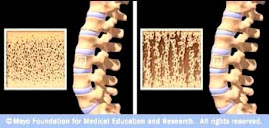
Source: www.mayoclinic.com