Human Skeleton

Human Skeleton

WELCOME TO STRONTIUM FOR BONES BLOG

Have you experienced negative, and even dangerous, side effects from Fosamax (alendronate), Boniva (ibandronate), Actonel (risedronate), Reclast (zoledronic acid), Prolia (denosumab), Forteo (teriparatide), Tymlos (abaloparatide), or other drugs prescribed for osteoporosis? If you have, then rest assured there is a safe, effective treatment for this condition. Strontium, primarily in the form of strontium citrate, is taken orally once a day.

Visitors to my blog can leave comments or ask questions and can remain anonymous, if they wish. Their comments are relayed to my g-mail inbox. Below each post, the number of comments for that post is cited and underlined because it is a link. By clicking on that link below any post, a window opens so that a visitor can leave a comment. Ideally, visitors leave comments on posts most relevant to their comments. All comments to my posts are moderated by me.

Browse the posts and visit the link library of references.


Blog Archive

Monday, December 15, 2014

Modifiable Risk Factors for Osteoporosis and Fractures


Most modifiable risk factors, which arise primarily because of unhealthy diet or lifestyle choices, directly impact bone biology and result in a decrease in bone mineral density (BMD). Some modifiable risk factors also increase the risk of fracture independently of their effect on bone itself.

The good news is everyone can take steps to reduce these risk factors for osteoporosis and related fractures.
Modifiable risk factors include:
Alcohol
People with excessive alcohol consumption (>2 units daily) have a 40% increased risk of sustaining any osteoporotic fracture, compared to people with moderate or no alcohol intake. High intakes of alcohol cause secondary osteoporosis due to direct adverse effects on bone-forming cells, on the hormone that regulates calcium metabolism and poor nutritional status (calcium, protein and vitamin D deficiency)1.
Smoking
People with a past history of cigarette smoking and people who smoke are at increased risk of any fracture, compared to non-smokers2.
Low Body Mass Index
Leanness (body mass index (BMI) less than 20 kg/m2) regardless of age, sex and weight loss, is associated with greater bone loss and increased risk of fracture. People with a BMI of 20kg/m2 have a two-fold increased risk of fracture compared to people with a BMI of 25 kg/m2
Poor nutrition
When insufficient calcium is absorbed from dietary sources, the body produces more parathyroid hormone, which boosts bone remodeling, mobilizing osteoclasts in the bone to break down and sacrifice bone calcium to supply the nerves and muscles with the mineral they need. There are indications that protein is also important in that it may act synergistically with vitamin D and calcium.
Vitamin D deficiency
Vitamin D is also essential, since it helps calcium absorption from the intestines into the blood. Vitamin D is made in our skin with exposure to the sun’s ultraviolet rays. In most people casual exposure to the sun for as little as 10-to-15 minutes a day is usually sufficient. However in elderly people, people who do not go outdoors, and during the winter months in northern latitudes, food or supplemental sources of vitamin D is of importance. At least 800 international units of vitamin D and 1,000 to 1,200 mg of calcium daily can protect against osteoporosis3.
Eating disorders
Osteoporosis can also be compounded by eating disorders such as anorexia nervosa and bulimia.
Estrogen deficiency
Estrogen deficiency in women afflicted by these disorders speeds up bone loss in a similar way to that which occurs in post-menopausal women, but to make matters worse, these diseases reduce the robust build up of bone mineral density that usually occurs in adolescence and early adulthood. This may be related to both hormone imbalance and nutritional factors.
Insufficient exercise
People with a more sedentary lifestyle are more likely to have a hip fracture than those who are more active. For example, women who sit for more than nine hours a day are 50% more likely to have a hip fracture than those who sit for less than six hours a day. Read more about the role of exercise in bone health.
Frequent falls
Visual impairments, loss of balance, neuromuscular dysfunction, dementia, immobilization, and use of sleeping pills which are quite common conditions in elderly persons, significantly increase the risk of falling and accordingly increase the risk of fracture. Ninety percent of hip fractures result from falls4.

References
  1.  Kanis JA, Johnell O, Odén A, Johansson H, De Laet C, Eisman JA, Fujiwara S, Kroger H, McCloskey, Mellstrom D, Melton LJ III, Pols H, Reeve J, Silman A, Tenehouse A. Smoking and fracture risk: a meta-analysis. Osteoporosis Int. 2005;16:155-62
  2. Kanis JA. Johansso H, Johnell O, Odén A, De Laet C, Eisman J, Pols H, Tenenhouse A. Alcohol intake as a risk factor for fracture. Osteoporosis Int 2005;16:737-42
  3. Dawson-Hughes B, Heaney RP, Holick MF, et al. (2005) Estimates of optimal vitamin D status. Osteoporos Int 16:713-716
  4. Woolf AD, Akesson K. Preventing fractures in elderly people. BMJ 2003; 327:89-95

Friday, December 12, 2014

FRAX Accurately Identifies Women at Risk for Vertebral Fracture


By Will Boggs MD
December 01, 2014
  

NEW YORK (Reuters Health) - The WHO fracture risk assessment tool FRAX is better than lumbar spine and femoral neck T-scores at identifying women with vertebral fractures, researchers from Morocco report.

"An elevated FRAX score may be used as a screening tool to indicate bone mineral density (BMD) measurement and vertebral fracture assessment (VFA) at the same time," Dr. Abdellah El Maghraoui from Military Hospital Mohammed in Rabat, Morocco, told Reuters Health. "The cut-off of what is an elevated FRAX has to be determined in different populations."

"Vertebral fractures (VFs) are the most common type of osteoporotic fractures in older adults," Dr. Maghraoui explained. "It has been shown that VFs are usually asymptomatic (only one-fourth to one-third of these fractures come to medical attention). The identification of asymptomatic VFs is of primordial importance especially in patients without densitometric osteoporosis, a common situation where all experts agree to recommend treatment."

Dr. Maghraoui's team developed a Moroccan model based on FRAX and evaluated the performance of FRAX scores in comparison with BMD measurement in identifying women with prevalent asymptomatic vertebral fractures.

Their cross-sectional study included 908 menopausal women aged 50 years and older. Of these women, nearly a third had osteoporosis and 44% had osteopenia.

Vertebral fractures were present in 382 (42.1%) of women, the researchers report in BMC Musculoskeletal Disorders, online November 4.

FRAX without BMD provided the best method of predicting vertebral fracture in these women, and there was no improvement when BMD was added to the model.

A FRAX cutoff of 3%, for example, yielded 57% sensitivity, 78% specificity, 40% positive predictive value, and 2.68 positive likelihood ratio for predicting major fractures.

"The FRAX tool is not designed to examine the risk of asymptomatic vertebral fractions," the researchers say. "However, we performed this analysis because of the importance of this kind of fracture in the outcome of osteoporosis."

"A woman with elevated FRAX should be evaluated further: DXA with VFA, biological exams including vitamin D, iPTH, etc., and in some cases bone turnover markers," Dr. Maghraoui said. "Other factors not included in FRAX should be evaluated such as the risk of fall."

"VFA can easily be performed at the same time of bone mineral density (BMD) measurement, allowing integration of BMD and VF information in the clinical care of patients evaluated for osteoporosis," Dr. Maghraoui concluded. "Advantages of VFA compared with spine radiographs include greater patient convenience (VFA can be done in association with BMD testing by DXA), smaller dose of ionizing radiation, and lower cost."
http://www.medscape.com/viewarticle/835572?src=wnl_edit_tpal&uac=127701PY


For the abstract of this article, see http://strontiumforbones.blogspot.com/2014/12/frax-identifies-women-with-prevalent.html
For the original article, follow either of these two links:

http://bit.ly/1yMo74D
http://www.biomedcentral.com/1471-2474/15/365


Thursday, December 11, 2014

Three Quarters of Hip Fracture Patients are Vitamin D Deficient


New Delhi researchers show that vitamin D levels may be a useful index for the assessment of hip fracture risk in elderly people.

A study in New Delhi India has revealed high rates of vitamin D deficiency among hip fracture patients, confirming the conclusions of similar international studies which point to vitamin D deficiency as a risk factor for hip fracture.

A group of 90 hip fracture patients was compared to a matched control group of similar age, sex and co-morbidity. Of the patients who had suffered hip fractures, 76.7% were shown to be vitamin D deficient as measured by serum 25(OH)D levels of less than 20 ng/ml. In addition, 68.9% had elevated PTH levels. In comparison, only 32.3% of the controls had vitamin D deficiency and 42.2% had elevated PTH levels (secondary hyperparathyroidism).

Vitamin D deficiency has been linked to the pathogenesis of osteoporosis and is increasingly thought to play a role in muscle strength, certain cancers, multiple sclerosis and diabetes. Vitamin D levels are very low in the Indian population in all age groups, and could be explained by skin pigmentation, traditional clothing and the avoidance of sunlight.

The results of the New Delhi study confirm that serum 25 (OH)D levels may be a useful index for the assessment of risk of hip fracture in elderly people.

The study (OC13) was presented at the IOF Regionals – 1st Asia-Pacific Regional Osteoporosis Meeting being held in Singapore from December 10-13, 2010.
 
All abstracts from the meeting have been published in Osteoporosis International, Vol. 21, Suppl. 5, 2010.
http://www.iofbonehealth.org/news/indian-study-reveals-three-quarters-hip-fracture-patients-are-vitamin-d-deficient

Wandering Skeleton

Wandering Skeleton
Artist: Joel Hoekstra

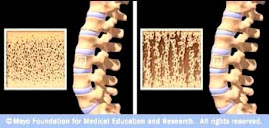
Osteoporotic Bone

Osteoporotic Bone
Source: www.mayoclinic.com

How Strontium Builds Bones

Strontium is a mineral that tends to accumulate in bone. Studies have shown that oral doses of strontium are a safe and effective way to prevent and reverse osteoporosis. Doses of 680 mg per day appear to be optimal. See my "For More Information About Strontium" links section.

Osteoporosis is caused by changes in bone production. In healthy young bones there is a constant cycle of new bone growth and bone removal. With age, more bone is removed and less new bone is produced. The bones become less dense and thus more fragile.

Scientists believe that strontium works in two ways. It may stimulate the replication of pre-osteoblasts, leading to an increase in osteoblasts (cells that build bone). Strontium also directly inhibits the activity of osteoclasts (cells that break down bone). The result is stronger bones.

When taking strontium, be sure to take 1200 mg calcium, 1000 IU vitamin D3, and 500 mg magnesium daily. It is best to take strontium late at night on an empty stomach. Calcium and strontium may compete with each other for absorption if taken together.