Human Skeleton

Human Skeleton

WELCOME TO STRONTIUM FOR BONES BLOG

Have you experienced negative, and even dangerous, side effects from Fosamax (alendronate), Boniva (ibandronate), Actonel (risedronate), Reclast (zoledronic acid), Prolia (denosumab), Forteo (teriparatide), Tymlos (abaloparatide), or other drugs prescribed for osteoporosis? If you have, then rest assured there is a safe, effective treatment for this condition. Strontium, primarily in the form of strontium citrate, is taken orally once a day.

Visitors to my blog can leave comments or ask questions and can remain anonymous, if they wish. Their comments are relayed to my g-mail inbox. Below each post, the number of comments for that post is cited and underlined because it is a link. By clicking on that link below any post, a window opens so that a visitor can leave a comment. Ideally, visitors leave comments on posts most relevant to their comments. All comments to my posts are moderated by me.

Browse the posts and visit the link library of references.


Blog Archive

Showing posts with label strontium BMD artefact. Show all posts

Tuesday, April 24, 2012

Interpretation of BMD Scans in Patients Stopping Strontium Ranelate Treatment

“The oral administration of strontium ranelate causes a clinically significant overestimation of BMD because of the high attenuation of X-rays by strontium atoms in bone." GM Blake and I. Fogelman “performed a theoretical study to calculate the long-term effect of strontium treatment on BMD and establish the duration of past treatment for which the remaining bone strontium content (BSC) has a negligible effect on BMD.” “Estimates of the strontium BMD artefact after treatment has stopped were performed on the assumption that the BSC effect accounts for 75% of the total measured BMD change at 3 years.” “If 75% of the BMD changes are explained by BSC, in the average patient, 3-year treatment leads to a spine BMD artefact of 11.2%, decreasing to 3.8% 10 years after stopping treatment. The BMD artefacts at the total hip and femoral neck sites are smaller by factors of 0.65 and 0.53, respectively.” “On average, 6-month treatment is required for the spine BMD artefact to exceed 3%, the figure adopted as the maximum BMD change caused by bone strontium that has a negligible effect on scan interpretation.” The researchers concluded that “strontium ranelate treatment lasting for > 6 months can affect BMD measurements for many years afterward.” http://www.ncbi.nlm.nih.gov/pubmed/16939400 J Bone Miner Res. 2006 Sep;21(9):1417-24.

Wandering Skeleton

Wandering Skeleton
Artist: Joel Hoekstra

Osteoporotic Bone
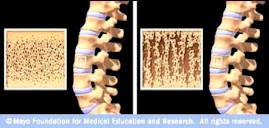
Osteoporotic Bone
Source: www.mayoclinic.com

How Strontium Builds Bones

Strontium is a mineral that tends to accumulate in bone. Studies have shown that oral doses of strontium are a safe and effective way to prevent and reverse osteoporosis. Doses of 680 mg per day appear to be optimal. See my "For More Information About Strontium" links section.

Osteoporosis is caused by changes in bone production. In healthy young bones there is a constant cycle of new bone growth and bone removal. With age, more bone is removed and less new bone is produced. The bones become less dense and thus more fragile.

Scientists believe that strontium works in two ways. It may stimulate the replication of pre-osteoblasts, leading to an increase in osteoblasts (cells that build bone). Strontium also directly inhibits the activity of osteoclasts (cells that break down bone). The result is stronger bones.

When taking strontium, be sure to take 1200 mg calcium, 1000 IU vitamin D3, and 500 mg magnesium daily. It is best to take strontium late at night on an empty stomach. Calcium and strontium may compete with each other for absorption if taken together.