Human Skeleton

Tuesday, April 24, 2012
Interpretation of BMD Scans in Patients Stopping Strontium Ranelate Treatment
“The oral administration of strontium ranelate causes a clinically significant overestimation of BMD because of the high attenuation of X-rays by strontium atoms in bone." GM Blake and I. Fogelman “performed a theoretical study to calculate the long-term effect of strontium treatment on BMD and establish the duration of past treatment for which the remaining bone strontium content (BSC) has a negligible effect on BMD.” “Estimates of the strontium BMD artefact after treatment has stopped were performed on the assumption that the BSC effect accounts for 75% of the total measured BMD change at 3 years.”
“If 75% of the BMD changes are explained by BSC, in the average patient, 3-year treatment leads to a spine BMD artefact of 11.2%, decreasing to 3.8% 10 years after stopping treatment. The BMD artefacts at the total hip and femoral neck sites are smaller by factors of 0.65 and 0.53, respectively.” “On average, 6-month treatment is required for the spine BMD artefact to exceed 3%, the figure adopted as the maximum BMD change caused by bone strontium that has a negligible effect on scan interpretation.”
The researchers concluded that “strontium ranelate treatment lasting for > 6 months can affect BMD measurements for many years afterward.”
http://www.ncbi.nlm.nih.gov/pubmed/16939400
J Bone Miner Res. 2006 Sep;21(9):1417-24.


Thursday, April 5, 2012
Minimum Effective Doses of Strontium
The aim of the PREVOS study
(PREVention Of early postmenopausal bone loss by Strontium ranelate) and the
STRATOS study (STRontium Administration for Treatment of OSteoporosis) was to
determine the minimum dose at which strontium ranelate (SR) is effective in,
respectively, the prevention of bone loss in early postmenopausal
nonosteoporotic women and the treatment of postmenopausal vertebral
osteoporosis.
The minimum dose at which SR is
effective in preventing bone loss in early postmenopausal nonosteoporotic women
and in the treatment of postmenopausal osteoporosis is 1 g/day and 2 g/day,
respectively.
Strontium ranelate phase 2 dose-ranging
studies: PREVOS and STRATOS studies, J. Y. Reginster and P. J.
Meunier, Osteoporosis
International, Volume
14, Supplement 3, 56-65, DOI:
10.1007/s00198-002-1349-0
The chemical structure of strontium ranelate is
composed of two atoms of stable strontium combined with organic ranelic acid.
Strontium is the bone active component and makes up 34% by weight of the whole
molecule, so each 2 g dose of strontium ranelate delivers 680 mg of elemental
strontium.
Friday, March 2, 2012
Update On My Calcium And Magnesium Intake
For many years, I have been taking one tablet per day of KAL
Calcium Magnesium Extra Strength, which contains 500 mg calcium (as calcium
carbonate and calcium amino acid chelate), 250 mg magnesium (as magnesium oxide
and magnesium amino acid chelate), 15 mg sodium, and 50 mg betaine HCl. I was buying it at my local health food
store, but I found a replacement that I think is even better and will be
ordering it soon from www.iherb.com, an
online distributor I've been getting my strontium and a couple of other
supplements from.
The new product is Country Life, Gluten Free, Calcium
Magnesium Complex 1000 mg/500 mg in two tablets, 360 tablets, $20.23. The
calcium is in the form of calcium hydroxyapatite, citrate, aspartate,
alpha-ketoglutarate, and lysinate. The magnesium is in the form of magnesium
oxide, citrate, taurinate, alpha-ketoglutarate, and aspartate. Each tablet
contains 500 mg calcium, 250 mg magnesium, and 250 mg phosphorus (as calcium
hydroxyapatite).
In addition to a calcium/magnesium supplement, I take a
multivitamin, Nature Made Multi For Her 50+, which I buy online at www.walgreen.com when the company has one of
their frequent “buy one, get one free” offers. This multivitamin contains 200 mg
calcium, 100 mg magnesium, 1000 IU vitamin D3, 80 mcg vitamin K, and many other
key nutrients.
For breakfast, I have 12 oz fat-free milk, which gives me 450
mg calcium. At lunch, I take the 500 mg calcium/250 mg magnesium supplement.
With supper, I take my multivitamin for 200 mg calcium and 100 mg magnesium. That
comes to 1150 mg calcium, without counting other food sources. The RDA for
women 50+ is 1200 mg calcium per day. I may cut back to 8 oz milk (300 mg calcium) on days when
I know I’ll be having something calcium rich for supper.
Thursday, February 9, 2012
Combination of Micronutrients for Bone (COMB) Study
After 12 months of consecutive supplemental micronutrient therapy,repeat bone densitometry was performed. The results were analyzed in a group of compliant patients and demonstrate improved BMD in patients classified with normal, osteopenic and osteoporotic bone density.
Combination of Micronutrients (COMB) Protocol for Bone Health
1. Docosahexanoic acid or DHA (from Purified Fish Oil): 250 mg/day
2. Vitamin D3: 2000 IU/day
3. Vitamin K2 (non-synthetic MK7 form): 100 ug/day
4. Strontium citrate: 680 mg/day
5. Elemental magnesium: 25 mg/day
6. Dietary sources of calcium recommended
7. Daily impact exercising encouraged
After one year of therapy with the COMB protocol compared to published results for strontium ranelate and bisphosphonate medications, the percent changes in bone mineral density (z values) were as follows:
Femoral neck: 4% increase for the group on the COMB protocol vs. 2% for strontium ranelate, alendronate, and risedronate
Total hip: 3% increase for the COMB protocol vs. 3-4% for strontium ranelate, 2% for alendronate, and not calculated for risedronate
Total spine: 6% increase for COMB protocol vs. 5-6% for strontium ranelate, 4% for both alendronate and risedronate
This combined micronutrient supplementation regimen appears to be at least as effective as bisphosphonates or strontium ranelate in raising BMD levels in hip, spine, and femoral neck sites. No fractures occurred in the group taking the micronutrient protocol. This micronutrient regimen also appears to show efficacy in individuals for whom bisphosphonate therapy was previously unsuccessful in maintaining or raising BMD. Prospective clinical trials are required to confirm efficacy.
This study by Stephen J. Genuis and Thomas P. Bouchard was published in the Journal of Environmental and Public Health, Volume 2012 (2012), Article ID 354151,doi:10.1155/2012/354151 COMB Protocol
Combination of Micronutrients (COMB) Protocol for Bone Health
1. Docosahexanoic acid or DHA (from Purified Fish Oil): 250 mg/day
2. Vitamin D3: 2000 IU/day
3. Vitamin K2 (non-synthetic MK7 form): 100 ug/day
4. Strontium citrate: 680 mg/day
5. Elemental magnesium: 25 mg/day
6. Dietary sources of calcium recommended
7. Daily impact exercising encouraged
After one year of therapy with the COMB protocol compared to published results for strontium ranelate and bisphosphonate medications, the percent changes in bone mineral density (z values) were as follows:
Femoral neck: 4% increase for the group on the COMB protocol vs. 2% for strontium ranelate, alendronate, and risedronate
Total hip: 3% increase for the COMB protocol vs. 3-4% for strontium ranelate, 2% for alendronate, and not calculated for risedronate
Total spine: 6% increase for COMB protocol vs. 5-6% for strontium ranelate, 4% for both alendronate and risedronate
This combined micronutrient supplementation regimen appears to be at least as effective as bisphosphonates or strontium ranelate in raising BMD levels in hip, spine, and femoral neck sites. No fractures occurred in the group taking the micronutrient protocol. This micronutrient regimen also appears to show efficacy in individuals for whom bisphosphonate therapy was previously unsuccessful in maintaining or raising BMD. Prospective clinical trials are required to confirm efficacy.
This study by Stephen J. Genuis and Thomas P. Bouchard was published in the Journal of Environmental and Public Health, Volume 2012 (2012), Article ID 354151,doi:10.1155/2012/354151 COMB Protocol
Friday, January 6, 2012
Spinal BMD And Scoliosis
On June 15, 2006, Ioannis P. Pappou, MD et al published a retrospective study entitled “Discordantly High Spinal Bone Mineral Density Values in Patients With Adult Lumbar Scoliosis.” The purposes of this study were: 1) to investigate the validity of bone mineral density measurements with DEXA in patients with adult lumbar scoliosis and 2) to investigate the association between osteoporosis and adult lumbar scoliosis.
The study concluded the following:
Cobb’s angle measurements on DEXA scans are reliable and comparable to conventional radiographs.
Spinal BMD values are less valuable for monitoring osteoporosis than hip values in scoliotic patients; an increasing discrepancy with age was noted. Scoliotic patients exhibited discordantly high spinal BMD values, despite significant hip osteoporosis. The discrepancy correlated with aging and curve magnitude.
Scoliosis was common among the osteoporotic population (9.47%). Lumbar scoliosis is a useful clinical marker for osteoporosis, irrespective of scoliosis history and magnitude.
Viable alternatives for osteoporosis evaluation of adult patients with lumbar scoliosis are hip DEXA values, in conjunction with other BMD measurements.
http://journals.lww.com/spinejournal/Abstract/2006/06150/Discordantly_High_Spinal_Bone_Mineral_Density.19.aspx
Friday, December 23, 2011
Effects of Strontium Ranelate on Spinal Osteoarthritis Progression
In “Effects of strontium ranelate on spinal osteoarthritis progression,” published in Ann Rheum Dis 2008;67:335-339, O Bruyere et al aimed to determine whether a three-year treatment with strontium ranelate could delay the progression of spinal osteoarthritis (OA).
This study was a post-hoc analysis of pooled data from the Spinal Osteoporosis Therapeutic Intervention (SOTI) and TReatment Of Peripheral OSteoporosis (TROPOS) trials performed on 1,105 women with osteoporosis and concomitant radiological spinal OA at baseline, and for whom lumbar x-rays were available at baseline and over the three-year treatment period. The presence and severity of osteophytes, disc space narrowing and sclerosis in the lumbar intervertebral spaces was graded, and an overall OA score was calculated for each intervertebral space. Back pain (measured on a five-point Likert scale only in SOTI) and health-related quality of life (SF-36 questionnaire) were assessed at baseline and after three years. Patients who suffered an incident or progressive vertebral fracture during the study were excluded from the analysis.
The proportion of patients with worsening overall spinal OA score was reduced by 42% in the strontium ranelate group, compared with placebo. Significantly more patients in the strontium ranelate group experienced an improvement in back pain after three years, compared with placebo, while no significant difference was observed in terms of health-related quality of life between these patient groups.
The researchers concluded that strontium ranelate could reduce the progression of the radiographic features of spinal osteoarthritis (OA) and back pain in women with osteoporosis and prevalent spinal OA. http://ard.bmj.com/content/67/3/335.abstract.
Subscribe to:
Posts (Atom)
Wandering Skeleton

Artist: Joel Hoekstra
Osteoporotic Bone
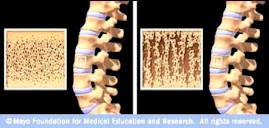
Source: www.mayoclinic.com