Human Skeleton

Human Skeleton

WELCOME TO STRONTIUM FOR BONES BLOG

Have you experienced negative, and even dangerous, side effects from Fosamax (alendronate), Boniva (ibandronate), Actonel (risedronate), Reclast (zoledronic acid), Prolia (denosumab), Forteo (teriparatide), Tymlos (abaloparatide), or other drugs prescribed for osteoporosis? If you have, then rest assured there is a safe, effective treatment for this condition. Strontium, primarily in the form of strontium citrate, is taken orally once a day.

Visitors to my blog can leave comments or ask questions and can remain anonymous, if they wish. Their comments are relayed to my g-mail inbox. Below each post, the number of comments for that post is cited and underlined because it is a link. By clicking on that link below any post, a window opens so that a visitor can leave a comment. Ideally, visitors leave comments on posts most relevant to their comments. All comments to my posts are moderated by me.

Browse the posts and visit the link library of references.


Blog Archive

Showing posts with label menopause. Show all posts

Thursday, December 11, 2014

FRAX Identifies Women with Prevalent Asymptomatic Vertebral Fractures


Abstract

Background
A Moroccan model for the FRAX tool to determine the absolute risk of osteoporotic fracture at 10 years has been established recently. The study aimed to assess the discriminative capacity of FRAX in identifying women with prevalent asymptomatic vertebral fractures (VFs).

Methods
We enrolled in this cross-sectional study 908 post-menopausal women with a mean age of 60.9 years ±7.7 (50 to 91) with no prior known diagnosis of osteoporosis. Subjects were recruited from asymptomatic women selected from the general population. Lateral VFA (vertebral fracture assessment) images and scans of the lumbar spine and proximal femur were obtained using a GE Healthcare Lunar Prodigy densitometer. VFs were defined using a combination of Genantsemiquantitative (SQ) approach and morphometry. We calculated the absolute risk of major fracture and hip fracture with and without bone mineral density (BMD)using the FRAX website.The overall discriminative value of the different risk scores was assessed by calculating the areas under the ROC curve (AUC).

Results
VFA images showed that 179 of the participants (19.7%) had at least one grade 2/3 VF. The group of women with VFs had a statistically significant higher FRAX scores for major and hip fractures with and without BMD, and lower weight, height, and lumbar spine and hip BMD and T-scores than those without a VFA-identified VF. The AUC ROC of FRAX for major fracture without BMD was 0.757 (CI 95%; 0.718-0.797) and 0.736 (CI 95%; 0.695-0.777) with BMD, being 0.756 (CI 95%; 0.716-0.796) and 0.747 (CI 95%; 0.709-0.785), respectively for FRAX hip fracture without and with BMD. The AUC ROC of lumbar spine T-score and femoral neck T-score were 0.660 (CI 95%; 0.611-0.708) and 0.707 (CI 95%; 0.664-0.751) respectively.

Conclusion
In asymptomatic post-menopausal women, the FRAX risk for major fracture without BMD had a better discriminative capacity in identifying the women with prevalent VFs than lumbar spine and femoral neck T-scores suggesting its usefulness in identifying women in whom VFA could be indicated. 

To read the full research article by Abdellah El Maghraoui, Siham Sadni, Nabil Jbili, Asmaa Rezqi, Aziza Mounach and Imad Ghozlani click on this link:

 http://www.biomedcentral.com/1471-2474/15/365


Tuesday, May 20, 2014

Non-modifiable Risk Factors for Osteoporosis


What you cannot change!
These are risk factors that one is born with or cannot alter. (Question 7
could arguably be placed under lifestyle risk factors that can be changed.)
Nevertheless, it is important to be aware of risk factors you cannot
change so that steps can be taken to reduce loss of bone mineral.


1. Have either of your parents been diagnosed with
osteoporosis or broken a bone after a minor fall (a fall
from standing height or less)?

2.Did either of your parents have a stooped back
(dowager’s hump)?

3.Are you 40 years old or older?

4.Have you ever broken a bone after a minor fall, as an
adult?

5.Do you fall frequently (more than once in the last year)
or do you have a fear of falling because you are frail?

6.After the age of 40, have you lost more than 3 cm in
height (just over 1 inch)?

7.Are you underweight (is your Body Mass Index less than
19 kg/m2)?

Body mass index (BMI) is a measure based on height and
weight that applies to both adult men and women.
BMI Categories:
Underweight = below 18.5
Normal weight = 18.5 – 24.9
Overweight = 25 – 29.9
Obesity = 30 or greater
Imperial BMI Formula
Metric BMI Formula

BMI = weight in pounds X 703/height in inches2

BMI = weight in kilograms/height in meters2


8.Have you ever taken corticosteroid tablets (cortisone,
prednisone, etc.) for more than 3 consecutive months
(corticosteroids are often prescribed for conditions like
asthma, rheumatoid arthritis, and some inflammatory
diseases)?

9.Have you ever been diagnosed with rheumatoid arthritis?

10.Have you been diagnosed with an over-active thyroid, over-
active parathyroid glands, type 1 diabetes or a nutritional/
gastrointestinal disorder such as Crohn’s or celiac disease?

For Women:

11.For women over 45: Did your menopause occur before
the age of 45?

12.Have your periods ever stopped for 12 consecutive
months or more (other than because of pregnancy,
menopause or hysterectomy)?

13.Were your ovaries removed before age 50, without you
taking Hormone Replacement Therapy?

For Men:

14.Have you ever suffered from impotence, lack of libido or
other symptoms related to low testosterone levels?


 Note: See next blog post: Lifestyle Risk Factors. 


Friday, September 13, 2013

Protein Believed to Cause Postmenopausal Osteoporosis

Researchers have identified a protein that likely causes osteoporosis in women after menopause. In experiments on mice, the research team from Tokyo’s Keio University School of Medicine and other institutions found that a decrease in the secretion of estrogen enhances the function of HIF1 alpha protein. Once the amount of estrogen secreted by the ovaries begins to decline around the time of menopause, HIF1 alpha protein in osteoclasts increases.

Normal mice after menopause showed decreased femoral bone density compared with premenopausal levels, but mice whose genes were manipulated so as not to produce the HIF1 alpha protein did not show a decline of femoral bone density even after menopause. Moreover, a substance to inhibit the function of the HIF1 alpha protein that was given to postmenopausal mice led to an increase of bone density compared with premenopausal levels. The discovery is expected to lead to the development of an effective medicine to prevent osteoporosis.

The study is to be published in the online edition of the Proceedings of the U.S. National Academy of Science.


Wandering Skeleton

Wandering Skeleton
Artist: Joel Hoekstra

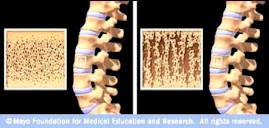
Osteoporotic Bone

Osteoporotic Bone
Source: www.mayoclinic.com

How Strontium Builds Bones

Strontium is a mineral that tends to accumulate in bone. Studies have shown that oral doses of strontium are a safe and effective way to prevent and reverse osteoporosis. Doses of 680 mg per day appear to be optimal. See my "For More Information About Strontium" links section.

Osteoporosis is caused by changes in bone production. In healthy young bones there is a constant cycle of new bone growth and bone removal. With age, more bone is removed and less new bone is produced. The bones become less dense and thus more fragile.

Scientists believe that strontium works in two ways. It may stimulate the replication of pre-osteoblasts, leading to an increase in osteoblasts (cells that build bone). Strontium also directly inhibits the activity of osteoclasts (cells that break down bone). The result is stronger bones.

When taking strontium, be sure to take 1200 mg calcium, 1000 IU vitamin D3, and 500 mg magnesium daily. It is best to take strontium late at night on an empty stomach. Calcium and strontium may compete with each other for absorption if taken together.