Human Skeleton

Human Skeleton

WELCOME TO STRONTIUM FOR BONES BLOG

Have you experienced negative, and even dangerous, side effects from Fosamax (alendronate), Boniva (ibandronate), Actonel (risedronate), Reclast (zoledronic acid), Prolia (denosumab), Forteo (teriparatide), Tymlos (abaloparatide), or other drugs prescribed for osteoporosis? If you have, then rest assured there is a safe, effective treatment for this condition. Strontium, primarily in the form of strontium citrate, is taken orally once a day.

Visitors to my blog can leave comments or ask questions and can remain anonymous, if they wish. Their comments are relayed to my g-mail inbox. Below each post, the number of comments for that post is cited and underlined because it is a link. By clicking on that link below any post, a window opens so that a visitor can leave a comment. Ideally, visitors leave comments on posts most relevant to their comments. All comments to my posts are moderated by me.

Browse the posts and visit the link library of references.


Blog Archive

Tuesday, June 17, 2014

When to Stop Taking Strontium


When to stop taking strontium after having taken it successfully for a number of years is a good question. Once you reach normal bone mineral density (BMD), it makes sense to stop taking strontium and just monitor your BMD. If your BMD readings are at the osteopenia stage, defined as a T-score between -1.0 and -2.5, the decision becomes more complicated. As I see it, the choice, at that point, is either to reduce the dosage or continue with the full dose until normal BMD is reached. I would definitely not stop taking it altogether after reaching a BMD in the osteopenia range.

I have been taking 680 mg strontium from strontium citrate for osteoporosis for six and a half years. My lowest T-scores have always been at the spine. Last year (2013), my T-score at the spine from L1-L4 was -1.6, which is in the range of osteopenia. I have continued taking the same dosage since then. I may wait another year until my next DXA before deciding on any change.


One person I know from an osteoporosis forum says she had osteoporosis and achieved normal BMD after 4.5 years on strontium citrate (lucky lady!). She says she took 680 mg strontium for 3.5 years and then 340 mg for the final year. She then stopped taking strontium but had yearly DXA scans. Two years later, her BMD is still at the normal range. Don’t be discouraged if your results aren’t quite as spectacular; mine aren’t compared to hers. What is really encouraging to me is that she has retained most of her gains in BMD after two years!


http://www.inspire.com/groups/national-osteoporosis-foundation/discussion/strontium-citrate-25/?ref=as&asat=172752721 (Charella’s update after two years off strontium is nestled within a discussion started by another forum member.)

http://www.inspire.com/groups/national-osteoporosis-foundation/discussion/success-with-strontium-continues-to-be-great/ (Charella’s update after more than one year off strontium citrate is featured in a discussion she initiated.)


Thursday, June 5, 2014

Secondary Causes of Osteoporosis


Secondary causes of bone loss are not often considered in patients who are diagnosed as having osteoporosis. In some studies, 20% to 30% of postmenopausal women and more than 50% of men with osteoporosis have a secondary cause. Before starting a course of treatment for osteoporosis, whether with over-the-counter strontium citrate or with a prescription drug, secondary causes of bone loss should be ruled out. In secondary osteoporosis, treatment should include treating the underlying cause of the disease. This short article by the International Osteoporosis Foundation (IOF) lists most of the causes of secondary osteoporosis. The causes are broken down into four categories: medical conditions, hormonal, other links, and medications or chemicals.


Wednesday, May 28, 2014

Is Bone Loss Due to Weight Loss Regained?


Short-term weight loss is accompanied by bone loss in postmenopausal women. The longer-term impact of weight loss on bone in reduced overweight/obese women compared with women who regained their weight was examined in this study using a case-control design. Forty-two postmenopausal women were recruited two years after the start of a six-month weight loss trial. The 22 women who maintained their weight (weight loss maintainer [WL-M] group) were matched to a cohort of 20 women who regained their weight (weight loss regainer [WL-R] group).

Bone mineral density (BMD) at the femoral neck, trochanter, spine, radius, and total body, and soft-tissue composition were taken at baseline, 0.5 years, and two years. After two years, both groups lost BMD at the femoral neck and trochanter , whereas only the WL-M group reduced BMD at the 1/3 radius. There was greater BMD loss at the trochanter and 1/3 radius in the WL-M group compared with the WL-R group after two years.

The study concluded that, after two years, there is no recovery of bone loss induced by weight reduction, irrespective of weight regain. Weight regain does not result in recovery of bone, but it prevents greater loss at the trochanter and 1/3 radius compared with reduced-obese women. These data suggest that the period after weight loss may be an important point in time to prevent bone loss for those who maintain weight and those who regain weight.

This information is taken from a much longer article, Does Bone Loss Begin After Weight Loss Ends?


Tuesday, May 20, 2014

Lifestyle Risk Factors for Osteoporosis


What you can change!
These are modifiable risk factors which primarily arise because of
diet or lifestyle choices.

15.Do you regularly drink alcohol in excess of safe drinking
limits (more than 2 units a day)?

A unit of alcohol is equivalent to 10 ml (or approximately
8 grams) of pure ethanol, the active chemical ingredient
in alcoholic beverages. Excessive alcohol consumption
increases the risk of osteoporosis and fractures.

One unit of beer or cider (4% alcohol) is 250 ml/8.75 oz.
One unit of wine (12.5% alcohol) is 80 ml/2.80 oz.
One unit of spirits (40% alcohol) is 25 ml/0.88 oz.

16.Do you currently, or have you ever, smoked cigarettes?

17.Is your daily level of physical activity less than 30
minutes per day (housework, gardening, walking,
running etc.)?

18. Do you avoid, or are you allergic to milk or dairy
products, without taking any calcium supplements?

19.Do you spend less than 10 minutes per day outdoors
(with part of your body exposed to sunlight), without
taking vitamin D supplements?

Note: See previous blog post: Non-modifiable Risk Factors 
for Osteoporosis

Understanding Your Answers:

If you answered “yes” to any of these questions (1 -19) it does not
mean that you have osteoporosis. Positive answers simply
mean that you have clinically-proven risk factors which may
lead to osteoporosis and fractures.

Please show this risk test to your doctor who may encourage
you to take a FRAX® risk assessment (available at
www.shef.ac.uk/FRAX/) and/or have a bone mineral density
(BMD) test. In addition your doctor will advise on what
treatment, if any, is recommended.


Wandering Skeleton

Wandering Skeleton
Artist: Joel Hoekstra

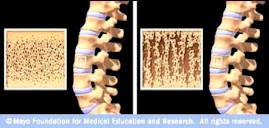
Osteoporotic Bone

Osteoporotic Bone
Source: www.mayoclinic.com

How Strontium Builds Bones

Strontium is a mineral that tends to accumulate in bone. Studies have shown that oral doses of strontium are a safe and effective way to prevent and reverse osteoporosis. Doses of 680 mg per day appear to be optimal. See my "For More Information About Strontium" links section.

Osteoporosis is caused by changes in bone production. In healthy young bones there is a constant cycle of new bone growth and bone removal. With age, more bone is removed and less new bone is produced. The bones become less dense and thus more fragile.

Scientists believe that strontium works in two ways. It may stimulate the replication of pre-osteoblasts, leading to an increase in osteoblasts (cells that build bone). Strontium also directly inhibits the activity of osteoclasts (cells that break down bone). The result is stronger bones.

When taking strontium, be sure to take 1200 mg calcium, 1000 IU vitamin D3, and 500 mg magnesium daily. It is best to take strontium late at night on an empty stomach. Calcium and strontium may compete with each other for absorption if taken together.