Human Skeleton

Human Skeleton

WELCOME TO STRONTIUM FOR BONES BLOG

Have you experienced negative, and even dangerous, side effects from Fosamax (alendronate), Boniva (ibandronate), Actonel (risedronate), Reclast (zoledronic acid), Prolia (denosumab), Forteo (teriparatide), Tymlos (abaloparatide), or other drugs prescribed for osteoporosis? If you have, then rest assured there is a safe, effective treatment for this condition. Strontium, primarily in the form of strontium citrate, is taken orally once a day.

Visitors to my blog can leave comments or ask questions and can remain anonymous, if they wish. Their comments are relayed to my g-mail inbox. Below each post, the number of comments for that post is cited and underlined because it is a link. By clicking on that link below any post, a window opens so that a visitor can leave a comment. Ideally, visitors leave comments on posts most relevant to their comments. All comments to my posts are moderated by me.

Browse the posts and visit the link library of references.


Blog Archive

Friday, November 23, 2012

Hip Fracture Risk and Antihypertensive Drugs

Are you taking strontium citrate or one of the osteoporosis medications to increase your BMD and decrease your bone fracture risk? Here is something else to consider if you are at least 66 years of age. 
 
Initiating antihypertensive drugs in the elderly has been associated with an immediate increased risk of falls. The most likely mechanism is orthostatic hypotension, which is associated with dizziness and fainting. The effect is acute, occurs over a relatively short time, and may lead to falls, some of which can result in hip fractures.

The following study was undertaken to determine whether initiation of antihypertensive drugs (e.g., thiazide diuretics, angiotensin II converting–enzyme inhibitors, angiotensin II receptor blockers, calcium channel blockers, or β-adrenergic blockers) was associated with an immediate increased risk of hip fractures. Health care administrative databases were used to identify patients initiating an antihypertensive drug in Ontario, Canada. Elderly  people who began receiving an antihypertensive drug had a 43% increased risk of having a hip fracture during the first 45 days following treatment initiation.


Tuesday, November 20, 2012

Facebook

This blog www.strontiumforbones.com has a link on facebook. You can post questions or comments on my blog or on my facebook page at http://www.facebook.com/?sk=welcome#!/pages/Strontium-for-Osteoporosis/462179087156676. I hope to hear from you soon! You have to sign in to use facebook, but it is free and simple.

Tuesday, October 9, 2012

Case Study on Strontium Citrate for Osteoporosis with Fragility Fractures


Sara S. DeHart, MSN, Ph.D., is an 80-year-old woman who was diagnosed with osteopenia at age 63. She was treated initially with Fosamax 10 mg. daily and Estraderm patches twice weekly.  She discontinued the patches after about two years, and Fosamax after about three years. Following a fragility fracture of the sacrum, she was prescribed Actonel 5 mg five times a week. Her vitamin D blood level was found to be very low, although she had supplemented with 400 IU vitamin D3 throughout her adult life.
She followed “standards of care” medical recommendations until she developed a second fragility fracture at T9 while taking Actonel.  At that point, she stopped using Actonel and began taking strontium citrate. She increased her vitamin D3 supplementation. Today, she is 80 years old and her BMD is normal. More importantly, she has not fractured, even after a recent fall onto an asphalt driveway! Follow this link to read her amazing story:


Sunday, August 19, 2012

Methods for Assessing Bone Quality


Bone mass, geometry, and tissue material properties contribute to bone structural integrity. Thus, bone strength arises from both bone quantity and quality. Bone quality encompasses the geometric and material factors that contribute to fracture resistance. Although no single method can completely characterize bone quality, current noninvasive imaging techniques can be combined with ex vivo mechanical and compositional techniques to provide a comprehensive understanding of bone quality.


Methods for assessing mechanical properties include whole-bone, bulk tissue, microbeam, and micro- and nanoindentation testing techniques. Outcomes include structural strength and material modulus. Advantages include direct assessment of bone strength; disadvantages include specimen destruction during testing.


 Methods for characterizing bone geometry and microarchitecture include quantitative CT, high-resolution peripheral quantitative CT, high-resolution MRI, and micro-CT. Outcomes include three-dimensional whole-bone geometry, trabecular morphology, and tissue mineral density. The primary advantage is the ability to image noninvasively; disadvantages include the lack of a direct measure of bone strength.


 Methods for measuring tissue composition include scanning electron microscopy, vibrational spectroscopy, nuclear magnetic resonance imaging, and chemical and physical analytical techniques. Outcomes include mineral density and crystallinity, elemental composition, and collagen crosslink composition. Advantages include the detailed material characterization; disadvantages include the need for a biopsy.


Clinical Orthopaedics and Related Research, Volume 469, Number 8 (2011), 2128-2138.

Tuesday, August 14, 2012

Is Strontium Ranelate Safe?


“Clinical trials are designed to assess efficacy, not safety and so post marketing data is needed to evaluate safety. Jakob et al report the results of an observational cohort study to assess safety and treatment persistence with SR during 3 years follow-up in 12,702 postmenopausal women from 7 countries (29). Mean age was 69.0 years with 16.5% of patients being over 80 years. Mean follow-up duration was 32 months and mean treatment duration was 25.2 months (24,956 patient-years of treatment). VTE was reported in 55 patients, an incidence of 2.1/1000 patient-years (95% CI 1.6, 2.8), lower than that observed in patients treated with SR in the phase III studies (7.9/1000 patient-years; 95% CI 6.3, 9.7). No DRESS syndrome or Stevens-Johnson syndrome was reported. Persistence of SR treatment was 80%, 68% and 64% after 12, 24 and 32 months treatment, respectively.”

29. Jakob FJ, Palacios S, Audran M, et al. Final results of a 3 years prospective observational cohort study of patients treated with strontium ranelate. Osteoporos Int 2012;23(Suppl 2):S73.


Thursday, July 5, 2012

Vitamins B6 and B12 and Folic Acid

Readers of my blog know that I advocate taking strontium citrate along with a combination of vitamins, minerals, and other supplements for bone health. Most people understand that calcium, magnesium, and vitamin D are essential for strong bones. Some people are adding vitamin K1 and/or vitamin K2 (MK4 or MK7) to their supplement lists. But did you know that you may also need vitamins B6 and B12 and folic acid?

“Some studies suggest high blood levels of the amino acid homocysteine may be linked to lower bone density and higher risk of hip fracture in the elderly. Vitamins B6 and B12, as well as folic acid, play a role in changing homocysteine into other amino acids for use by the body; so, it is possible that they might play a protective role in osteoporosis. Research is ongoing as to whether supplementation with these B vitamins might reduce fracture risk.” This paragraph is quoted from:
http://www.iofbonehealth.org/nutrition

The studies referred to are:

1. McLean RR, Jacques PF, Selhub J, et al. (2004) Homocysteine as a predictive factor for hip fracture in older persons. N Engl J Med 350:2042-49
2. Morris MS, Jacques PF, Selhub J (2005) Relation between homocysteine and B-vitamin status indicators and bone mineral density in older Americans. Bone 37:234-42

I take Nature's Bounty Sublingual Vitamin B12, 5000 mcg (5 mg) per microlozenge. I was using it three times per week, but I have recently increased my intake to the recommended dosage of one microlozenge daily. You dissolve these under your tongue for maximum absorption.

My multivitamin, Nature Made Multi For Her 50+, contains 6 mg of vitamin B6,25 mcg of vitamin B12, and 400 mcg of folic acid.

Wandering Skeleton

Wandering Skeleton
Artist: Joel Hoekstra

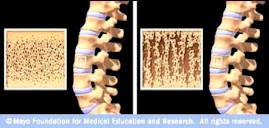
Osteoporotic Bone

Osteoporotic Bone
Source: www.mayoclinic.com

How Strontium Builds Bones

Strontium is a mineral that tends to accumulate in bone. Studies have shown that oral doses of strontium are a safe and effective way to prevent and reverse osteoporosis. Doses of 680 mg per day appear to be optimal. See my "For More Information About Strontium" links section.

Osteoporosis is caused by changes in bone production. In healthy young bones there is a constant cycle of new bone growth and bone removal. With age, more bone is removed and less new bone is produced. The bones become less dense and thus more fragile.

Scientists believe that strontium works in two ways. It may stimulate the replication of pre-osteoblasts, leading to an increase in osteoblasts (cells that build bone). Strontium also directly inhibits the activity of osteoclasts (cells that break down bone). The result is stronger bones.

When taking strontium, be sure to take 1200 mg calcium, 1000 IU vitamin D3, and 500 mg magnesium daily. It is best to take strontium late at night on an empty stomach. Calcium and strontium may compete with each other for absorption if taken together.