Most of my posts are about my own experience with strontium citrate and about research on the various strontium salts. This post is about Sara S. DeHart's strontium success story, which she wrote about herself in two articles, the most recent one published online just a few days ago. In 2006, she was taking Actonel and developed a fracture at T-9. Later, that same year, she switched to strontium citrate (750 mg strontium/day) and has had no further vertebral fractures. Here are her T-scores from 2006 to the present:
Left Hip Lumbar Spine
2006 -1.2 -1.4
2008 -0.6 -0.2
2010 -0.5 +0.2
Here is the original article: http://onlinejournal.com/artman/publish/printer_6185.shtml
Human Skeleton

Showing posts with label strontium salts. Show all posts
Showing posts with label strontium salts. Show all posts
Tuesday, August 10, 2010


Monday, March 22, 2010
Strontium And Calcium
For patients taking any strontium salt (e.g., strontium ranelate, strontium citrate) for osteoporosis, it is recommended that you obtain an adequate calcium intake as part of a well balanced diet. If you have difficulties obtaining adequate calcium from your diet, a calcium supplement may also be required. (All patients participating in the strontium ranelate research trials had an adequate calcium intake.) Take your calcium supplement or calcium-rich food at least two hours before or two hours after you have taken the strontium because calcium will prevent the absorption of strontium.
There is an upper limit to the amount of calcium that can be taken safely. It is recommended that you do not exceed 2000 - 2500 mg of calcium per day included in your food, drink and supplements. Consistently exceeding the upper limit may increase your risk of medical problems, including a high level of calcium in the blood (milk alkali syndrome), and may interfere with the absorption of other minerals such as iron. If you have a history of kidney stones, consuming a diet rich in calcium will not increase your risk of further stone formation. Most renal doctors do not restrict calcium intake for their patients these days.
Splitting your calcium intake into 500-mg doses is advisable, as the gut would not be able to absorb 1000 mg all at once. To maximize the absorption of your calcium tablet, take it at meal times with or after food. If you take iron tablets for other health reasons, avoid taking calcium at the same time by staggering the tablets throughout the day. This will ensure that both minerals are fully absorbed.
This information is from the National Osteoporosis Society, located in the United Kingdom, where strontium ranelate (Protelos) is an approved prescription drug for the treatment of postmenopausal osteoporosis. To obtain NOS publications and Information Sheets, go to www.nos.org.uk.
There is an upper limit to the amount of calcium that can be taken safely. It is recommended that you do not exceed 2000 - 2500 mg of calcium per day included in your food, drink and supplements. Consistently exceeding the upper limit may increase your risk of medical problems, including a high level of calcium in the blood (milk alkali syndrome), and may interfere with the absorption of other minerals such as iron. If you have a history of kidney stones, consuming a diet rich in calcium will not increase your risk of further stone formation. Most renal doctors do not restrict calcium intake for their patients these days.
Splitting your calcium intake into 500-mg doses is advisable, as the gut would not be able to absorb 1000 mg all at once. To maximize the absorption of your calcium tablet, take it at meal times with or after food. If you take iron tablets for other health reasons, avoid taking calcium at the same time by staggering the tablets throughout the day. This will ensure that both minerals are fully absorbed.
This information is from the National Osteoporosis Society, located in the United Kingdom, where strontium ranelate (Protelos) is an approved prescription drug for the treatment of postmenopausal osteoporosis. To obtain NOS publications and Information Sheets, go to www.nos.org.uk.
Thursday, May 28, 2009
Update On Strontium Malonate For Osteoporosis
Osteologix, Inc. has received a key U.S. Patent Allowance for its osteoporosis drug, NB S101 (strontium malonate). This brings the company closer to its goal of manufacturing and marketing a prescription strontium drug in the U.S.
The Notice of Allowance from the U.S. Patent and Trademark Office is for U.S. Patent Application Number 11/269,289 titled "Water-Soluble Strontium Salts for Use in Treatment of Cartilage and/or Bone Conditions." It allows claims covering the treatment of osteoporosis and related bone conditions using NB S101 (strontium malonate). The patent will most likely issue in the second half of 2009 and expire in 2024.
The company has a number of other pending patent applications covering various aspects of the NB S101 drug program, including composition, manufacturing and method of use patent applications. "Based on the Notice of Allowance and the claims allowed by the USPTO, we believe the intellectual property protections established by this US patent allowance, coupled with our recently upheld European equivalent, will significantly enhance our ability to finalize strong development collaborations with potential partners to complete the Phase III development of NB S101 in osteoporosis," stated Philip J. Young, President and Chief Executive Officer of Osteologix. This is from the company's website at http://www.osteologix.com/.
The Notice of Allowance from the U.S. Patent and Trademark Office is for U.S. Patent Application Number 11/269,289 titled "Water-Soluble Strontium Salts for Use in Treatment of Cartilage and/or Bone Conditions." It allows claims covering the treatment of osteoporosis and related bone conditions using NB S101 (strontium malonate). The patent will most likely issue in the second half of 2009 and expire in 2024.
The company has a number of other pending patent applications covering various aspects of the NB S101 drug program, including composition, manufacturing and method of use patent applications. "Based on the Notice of Allowance and the claims allowed by the USPTO, we believe the intellectual property protections established by this US patent allowance, coupled with our recently upheld European equivalent, will significantly enhance our ability to finalize strong development collaborations with potential partners to complete the Phase III development of NB S101 in osteoporosis," stated Philip J. Young, President and Chief Executive Officer of Osteologix. This is from the company's website at http://www.osteologix.com/.
Subscribe to:
Posts (Atom)
Wandering Skeleton

Artist: Joel Hoekstra
Osteoporotic Bone
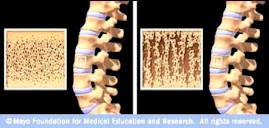
Source: www.mayoclinic.com