The optimal level of calcium intake to compensate for skeletal calcium losses and to prevent osteoporosis and fractures remains unclear. This is reflected by the wide range of daily calcium recommendations for individuals older than 50 years: at present 700 mg in the UK, 800 mg in Scandinavia, 1200 mg in the United States, and 1300 mg in Australia and New Zealand.
The findings of a large Swedish study recently published in the British Medical Journal show an association between a low habitual dietary calcium intake (below 751 mg per day for women) and an increased risk of fractures and of osteoporosis. Above this base level, only minor differences in risk were observed. The highest reported calcium intake (>1137 mg) did not further reduce the risk of fractures of any type, or of osteoporosis, but was associated with a higher rate of hip fracture.
Eva Warensjö, et al. BMJ. 2011; 342: d1473.
Published online 2011 May 24. doi: 10.1136/bmj.d1473.
http://www.ncbi.nlm.nih.gov/pmc/articles/PMC3101331/
Human Skeleton

WELCOME TO STRONTIUM FOR BONES BLOG
Have you experienced negative, and even dangerous, side effects from Fosamax (alendronate), Boniva (ibandronate), Actonel (risedronate), Reclast (zoledronic acid), Prolia (denosumab), Forteo (teriparatide), Tymlos (abaloparatide), or other drugs prescribed for osteoporosis? If you have, then rest assured there is a safe, effective treatment for this condition. Strontium, primarily in the form of strontium citrate, is taken orally once a day.
Visitors to my blog can leave comments or ask questions and can remain anonymous, if they wish. Their comments are relayed to my g-mail inbox. Below each post, the number of comments for that post is cited and underlined because it is a link. By clicking on that link below any post, a window opens so that a visitor can leave a comment. Ideally, visitors leave comments on posts most relevant to their comments. All comments to my posts are moderated by me.
Browse the posts and visit the link library of references.
Visitors to my blog can leave comments or ask questions and can remain anonymous, if they wish. Their comments are relayed to my g-mail inbox. Below each post, the number of comments for that post is cited and underlined because it is a link. By clicking on that link below any post, a window opens so that a visitor can leave a comment. Ideally, visitors leave comments on posts most relevant to their comments. All comments to my posts are moderated by me.
Browse the posts and visit the link library of references.
Thursday, June 23, 2011


Subscribe to:
Post Comments (Atom)
Wandering Skeleton
Artist: Joel Hoekstra
Osteoporotic Bone
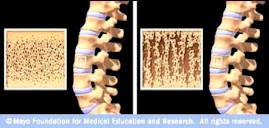
Source: www.mayoclinic.com
How Strontium Builds Bones
Strontium is a mineral that tends to accumulate in bone. Studies have shown that oral doses of strontium are a safe and effective way to prevent and reverse osteoporosis. Doses of 680 mg per day appear to be optimal. See my "For More Information About Strontium" links section.
Osteoporosis is caused by changes in bone production. In healthy young bones there is a constant cycle of new bone growth and bone removal. With age, more bone is removed and less new bone is produced. The bones become less dense and thus more fragile.
Scientists believe that strontium works in two ways. It may stimulate the replication of pre-osteoblasts, leading to an increase in osteoblasts (cells that build bone). Strontium also directly inhibits the activity of osteoclasts (cells that break down bone). The result is stronger bones.
When taking strontium, be sure to take 1200 mg calcium, 1000 IU vitamin D3, and 500 mg magnesium daily. It is best to take strontium late at night on an empty stomach. Calcium and strontium may compete with each other for absorption if taken together.
Osteoporosis is caused by changes in bone production. In healthy young bones there is a constant cycle of new bone growth and bone removal. With age, more bone is removed and less new bone is produced. The bones become less dense and thus more fragile.
Scientists believe that strontium works in two ways. It may stimulate the replication of pre-osteoblasts, leading to an increase in osteoblasts (cells that build bone). Strontium also directly inhibits the activity of osteoclasts (cells that break down bone). The result is stronger bones.
When taking strontium, be sure to take 1200 mg calcium, 1000 IU vitamin D3, and 500 mg magnesium daily. It is best to take strontium late at night on an empty stomach. Calcium and strontium may compete with each other for absorption if taken together.
For More Information about Strontium
- A Dose-response Study With Strontium Malonate
- A Review of the latest insights into the mechanism of action of strontium in bone
- Antifracture Efficacy Over 10 Years With Strontium Ranelate
- Combination of Micronutrients for Bone (COMB) Study: Bone Density after Micronutrient Intervention
- Echolight REMS Scan of Young, Normal Female
- Effect of bone strontium on BMD measurements
- Effect of Lumbar Scoliosis on DXA Results
- Effects of SrR on Calcium Metabolism
- Effects of strontium ions on growth and dissolution of hydroxyapatite and on bone mineral detection
- Influence of strontium on bone mineral density and bone mineral content measurements by dual X-ray absorptiometry
- Interpretation of BMD Scans in Patients Stopping Strontium
- Melatonin-micronutrients Osteopenia Treatment Study (MOTS)
- National Osteoporosis Foundation
- Osteoporosis And Bone Physiology
- Post-Marketing Assessment of the Safety of Strontium Ranelate
- PubMed Abstract On The SOTI Study
- PubMed Abstract On The TROPOS Study
- Strontium ranelate Aristo
- Strontium Ranelate For Spinal Osteoarthritis
- Strontium: Breakthrough Against Osteoporosis
- Summary Safety Review - Strontium
- The Effects of Strontium Ranelate on the Risk of Vertebral Fracture in Women with Postmenopausal Osteoporosis
- The Influence of Strontium on Bone Tissue Metabolism and Its Application in Osteoporosis Treatment
- Thirteen Key Diagnostic Tests
6 comments:
I am new to this blog, I hope I am posting this properly.
And I am new to all of this. I have read many positive things about Strontium and I bought a bottle and took it yesterday. Then I read: Vivian Goldschmidt, MA , on her web site Save Our Bones states: “Strontium in all its forms, as studies reveal, contributes to bone thickening rather than to the quality of bone mineral. In other words, the outer cortical bone becomes thicker – reducing tensile strength – and therefore, it can be logically implied that bones with a thicker outer cortex are more prone to breakage or fracture.” http://saveourbones.com/vivian-answers-day-7/.
This is confusing. Is she off base? I appreciate your answer.
BeteB,
The Save Our Bones website is a commercial one for selling Vivian Goldschmidt’s books. Her statement about strontium takes a partial truth (“the outer cortical bone becomes thicker”), ignores the fact that strontium also affects trabecular bone, and reaches the erroneous conclusion that somehow increased cortical thickness reduces tensile strength.
Here are the facts based on analysis of transiliac bone biopsy samples from phase 2 and 3 clinical trials of strontium ranelate: Strontium improves the microarchitecture of both trabecular and cortical bone. At the trabecular level, strontium significantly increases trabecular number by 14% and decreases trabecular separation by 16%, shifting trabeculae from rod-like structures to plate-like patterns. At the cortical level, strontium enlarges cortical bone dimensions by increasing cortical thickness by 18%. The change in 3D trabecular and cortical microarchitecture may improve bone biomechanical competence and explain the decreased fracture rate after strontium use.
Bone Lady is right. The TROPOS and SOTI numbers are the bottom line. Strontium works.
As to thickening the outer cortex to strenthen a bone...the state of Californa put steel jackets around bridge supports and that "stiffening" kept those supports from collaspsing in subsequent earthquakes.
http://www.exploratorium.edu/faultline/damage/retro.html
Besides, there are credible reports attesting to the high quality of bone formation in patients on strontium.
http://www.ncbi.nlm.nih.gov/pubmed/21276882
http://www.ncbi.nlm.nih.gov/pmc/articles/PMC2908746/
http://onlinelibrary.wiley.com/doi/10.1359/jbmr.091028/abstract;jsessionid=1A8FA809406F34CD14190BBA198F8E59.d02t02
Mom of three,
Thank you for your comments about strontium and the scholarly links. I love your analogy comparing taking strontium to increase cortical thickness and strengthen bone with putting steel jackets around bridge supports to strengthen those supports. However, the reduced fracture risk associated with strontium appears to result from changes to both cortical and trabecular bone. Expanding on your analogy, I would say that taking strontium is like putting steel jackets around bridge supports and repairing the bridge itself.
Do you have a specific article or reference to taking strontium WITHOUT taking ANY supplemental calcium and the risks of what it does to bone structure?
Thank you,
happynana
happynana,
Anyone taking strontium should have an adequate daily intake of calcium from food or supplements or a combination of the two. In other words, if an individual can get all her calcium from food, she does not need to supplement. However, most people probably will need some calcium supplementation. So, let me rephrase your question. “Do you have a specific reference to taking strontium without adequate calcium and the risks to bone structure?”
The risks of inadequate intake of calcium and vitamin D are reduced calcium absorption, increased serum parathyroid hormone concentrations, and bone loss. Low bone mass is a strong predictor of fracture.
There is a rationale for supplementing the diets of elderly subjects with a combination of calcium and vitamin D. Absorption of calcium and possibly of vitamin D and production of vitamin D by the skin decline with aging. Diets that are deficient in calcium tend also to be deficient in vitamin D because a single food, milk, is the principal dietary source of both these nutrients.
http://www.nejm.org/doi/full/10.1056/NEJM199709043371003#t=article
There is no clinical study of strontium with inadequate calcium and vitamin D because such a study would violate the ethical medical standard of doing no harm to patients.
Before inclusion in the TROPOS study of strontium ranelate, patients were subjected to a run-in study to initiate normalization of their calcium and vitamin D status. The duration of this run-in study was 2 wk to 6 months, depending on the severity of calcium and 25-OH vitamin D (25-OH D) deficiency. All enrolled women received daily supplements of up to 1000 mg of elemental calcium adapted to their needs according to their dietary intake (0, 500, or 1000 mg to reach a total daily intake above 1000 mg), and vitamin D according to their serum 25-OH D levels (800 IU for patients having serum 25-OH D lower than 45 nmol/liter and 400 IU for all the others). For patients with severe vitamin D deficiency (25-OH D lower than 30 nmol/liter) the duration of the run-in period was at least 3 months.
https://academic.oup.com/jcem/article-lookup/doi/10.1210/jc.2004-1774
Post a Comment