"Certain drugs (e.g., glucocorticoids, carbamazepine, phenytoin, valproic acid, lithium, depot medroxyprogesterone, chemotherapeutic agents, and long-term heparin therapy) are known to be associated with increases in bone loss or fracture rate. Thiazolidinediones are the newest addition to this list, as recent clinical trials have reported increased fracture rates in patients receiving these drugs for the treatment of type 2 diabetes mellitus."
"Pioglitazone and rosiglitazone, the two currently available thiazolidinediones, accounted for nearly one quarter of the antidiabetic drugs prescribed in the United States in 2004 and 2005. In 2008, both pioglitazone (8th) and rosiglitazone (98th) ranked within the top 100 prescription drug sales in the United States. This widespread use has exposed many postapproval adverse effects, including bone changes and fractures."
The entire article can be read at:
http://www.medscape.com/viewarticle/725156
Bone Loss and Fracture Risk Associated with Thiazolidinedione Therapy
Daniel M. Riche, Pharm.D.; S. Travis King, Pharm.D.
Posted: 10/05/2010; Pharmacotherapy
Human Skeleton

Thursday, April 21, 2011


Monday, February 28, 2011
Systematic Treatment After Successful Surgical Treatment for Primary Hyperparathyroidism With Strontium Ranelate
Patients with primary hyperparathyroidism (pHPT) with osteopenia or osteoporosis are treated with strontium ranelate/Ca+Vitamin-D or placebo/Ca+Vitamin D after successful surgical treatment of pHPT. This clinical trial is currently recruiting participants. ClinicalTrials.gov processed this record on February 27, 2011.
The chronic excessive hypersecretion of parathyroid hormone (PTH) has significant impact on bone remodeling. In primary hyperparathyroidism (pHPT) bone turnover is increased, resulting in a higher resorption of bone and thus loss of bone density.
After successful surgical treatment of pHPT, bone metabolism switches from catabolic state to anabolic state again. However, studies show that postmenopausal women in particular regain significantly less BMD and often suffer from osteopenia or osteoporosis. The hypothesis is that strontium ranelate/Ca + Vitamin-D helps to regain bone mass in patients with osteopenia or osteoporosis after successful parathyroidectomy for pHPT and results in higher gain of BMD than placebo-treated patients.
Eligibility Requirements: 18 Years and older, either gender, biochemically proven pHPT and PTX planned, osteopenia (t-score < -1 and > -2.5) or osteoporosis (t-score ≤ -2.5) according to WHO Criteria
Medical University Vienna, General Hospital Vienna, Vienna, Austria, 1090
Contact: Bruno Niederle, Prof., MD. at chir-endokrin@meduniwien.ac.at
Contact: Christian Scheuba, Prof., MD at christian.scheuba@meduniwien.ac.at
There is a long list of exclusion criteria and more information at:
http://www.clinicaltrials.gov/ct2/show/NCT01222026?term=strontium+AND+osteoporosis&rank=1
The chronic excessive hypersecretion of parathyroid hormone (PTH) has significant impact on bone remodeling. In primary hyperparathyroidism (pHPT) bone turnover is increased, resulting in a higher resorption of bone and thus loss of bone density.
After successful surgical treatment of pHPT, bone metabolism switches from catabolic state to anabolic state again. However, studies show that postmenopausal women in particular regain significantly less BMD and often suffer from osteopenia or osteoporosis. The hypothesis is that strontium ranelate/Ca + Vitamin-D helps to regain bone mass in patients with osteopenia or osteoporosis after successful parathyroidectomy for pHPT and results in higher gain of BMD than placebo-treated patients.
Eligibility Requirements: 18 Years and older, either gender, biochemically proven pHPT and PTX planned, osteopenia (t-score < -1 and > -2.5) or osteoporosis (t-score ≤ -2.5) according to WHO Criteria
Medical University Vienna, General Hospital Vienna, Vienna, Austria, 1090
Contact: Bruno Niederle, Prof., MD. at chir-endokrin@meduniwien.ac.at
Contact: Christian Scheuba, Prof., MD at christian.scheuba@meduniwien.ac.at
There is a long list of exclusion criteria and more information at:
http://www.clinicaltrials.gov/ct2/show/NCT01222026?term=strontium+AND+osteoporosis&rank=1
Friday, November 5, 2010
Strontium Citrate Clinical Trial Results By Year End
Data from the three-month strontium citrate clinical trial known as the Scope Study are currently (as of November 4, 2010) being evaluated at the UC Davis Medical Center. Some results should be available by the end of the year. Stay tuned for the latest word from the Scope Team.
Thursday, September 23, 2010
Strontium Ranelate Available In Mexico As Protos
I had been asked if strontium ranelate is available in Mexico. I knew the drug was available in different countries (not the U.S.) under various brand names. A spokesperson from Servier International just replied to my question: "Is Protelos available in Mexico? If it is available, what brand name is it sold under?" Here is the reply:
"Thank you for your interest for strontium ranelate/Protelos. In response to your question below, please be advised that strontium ranelate is available in Mexico under the brand name of Protos, however, please note that strontium ranelate has not been submitted to the FDA and, thus, is not approved for use in the USA."
Sincerely, M. Rebuffe-Scrive
Servier International
"Thank you for your interest for strontium ranelate/Protelos. In response to your question below, please be advised that strontium ranelate is available in Mexico under the brand name of Protos, however, please note that strontium ranelate has not been submitted to the FDA and, thus, is not approved for use in the USA."
Sincerely, M. Rebuffe-Scrive
Servier International
Saturday, September 18, 2010
The Osteoporosis Patient With Renal Insufficiency
A German paper by G. Lehmann, G. Hein, and G. Wolf addresses the osteoporosis patient with renal insufficiency and what has to be taken into account in the selection and administration of medications for osteoporosis. Because the incidence of osteoporosis and renal insufficiency increases with age, the use of antiosteoporotic drugs approved for long-term administration in patients with inadequate renal function is a cause for concern. In the dose approved for the treatment of osteoporosis, oral bisphosphonates and i.v. ibandronate (3 mg every 12 weeks) are considered safe in patients with glomerular filtration rate (GFR) > 30 ml/min. Treatment with strontium ranelate and the osteoanabolic substance teriparatide is not altered by impaired renal function until GFR falls below 30 ml/min. Efficiency of the selective estrogen receptor modulator (SERM) raloxifene is not altered by renal function.
http://www.ncbi.nlm.nih.gov/pubmed/16924452
http://www.ncbi.nlm.nih.gov/pubmed/16924452
Saturday, August 21, 2010
Picking a Bone With Contemporary Osteoporosis Management
I recently came across an abstract of a research article critical of contemporary osteoporosis management and recommending strontium, calcium, vitamins D and K, and essential fatty acids. The article was published in Clin Nutr. Apr. 2007;26(2):193-207 and Epub. Oct. 13, 2006, by S.J. Genuis and G.K. Schwalfenberg of the University of Alberta, Alberta, Canada. Here is the abstract of the paper entitled, "Picking a Bone with Contemporary Osteoporosis Management: Nutrient Strategies to Enhance Skeletal Integrity."
"Epidemic rates of osteoporosis in the western world have yielded intense efforts to develop management approaches to combat this potentially devastating disorder; recent research has unveiled innovative strategies which hold considerable promise for prevention of skeletal compromise and amelioration of suboptimal bone health. According to many algorithms and practice directives, the contemporary assessment and management of osteoporosis focuses heavily on determination of fracture risk and pharmaceutical intervention for those patients deemed to be at high risk. While routine recommendations for calcium and vitamin D have been incorporated into most regimens, disproportionately little attention has been given to recent research elucidating improved bone health and diminution in fracture rates experienced by patients receiving specific nutrients. In mainstream medical practice, clinical analysis and management of nutritional or dietary issues is sometimes perceived as unconventional, primitive or unsophisticated health care. Recent evidence-based research, however, supports intervention with adequate amounts of specific nutrients, including vitamin D, strontium, vitamin K, and essential fatty acids, in the prevention and primary management of osteoporosis."
http://www.ncbi.nlm.nih.gov/pubmed/17046114
"Epidemic rates of osteoporosis in the western world have yielded intense efforts to develop management approaches to combat this potentially devastating disorder; recent research has unveiled innovative strategies which hold considerable promise for prevention of skeletal compromise and amelioration of suboptimal bone health. According to many algorithms and practice directives, the contemporary assessment and management of osteoporosis focuses heavily on determination of fracture risk and pharmaceutical intervention for those patients deemed to be at high risk. While routine recommendations for calcium and vitamin D have been incorporated into most regimens, disproportionately little attention has been given to recent research elucidating improved bone health and diminution in fracture rates experienced by patients receiving specific nutrients. In mainstream medical practice, clinical analysis and management of nutritional or dietary issues is sometimes perceived as unconventional, primitive or unsophisticated health care. Recent evidence-based research, however, supports intervention with adequate amounts of specific nutrients, including vitamin D, strontium, vitamin K, and essential fatty acids, in the prevention and primary management of osteoporosis."
http://www.ncbi.nlm.nih.gov/pubmed/17046114
Subscribe to:
Posts (Atom)
Wandering Skeleton

Artist: Joel Hoekstra
Osteoporotic Bone
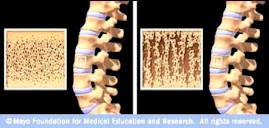
Source: www.mayoclinic.com