Human Skeleton

Human Skeleton

WELCOME TO STRONTIUM FOR BONES BLOG

Have you experienced negative, and even dangerous, side effects from Fosamax (alendronate), Boniva (ibandronate), Actonel (risedronate), Reclast (zoledronic acid), Prolia (denosumab), Forteo (teriparatide), Tymlos (abaloparatide), or other drugs prescribed for osteoporosis? If you have, then rest assured there is a safe, effective treatment for this condition. Strontium, primarily in the form of strontium citrate, is taken orally once a day.

Visitors to my blog can leave comments or ask questions and can remain anonymous, if they wish. Their comments are relayed to my g-mail inbox. Below each post, the number of comments for that post is cited and underlined because it is a link. By clicking on that link below any post, a window opens so that a visitor can leave a comment. Ideally, visitors leave comments on posts most relevant to their comments. All comments to my posts are moderated by me.

Browse the posts and visit the link library of references.


Blog Archive

Friday, March 2, 2012

Update On My Calcium And Magnesium Intake

For many years, I have been taking one tablet per day of KAL Calcium Magnesium Extra Strength, which contains 500 mg calcium (as calcium carbonate and calcium amino acid chelate), 250 mg magnesium (as magnesium oxide and magnesium amino acid chelate), 15 mg sodium, and 50 mg betaine HCl.  I was buying it at my local health food store, but I found a replacement that I think is even better and will be ordering it soon from www.iherb.com, an online distributor I've been getting my strontium and a couple of other supplements from.

The new product is Country Life, Gluten Free, Calcium Magnesium Complex 1000 mg/500 mg in two tablets, 360 tablets, $20.23. The calcium is in the form of calcium hydroxyapatite, citrate, aspartate, alpha-ketoglutarate, and lysinate. The magnesium is in the form of magnesium oxide, citrate, taurinate, alpha-ketoglutarate, and aspartate. Each tablet contains 500 mg calcium, 250 mg magnesium, and 250 mg phosphorus (as calcium hydroxyapatite).

In addition to a calcium/magnesium supplement, I take a multivitamin, Nature Made Multi For Her 50+, which I buy online at www.walgreen.com when the company has one of their frequent “buy one, get one free” offers. This multivitamin contains 200 mg calcium, 100 mg magnesium, 1000 IU vitamin D3, 80 mcg vitamin K, and many other key nutrients.

For breakfast, I have 12 oz fat-free milk, which gives me 450 mg calcium. At lunch, I take the 500 mg calcium/250 mg magnesium supplement. With supper, I take my multivitamin for 200 mg calcium and 100 mg magnesium. That comes to 1150 mg calcium, without counting other food sources. The RDA for women 50+ is 1200 mg calcium per day. I may cut back to 8 oz milk (300 mg calcium) on days when I know I’ll be having something calcium rich for supper.  

Thursday, February 9, 2012

Combination of Micronutrients for Bone (COMB) Study

After 12 months of consecutive supplemental micronutrient therapy,repeat bone densitometry was performed. The results were analyzed in a group of compliant patients and demonstrate improved BMD in patients classified with normal, osteopenic and osteoporotic bone density.

Combination of Micronutrients (COMB) Protocol for Bone Health

1. Docosahexanoic acid or DHA (from Purified Fish Oil): 250 mg/day
2. Vitamin D3: 2000 IU/day
3. Vitamin K2 (non-synthetic MK7 form): 100 ug/day
4. Strontium citrate: 680 mg/day
5. Elemental magnesium: 25 mg/day
6. Dietary sources of calcium recommended
7. Daily impact exercising encouraged

After one year of therapy with the COMB protocol compared to published results for strontium ranelate and bisphosphonate medications, the percent changes in bone mineral density (z values) were as follows:

Femoral neck: 4% increase for the group on the COMB protocol vs. 2% for strontium ranelate, alendronate, and risedronate

Total hip: 3% increase for the COMB protocol vs. 3-4% for strontium ranelate, 2% for alendronate, and not calculated for risedronate

Total spine: 6% increase for COMB protocol vs. 5-6% for strontium ranelate, 4% for both alendronate and risedronate

This combined micronutrient supplementation regimen appears to be at least as effective as bisphosphonates or strontium ranelate in raising BMD levels in hip, spine, and femoral neck sites. No fractures occurred in the group taking the micronutrient protocol. This micronutrient regimen also appears to show efficacy in individuals for whom bisphosphonate therapy was previously unsuccessful in maintaining or raising BMD. Prospective clinical trials are required to confirm efficacy.

This study by Stephen J. Genuis and Thomas P. Bouchard was published in the Journal of Environmental and Public Health, Volume 2012 (2012), Article ID 354151,doi:10.1155/2012/354151 COMB Protocol

Friday, January 6, 2012

Spinal BMD And Scoliosis

On June 15, 2006, Ioannis P. Pappou, MD et al published a retrospective study entitled “Discordantly High Spinal Bone Mineral Density Values in Patients With Adult Lumbar Scoliosis.” The purposes of this study were: 1) to investigate the validity of bone mineral density measurements with DEXA in patients with adult lumbar scoliosis and 2) to investigate the association between osteoporosis and adult lumbar scoliosis. The study concluded the following: Cobb’s angle measurements on DEXA scans are reliable and comparable to conventional radiographs. Spinal BMD values are less valuable for monitoring osteoporosis than hip values in scoliotic patients; an increasing discrepancy with age was noted. Scoliotic patients exhibited discordantly high spinal BMD values, despite significant hip osteoporosis. The discrepancy correlated with aging and curve magnitude. Scoliosis was common among the osteoporotic population (9.47%). Lumbar scoliosis is a useful clinical marker for osteoporosis, irrespective of scoliosis history and magnitude. Viable alternatives for osteoporosis evaluation of adult patients with lumbar scoliosis are hip DEXA values, in conjunction with other BMD measurements. http://journals.lww.com/spinejournal/Abstract/2006/06150/Discordantly_High_Spinal_Bone_Mineral_Density.19.aspx

Friday, December 23, 2011

Effects of Strontium Ranelate on Spinal Osteoarthritis Progression

In “Effects of strontium ranelate on spinal osteoarthritis progression,” published in Ann Rheum Dis 2008;67:335-339, O Bruyere et al aimed to determine whether a three-year treatment with strontium ranelate could delay the progression of spinal osteoarthritis (OA). This study was a post-hoc analysis of pooled data from the Spinal Osteoporosis Therapeutic Intervention (SOTI) and TReatment Of Peripheral OSteoporosis (TROPOS) trials performed on 1,105 women with osteoporosis and concomitant radiological spinal OA at baseline, and for whom lumbar x-rays were available at baseline and over the three-year treatment period. The presence and severity of osteophytes, disc space narrowing and sclerosis in the lumbar intervertebral spaces was graded, and an overall OA score was calculated for each intervertebral space. Back pain (measured on a five-point Likert scale only in SOTI) and health-related quality of life (SF-36 questionnaire) were assessed at baseline and after three years. Patients who suffered an incident or progressive vertebral fracture during the study were excluded from the analysis. The proportion of patients with worsening overall spinal OA score was reduced by 42% in the strontium ranelate group, compared with placebo. Significantly more patients in the strontium ranelate group experienced an improvement in back pain after three years, compared with placebo, while no significant difference was observed in terms of health-related quality of life between these patient groups. The researchers concluded that strontium ranelate could reduce the progression of the radiographic features of spinal osteoarthritis (OA) and back pain in women with osteoporosis and prevalent spinal OA. http://ard.bmj.com/content/67/3/335.abstract.

Friday, September 30, 2011

Supplements For Bone Health

On August 5, 2010, I posted “My Daily Supplements,” a list of the many supplements I take. You can access it at http://strontiumforbones.blogspot.com/search?updated-max=2010-08-21T15%3A28%3A00-04%3A00&max-results=6. Here are the three supplements I take specifically for osteoporosis and to which I attribute my significant gain in bone mineral density. The multivitamin is for general health, but, with 1000 IU vitamin D3, 200 mg calcium, 100 mg magnesium and 80 mcg vitamin K, it is an important part of my bone-building strategy. This list may help you get started on your own supplement program.

Because each one of us is unique, each will have to individually tailor his/her own program. Some people, for example, will need much more vitamin D3 than the 1000 IU I take. If your blood calcium level is low and/or your 25-hyroxy vitamin D test is low, and/or you live in a northern climate or an area of high smog density where your sun exposure is limited, you may have to take much higher vitamin D dosages. Corticosteroids, diuretics, anticonvulsants, and some heartburn medications may interfere with vitamin D. If you take any of these medicines, you may need to increase your vitamin D intake. I spend considerable time outdoors in a southern climate and my blood calcium levels tend to run high normal; therefore, 1000 IU vitamin D3 is plenty for me.

Doctor’s Best Strontium Bone Maker, 1944 mg strontium citrate, 680 mg elemental strontium in two capsules. I buy this at www.iherb.com.

Nature Made Multi For Her 50+ (contains 22 key nutrients, including 1000 IU vitamin D3, 200 mg calcium, 100 mg magnesium, 80 mcg vitamin K, 2500 IU vitamin A with 60% as beta carotene, 25 mcg vitamin B12, 180 mg vitamin C, 60 IU vitamin E, 15 mg zinc, 70 mcg selenium). I buy this at www.walgreens.com when they have two-for-one specials. Walgreens drugstores have the same specials.

Kal Extra-Strength Calcium Magnesium (I take one tablet, which contains 500 mg calcium and 250 mg magnesium.) The multivitamin listed above contains 200 mg calcium and 100 mg magnesium. I get approximately 500 mg calcium from food to total the 1200 mg recommended for a woman over 50 years old. I do eat dairy products. I am currently buying this supplement at www.vitaminshoppe.com.

Tuesday, September 27, 2011

New BONIVA Advertisement Features Correction

Have you seen the latest BONIVA ad? Apparently, the Food and Drug Administration (FDA) has forced Roche Therapeutics Inc. to recant a previous unsubstantiated claim about their product, which contains ibandronate sodium, a bisphosphonate. I saw this ad in the September 25, 2011, Parade magazine, which is included with my Sunday newspaper. The title and first two paragraphs of the advertisement concern the correction:

“An important correction from BONIVA for women with postmenopausal osteoporosis”

“You may have seen an ad about BONIVA for the treatment and prevention of postmenopausal osteoporosis that may have given you the wrong impression. Our ads stated that ‘After one year on BONIVA, 9 out of 10 women stopped and reversed their bone loss.’ The FDA has found that there is not enough evidence to support this statement and wants us to clear up any misunderstanding you may have had about these ads and make sure you have the correct information about BONIVA.”

“BONIVA has not been proven to stop and reverse bone loss in 9 out of 10 women and is not a cure for postmenopausal osteoporosis. BONIVA has been shown to help increase bone mass and help reduce the chance of having a spinal fracture (break). We encourage all patients to discuss their treatment with their healthcare provider. Only your doctor can determine if BONIVA is right for you.”

Wandering Skeleton

Wandering Skeleton
Artist: Joel Hoekstra

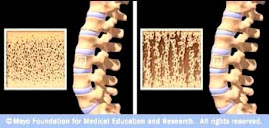
Osteoporotic Bone

Osteoporotic Bone
Source: www.mayoclinic.com

How Strontium Builds Bones

Strontium is a mineral that tends to accumulate in bone. Studies have shown that oral doses of strontium are a safe and effective way to prevent and reverse osteoporosis. Doses of 680 mg per day appear to be optimal. See my "For More Information About Strontium" links section.

Osteoporosis is caused by changes in bone production. In healthy young bones there is a constant cycle of new bone growth and bone removal. With age, more bone is removed and less new bone is produced. The bones become less dense and thus more fragile.

Scientists believe that strontium works in two ways. It may stimulate the replication of pre-osteoblasts, leading to an increase in osteoblasts (cells that build bone). Strontium also directly inhibits the activity of osteoclasts (cells that break down bone). The result is stronger bones.

When taking strontium, be sure to take 1200 mg calcium, 1000 IU vitamin D3, and 500 mg magnesium daily. It is best to take strontium late at night on an empty stomach. Calcium and strontium may compete with each other for absorption if taken together.