Human Skeleton

Human Skeleton

WELCOME TO STRONTIUM FOR BONES BLOG

Have you experienced negative, and even dangerous, side effects from Fosamax (alendronate), Boniva (ibandronate), Actonel (risedronate), Reclast (zoledronic acid), Prolia (denosumab), Forteo (teriparatide), Tymlos (abaloparatide), or other drugs prescribed for osteoporosis? If you have, then rest assured there is a safe, effective treatment for this condition. Strontium, primarily in the form of strontium citrate, is taken orally once a day.

Visitors to my blog can leave comments or ask questions and can remain anonymous, if they wish. Their comments are relayed to my g-mail inbox. Below each post, the number of comments for that post is cited and underlined because it is a link. By clicking on that link below any post, a window opens so that a visitor can leave a comment. Ideally, visitors leave comments on posts most relevant to their comments. All comments to my posts are moderated by me.

Browse the posts and visit the link library of references.


Blog Archive

Showing posts with label strontium salt. Show all posts

Tuesday, October 21, 2014

Accumulation of bone strontium measured by in vivo XRF in rats supplemented with strontium citrate and strontium ranelate

Wohl GR, Chettle DR, Pejović-Milić A, Druchok C, Webber CE, Adachi JD, Beattie KA

Bone 2013


Strontium ranelate is an approved pharmacotherapy for osteoporosis in Europe and Australia, but not in Canada or the United States. Strontium citrate, an alternative strontium salt, however, is available for purchase over-the-counter as a nutritional supplement. The effects of strontium citrate on bone are largely unknown.

The study's objectives were (1) to quantify bone strontium accumulation in female Sprague Dawley rats administered strontium citrate (N=7) and compare these levels to rats administered strontium ranelate (N=6) and vehicle (placebo) (N=6) over 8 weeks, and (2) to verify an in vivo X-ray fluorescence spectroscopy (XRF) system for measurement of bone strontium in the rat. Daily doses of strontium citrate and strontium ranelate were determined with the intention to achieve equivalent amounts of elemental strontium. However, post-hoc analyses of each strontium compound conducted using energy dispersive spectrometry microanalysis revealed a higher elemental strontium concentration in strontium citrate than strontium ranelate.

Bone strontium levels were measured at baseline and 8 weeks follow-up using a unique in vivo XRF technique previously used in humans. XRF measurements were validated against ex vivo measurements of bone strontium using inductively coupled plasma mass spectrometry. Weight gain in rats in all three groups was equivalent over the study duration. A two-way ANOVA was conducted to compare bone strontium levels amongst the three groups. Bone strontium levels in rats administered strontium citrate were significantly greater than in rats administered strontium ranelate and vehicle. ANCOVA analyses were performed with Sr dose as a covariate to account for differences in strontium dosing. The ANCOVA revealed differences in bone strontium levels between the strontium groups were not significant, but that bone strontium levels were still very significantly greater than vehicle.


Friday, April 4, 2014

Strontium Basics


What is the recommended amount of strontium?

The amount of a strontium salt (e.g. strontium citrate) for prevention of bone loss in early postmenopausal non-osteoporotic women is roughly 1 gram per day to get about 340 mg of elemental strontium.

The amount of a strontium salt for treatment of postmenopausal osteoporosis is roughly 2 grams per day to get about 680 mg of elemental strontium.

When should you take strontium as per time of day and how far apart from calcium?

You can take strontium at any time as long as you take it at least 2-3 hours after taking food, milk or milk products, or calcium supplements. Calcium competes with strontium for absorption; so, you will absorb less strontium if you take calcium and strontium too close together. You will absorb strontium better on an empty stomach. I take my strontium at night shortly before bedtime. Take it when it is most convenient for you.

In what ratio to calcium should you take strontium?

You do not need to worry about a ratio of calcium to strontium. The amount of calcium you need, whether you take strontium or not, depends on your age and sex. Adult men (51-70 years old) need 1000 mg daily. Adult women (51-70 years old) need 1200 mg per day. These are total amounts of calcium. So, what you need to do first is figure out how much calcium you are getting from food, and then supplement the rest, if needed. You should strive to get all, or most, of your calcium from food.

Wandering Skeleton

Wandering Skeleton
Artist: Joel Hoekstra

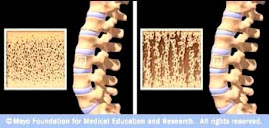
Osteoporotic Bone

Osteoporotic Bone
Source: www.mayoclinic.com

How Strontium Builds Bones

Strontium is a mineral that tends to accumulate in bone. Studies have shown that oral doses of strontium are a safe and effective way to prevent and reverse osteoporosis. Doses of 680 mg per day appear to be optimal. See my "For More Information About Strontium" links section.

Osteoporosis is caused by changes in bone production. In healthy young bones there is a constant cycle of new bone growth and bone removal. With age, more bone is removed and less new bone is produced. The bones become less dense and thus more fragile.

Scientists believe that strontium works in two ways. It may stimulate the replication of pre-osteoblasts, leading to an increase in osteoblasts (cells that build bone). Strontium also directly inhibits the activity of osteoclasts (cells that break down bone). The result is stronger bones.

When taking strontium, be sure to take 1200 mg calcium, 1000 IU vitamin D3, and 500 mg magnesium daily. It is best to take strontium late at night on an empty stomach. Calcium and strontium may compete with each other for absorption if taken together.