Human Skeleton

Human Skeleton

WELCOME TO STRONTIUM FOR BONES BLOG

Have you experienced negative, and even dangerous, side effects from Fosamax (alendronate), Boniva (ibandronate), Actonel (risedronate), Reclast (zoledronic acid), Prolia (denosumab), Forteo (teriparatide), Tymlos (abaloparatide), or other drugs prescribed for osteoporosis? If you have, then rest assured there is a safe, effective treatment for this condition. Strontium, primarily in the form of strontium citrate, is taken orally once a day.

Visitors to my blog can leave comments or ask questions and can remain anonymous, if they wish. Their comments are relayed to my g-mail inbox. Below each post, the number of comments for that post is cited and underlined because it is a link. By clicking on that link below any post, a window opens so that a visitor can leave a comment. Ideally, visitors leave comments on posts most relevant to their comments. All comments to my posts are moderated by me.

Browse the posts and visit the link library of references.


Blog Archive

Showing posts with label kidney stones. Show all posts

Thursday, July 23, 2015

Fat Soluble and Water Soluble Vitamins


“Many people think that taking a daily cocktail of vitamins, minerals, antioxidants and other supplements is a prescription for a healthy diet. But it's also likely that they don’t know whether the nutrients they're taking are fat soluble, water soluble, or if they are getting more of some nutrients than they need.”


“Vitamins are classified as either fat soluble (vitamins A, D, E and K) or water soluble (vitamins B and C). This difference between the two groups is very important. It determines how each vitamin acts within the body.”

“The fat soluble vitamins are soluble in lipids (fats). These vitamins are usually absorbed in fat globules (called chylomicrons) that travel through the lymphatic system of the small intestines and into the general blood circulation within the body. These fat soluble vitamins, especially vitamins A and E, are then stored in body tissues.”

“Fat soluble vitamins, once they have been stored in tissues in the body, tend to remain there. This means that if a person takes in too much of a fat soluble vitamin, over time they can have too much of that vitamin present in their body, a potentially dangerous condition called hypervitaminosis (literally, too much vitamin in the body).”

“Persons can be also be deficient in the fat soluble vitamins if their fat intake is too low or if their fat absorption is compromised, for example, by certain drugs (that interfere with the absorption of fat from the intestine) or by certain diseases such as cystic fibrosis (in which there is a deficiency of enzymes from the pancreas which similarly interferes with the absorption of fat from the intestine).”

 “There is a big difference between the water soluble vitamins and the fat soluble vitamins and this is absolutely a critical distinction.”

Fat-Soluble Vitamins: A, D, E, and K

“Quick Facts...”
  • “Small amounts of vitamin A, vitamin D, vitamin E and vitamin K are needed to maintain good health.”
  • “Fat-soluble vitamins will not be lost when the foods that contain them are cooked.”
  • “The body does not need these vitamins every day and stores them in the liver and adipose (fat) tissue when not used.”
  • “Most people do not need vitamin supplements.” (This is debatable, and I don’t agree, but I do want to admonish people to respect the upper intake limits for all vitamins, especially the fat soluble ones, and for minerals, such as calcium and magnesium.)
  • “Megadoses of vitamins A, D, E or K can be toxic and lead to health problems.”
  • “Requirements for vitamins may be expressed in different mathematical units. Close attention should be paid to ensure that similar units are being compared.”

http://www.ext.colostate.edu/pubs/foodnut/09315.html

Water-Soluble Vitamins and Nutrients

“Water-soluble nutrients work best when you get them in the proper amounts. When you eat or take more than your body needs, the body adapts by absorbing just what it needs, and then it usually excretes the excess in your urine -- but not always. A study in the August 2010 Journal of Nutrition Science and Vitaminology found that urinary excretion of certain vitamins and other nutrients was reduced when study participants fasted.”

“The field of nutrition is ever-changing, and experts used to think that taking excess amounts of a water-soluble nutrient was harmless because the excesses would just be eliminated in urine. Today, we know that’s not the case, and that some water-soluble vitamins and nutrients are handled differently by the body than others.”

“Just because most water-soluble vitamins are not stored by the body, you can’t assume that it is safe or effective to take more than the safe upper limit. In addition, you need to account for the vitamins and nutrients you get from the food you eat, says Ruth Frenchman, MS, RD, a spokesperson for the American Dietetic Association.”

"Certain water-soluble vitamins in excess can cause problems, such as too much vitamin B6 can cause nerve problems, too much niacin can cause flushing, and excess vitamin C can cause kidney stones," Frenchman observes. Excess folic acid may also mask a vitamin B12 deficiency, which is more common in people over age 50.”
http://www.webmd.com/vitamins-and-supplements/nutrition-vitamins-11/fat-water-nutrient?page=2


Tuesday, April 14, 2015

Strontium and Kidney Stones


Should you take strontium citrate if you have hypercalciuria (high urine calcium) or a history of kidney stones? Perhaps you should not. A recent study identified strontium in all calcium-based stones, present as strontium apatite. This finding may be critical since apatite is thought to be the initial nidus for calcium stone formation. Strontium is found in small amounts in food and water. The paper does not state if any of the stone formers had taken strontium supplements. I wrote to one of the researchers, the contact person, to find out if he knew the source of the strontium found in the kidney stones. He answered that he did not know if those with elevated strontium in their diet or those with strontium intake (tablets) were the ones with elevated strontium in their stones. What follows is the abstract from the research paper, “Strontium Substitution for Calcium in Lithogenesis.” Use the link at the end to read the entire paper.

Purpose
Strontium has chemical similarity to calcium, which enables the replacement of calcium by strontium in biomineralization processes. Incorporating strontium into human bone and teeth has been studied extensively but little research has been performed of the incorporation of strontium into urinary calculi. We used synchrotron based x-ray fluorescence and x-ray absorption techniques to examine the presence of strontium in different types of human kidney stones.

Materials and Methods
Multiple unique human stone samples were obtained via consecutive percutaneous nephrolithotomies/ureteroscopies. A portion of each stone was sent for standard laboratory analysis and a portion was retained for x-ray fluorescence and x-ray absorption measurements. X-ray fluorescence and x-ray absorption measurements determined the presence, spatial distribution and speciation of strontium in each stone sample.

Results
Traditional kidney stone analyses identified calcium oxalate, calcium phosphate, uric acid and cystine stones. X-ray fluorescence measurements identified strontium in all stone types except pure cystine. X-ray fluorescence elemental mapping of the samples revealed co-localization of calcium and strontium. X-ray absorption measurements of the calcium phosphate stone showed strontium predominately present as strontium apatite.

Conclusions
Advanced x-ray fluorescence imaging identified strontium in all calcium based stones, present as strontium apatite. This finding may be critical since apatite is thought to be the initial nidus for calcium stone formation. Strontium is not identified by standard laboratory stone analyses. Its substitution for calcium can be reliably identified in stones from multiple calcium based stone formers, which may offer opportunities to gain insight into early events in lithogenesis.
http://www.ncbi.nlm.nih.gov/pmc/articles/PMC4124908/

Monday, January 5, 2015

Salt and osteoporosis


Introduction

Osteoporosis is a condition involving the thinning of bones (bone demineralization), leaving them brittle and more susceptible to fracture. Ninety nice percent of calcium is stored in the bones, so sufficient calcium is important in order to maintain or reach peak bone mass (PBM).

In the UK, an estimated 3 million people are suffering from osteoporosis, with 1 in 2 women and 1 in 3 men over 50 years old breaking a bone at least once, mainly due to poor bone health. Each month, 1,150 people die as a result of a hip fracture. Osteoporosis mainly effects the older population, with 19.8 million people over the age of 50 in the UK. Since the 1960’s there has been a 7 fold increase in the number of osteoporosis cases. Each year osteoporosis costs the NHS approximately 2.3 billion pounds.

Who is most at risk of osteoporosis?

The older population are more at risk of osteoporosis because bones naturally become thinner as we get older. Post-menopausal women are particularly at risk of osteoporosis because of the decrease in the female hormone, estrogen. Those with higher salt intakes are increasing the amount of bone demineralization that takes place.

Studies have also demonstrated that there is a correlation between salt intake and calcium excretion in young and adolescent girls. It has been suggested that this may result in a reduced peak bone mass, which would increase the risk of osteoporosis later in life.  Consuming a low salt diet during adolescent years may therefore be important, to reduce the risk of osteoporosis later in life.

How does Salt Contribute?

Studies dating back to the 1980’s have found possible links between salt intake and urinary calcium (Ca) excretion.

Figure 1 – Changes in hip bone density with different urinary sodium excretions. 
A high salt intake increases calcium losses in the urine (calciuria), some of which will be directly from the bones. One study found that for each 100mmol increase in salt intake, urinary Ca is increased by 1.4mmol. If this loss is assumed to be from the bone, then this equates to about 1% extra loss of bone each year.   Over extended periods this would lead to the weakening of bones and ultimately osteoporosis.

Both epidemiological studies and randomized trials have shown that a decrease in salt intake reduces urinary calcium excretion. A study in post-menopausal women showed that the loss of hip bone density over 2 years was related to 24-hour urinary sodium at entry to the study, and was as strong as that relating to calcium intake. It was calculated that a reduction in salt intake from 10 to 5 g/day would have the same effect on hip bone density as an increase in calcium intake of 1000mg/day, a difficult amount to achieve without resorting to supplements (Fig 1).  Another study has suggested that in postmenopausal women with a sodium intake of more than or equal to 3.4g/day (8.5g salt), a reduction in salt intake would benefit their bone health.

Blood Pressure, Osteoporosis and Kidney Stones

Salt intake and blood pressure are strongly linked, and it is also believed that patients with high blood pressure excrete more calcium in the urine and are, therefore, at higher risk of osteoporosis and kidney stones.  Recently, a study showed sodium to be a major linking factor between blood pressure and osteoporosis. The authors found that hip and spine Bone Mass Density (BMD) were inversely correlated with a higher sodium excretion, i.e. the higher the salt intake, the lower the BMD. They concluded that the increase in calcium excretion is obligatory as a result of the increased sodium in the diet (Fig 2).  Another study showed that a 20mmHg increase in BP is associated with 0.28mmol/day increase in Urinary Ca.

Figure  2 – the link between salt intake, blood pressure and bone mineral loss.

Current Salt Intake & Dietary Advice

Almost everyone in the UK (and the rest of the Western world) eats too much salt. The daily recommended amount in the UK is no more than 6 grams a day; the current average salt intake is 8.6g salt a day although many people are eating more than this.

People with or considered at risk of osteoporosis should ensure that they keep their salt intake below the recommended maximum of 6g. This can be achieved by simple changes, such as consuming less processed foods and checking product labels before purchase. Consuming low salt dairy products such as milk will also help maintain bone mass. Caffeine and fizzy drinks are thought to reduce bone mass, and therefore should be kept to a minimum. An increase in Vitamin D, Zinc and Copper may also be of help.
The original article with references is available here: 

Also see my next post, "Americans Consume Too Much Sodium (Salt)," for information about salt intake in the U.S.A.  

Wandering Skeleton

Wandering Skeleton
Artist: Joel Hoekstra

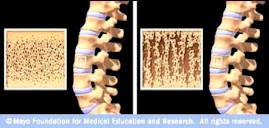
Osteoporotic Bone

Osteoporotic Bone
Source: www.mayoclinic.com

How Strontium Builds Bones

Strontium is a mineral that tends to accumulate in bone. Studies have shown that oral doses of strontium are a safe and effective way to prevent and reverse osteoporosis. Doses of 680 mg per day appear to be optimal. See my "For More Information About Strontium" links section.

Osteoporosis is caused by changes in bone production. In healthy young bones there is a constant cycle of new bone growth and bone removal. With age, more bone is removed and less new bone is produced. The bones become less dense and thus more fragile.

Scientists believe that strontium works in two ways. It may stimulate the replication of pre-osteoblasts, leading to an increase in osteoblasts (cells that build bone). Strontium also directly inhibits the activity of osteoclasts (cells that break down bone). The result is stronger bones.

When taking strontium, be sure to take 1200 mg calcium, 1000 IU vitamin D3, and 500 mg magnesium daily. It is best to take strontium late at night on an empty stomach. Calcium and strontium may compete with each other for absorption if taken together.