Human Skeleton

Human Skeleton

WELCOME TO STRONTIUM FOR BONES BLOG

Have you experienced negative, and even dangerous, side effects from Fosamax (alendronate), Boniva (ibandronate), Actonel (risedronate), Reclast (zoledronic acid), Prolia (denosumab), Forteo (teriparatide), Tymlos (abaloparatide), or other drugs prescribed for osteoporosis? If you have, then rest assured there is a safe, effective treatment for this condition. Strontium, primarily in the form of strontium citrate, is taken orally once a day.

Visitors to my blog can leave comments or ask questions and can remain anonymous, if they wish. Their comments are relayed to my g-mail inbox. Below each post, the number of comments for that post is cited and underlined because it is a link. By clicking on that link below any post, a window opens so that a visitor can leave a comment. Ideally, visitors leave comments on posts most relevant to their comments. All comments to my posts are moderated by me.

Browse the posts and visit the link library of references.


Blog Archive

Showing posts with label glucocorticosteroids. Show all posts

Monday, January 26, 2015

Adverse Skeletal Effects of Drugs


There is an expanding list of drugs for which there are concerns regarding adverse skeletal effects. The effect of long-term use of glucocorticoid drugs to cause accelerated bone loss and increase the risk of fracture is well recognized. For some drugs (TKIs, calcineurin inhibitors and loop diuretics), the available data are inconsistent and/or do not support a definite adverse skeletal effect. Patients receiving these drugs can be managed in line with guidelines for the general population (See table). Other drugs (SSRIs, antipsychotic drugs, AEDs and PPIs) do not seem to affect bone metabolism or BMD, but there is evidence for increased fracture risk. However, the evidence is limited to observational data, and any relationship may be attributable either to nonbone effects of the drug or effects of the underlying condition to increase fracture rate. In these patients, evaluation for other risk factors for fracture and management of these risk factors should be considered. In a third group (depot MPA, chemotherapy and ART), there is evidence for increased bone loss and/or fracture, but the patient population is generally at low risk for fracture. In these cases, patients may require an assessment of risk, but will rarely require specific treatment for fracture risk reduction. In the last group (aromatase inhibitors, GnRH agonists and thiazolidinediones), there is evidence of increased risk of bone loss and/or fracture, and the drugs are more frequently prescribed to individuals at higher baseline fracture risk. Patients receiving these drugs require risk assessment and those at high risk of fracture should receive alternative treatments (or "add-back" HRT in the case of GnRH agonists) or, if necessary, specific treatment for osteoporosis.


Table:  Summary of management recommendations
Example drugs
Evidence for risk
Management recommendations
Tyrosine kinase inhibitors

   Calcineurin inhibitors

   Loop diuretics
No adverse 
skeletal effect 
or data 
inconsistent
Manage as per general population


Selective serotonin re-uptake inhibitors (SSRIs)

   Antipsychotics

   Anti-epileptic drugs

   Proton pump inhibitors
Evidence for increased fracture risk but fracture risk seems to relate to nonbone effects of the drug or effects of the underlying condition
Evaluate for other risk factors for fracture and manage these risk factors


Depot medroxyprogesterone acetate

   Chemotherapy

   Antiretroviral therapy
Evidence for increased bone
loss and/or 
fracture, but low
risk population
Assessment of fracture risk, but will rarely require specific treatment


Aromatase inhibitors

   Gonadotrophin hormone-releasing hormone agonists

   Thiazolidinediones


Evidence for increased risk of bone loss and/or fracture, and the drugs are more frequently prescribed to individuals at higher baseline fracture risk

Assessment of fracture risk and those at high risk should receive alternative treatments and/or specific treatment for osteoporosis.


 The conclusions and table are from a longer article, “Adverse Skeletal Effects of Drugs – Beyond Glucocorticoids,” by Susannah O'Sullivan and Andrew Grey, Clin Endocrinol. 2015;82(1):12-22. 


Monday, December 15, 2014

Fixed Risk Factors for Osteoporosis


Fixed risk factors determine whether an individual is at heightened risk of osteoporosis. Also, unlike modifiable risks, they are factors which we can’t change, including age, gender and family history.
In addition, people may have secondary risk factors. These include disorders and medications that weaken bone and affect balance (heightening the risk of fracture due to falling). Read more about Secondary Osteoporosis.

Low bone mineral density, one of the most important indicators that a person is at risk of a fracture, is considered both fixed and modifiable since it is determined by a wide range of factors, including family history, age and lifestyle factors.

Although fixed risk factors for osteoporosis cannot be changed, people need to be aware of these risks so that they can take steps to reduce bone mineral loss as early as possible. These risks include:
Age
The majority of hip fractures (90%) occur in people aged 50 and older. This is partly due to reduced bone mineral density as we age. But age can also be a risk factor independent of bone mineral density. In other words, even older adults with normal bone mineral density are more likely to suffer a fracture than younger people1.
Female gender
Women, particularly post-menopausal women, are more susceptible to bone loss than men, because their bodies produce less estrogen. This hormone is an important component in bone formation. Women are more likely to sustain an osteoporotic fracture than men. Lifetime risk of any fracture ranges between 40-50% in women, compared to 13-22% in men.
Family history
A parental history of fracture (particularly a family history of hip fracture) is associated with an increased risk of fracture that is independent of bone mineral density2.
Previous fracture
A previous fracture increases the risk of any fracture by 86%, compared with people without a prior fracture. Both men and women are almost twice (1.86 times) as likely to have a second fracture compared to people who are fracture free3.
Ethnicity
Studies have found osteoporosis is more common in Caucasian and Asian populations, and the incidence of osteoporosis and fractures of the hip and spine is lower in black than in white people.
Menopause or hysterectomy
Hysterectomy, if accompanied by removal of the ovaries, may also increase the risk for osteoporosis because of estrogen loss. Post-menopausal women, and those who have had their ovaries removed, must be particularly vigilant about their bone health.
Long term glucocorticoid therapy
Long-term corticosteroids use is a very common cause of secondary osteoporosis and is associated with an increased risk of fracture4.
Rheumatoid arthritis
Rheumatoid arthritis and diseases of the endocrine system can take a heavy toll on bones. Hyperparathyroidism, for example, results in elevated levels of parathyroid hormone, which signals bone cells to release calcium from bone into the blood.
Primary or secondary hypogonadism in men
Like estrogen deficiency in women (which is observed in case of primary or secondary amenorrhea and premature menopause), androgen deficiency in men (primary or secondary hypogonadism) increases the risk of fracture.

At any age, acute hypogonadism, such as that resulting from orchidectomy for prostate cancer, accelerates bone loss to a similar rate as seen in menopausal women. The bone loss following orchidectomy is rapid for several years, and then reverts to the gradual loss that normally occurs with aging.
Secondary Risk Factors
Secondary risk factors are less prevalent but they can have a significant impact on bone health and fracture incidence. These risk factors include other diseases that directly or indirectly affect bone remodeling and conditions that affect mobility and balance, which can contribute to the increased risk of falling and sustaining a fracture.
Disorders that affect the skeleton:
  • Asthma
  • Nutritional/gastrointestinal problems (e.g. Crohn’s or celiac disease)
  • Rheumatoid arthritis
  • Hematological disorders/malignancy
  • Some inherited disorders
  • Hypogonadal states (e.g. Turner syndrome/Kleinfelter syndrome, amenorrhea)
  • Endocrine disorders (e.g. Cushing’s syndrome, hyperparathyroidism, diabetes)
  • Immobility
Medical treatments affecting bone health:

Some medications may have side effects that directly weaken bone or increase the risk of fracture due to fall or trauma. Patients taking any of the following medications should consult with their doctor about increased risk to bone health.
  • Glucocorticosteroids
  • Certain immunosuppressant (calmodulin/calcineurine phosphatase inhibitors)
  • Thyroid hormone treatment (L-Thyroxine)
  • Certain steroid hormones (medroxyprogesterone acetate, leutenising hormone releasing hormone agonists)
  • Aromatase inhibitors
  • Certain antipsychotics
  • Certain anticonvulsants
  • Certain antiepileptic drugs
  • Lithium
  • Methotrexate
  • Antacids
  • Proton pump inhibitors 
References
1. Kanis JA, Johnell O, Odén A, Dawson A, De LAet C, Jonsson B. Ten year probabilities of osteoporotic fractures according to BMD and diagnosis thresholds. Osteoporosis Int 2001; 12:989-95
2. Kanis JA, Johansson H, Odén A, Johnell O, De LAet C, Eisman JA, McCloskey EV, Mellström D, Melton LJ III, Pols HA, Reeve J, Silman AJ, Tenenhouse A. A family history of fracture and fracture risk: a meta-analysis. Bone 2004; 35:1029-37
3. Kanis JA, De LAet C, Delmas P, Garnero P, Johansson H, Johnell O, Kriger H, McCloskey EV, Mellstrom D, Melton LJ III, Odén A, Pols H, Reeve J, Silman A, tenehouse A. A meta-analysis of previous fracture and fracture risk. Bone 2004; 35: 375-82
4. Kanis J A, Johansson H, Odén A, Johnell O, De Laet C, Melton LJ III, Tenenhouse A, Reeve J, Silman AJ, Pols H, Eisman JA, McCliskey EV, Mellström D. A meta-analysis of prior corticosteroid use and fracture risk. J Bone and Miner Res 2004;19: 893-99

Wandering Skeleton

Wandering Skeleton
Artist: Joel Hoekstra

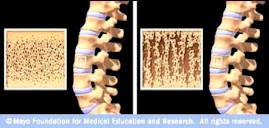
Osteoporotic Bone

Osteoporotic Bone
Source: www.mayoclinic.com

How Strontium Builds Bones

Strontium is a mineral that tends to accumulate in bone. Studies have shown that oral doses of strontium are a safe and effective way to prevent and reverse osteoporosis. Doses of 680 mg per day appear to be optimal. See my "For More Information About Strontium" links section.

Osteoporosis is caused by changes in bone production. In healthy young bones there is a constant cycle of new bone growth and bone removal. With age, more bone is removed and less new bone is produced. The bones become less dense and thus more fragile.

Scientists believe that strontium works in two ways. It may stimulate the replication of pre-osteoblasts, leading to an increase in osteoblasts (cells that build bone). Strontium also directly inhibits the activity of osteoclasts (cells that break down bone). The result is stronger bones.

When taking strontium, be sure to take 1200 mg calcium, 1000 IU vitamin D3, and 500 mg magnesium daily. It is best to take strontium late at night on an empty stomach. Calcium and strontium may compete with each other for absorption if taken together.