I always grin to myself when I read about not taking calcium and magnesium together because the two are together in many foods. It is true that if you take a large amount of calcium (e.g., 500 mg) with a smaller amount of magnesium (e.g., 250 mg), you will not absorb as much of the magnesium, but you will probably absorb the calcium better. We need magnesium to absorb and metabolize calcium and vitamin D. Below is a chart of calcium and magnesium in foods.
Calcium and Magnesium in Foods (milligrams)
Collards (1 cup, boiled)
268 Ca
40 Mg
Orange juice, calcium-fortified (1 cup)
349 Ca
27 Mg
Oatmeal, fortified instant (1 packet)
98 Ca
36 Mg
Figs, dried (10 medium)
136 Ca
57 Mg
Tofu, calcium-set (1/2 cup)
861 Ca
73 Mg
Spinach (1 cup, boiled)
245 Ca
157 Mg
Soybeans (1 cup, boiled)
261 Ca
108 Mg
White beans (1 cup, boiled)
161 Ca
113 Mg
Mustard greens (1 cup, boiled)
165 Ca
18 Mg
Navy beans (1 cup, boiled)
128 Ca
96 Mg
Great northern beans (1 cup, boiled)
120 Ca
88 Mg
Black turtle beans (1 cup, boiled)
102 Ca
91 Mg
Swiss chard (1 cup, boiled)
102 Ca
152 Mg
Broccoli (1 cup, boiled)
62 Ca
33 Mg
Kale (1 cup boiled)
94 Ca
23 Mg
English muffin
101 Ca
21 Mg
Butternut squash (1 cup, boiled)
84 Ca
60 Mg
Pinto beans (1 cup, boiled)
79 Ca
86 Mg
Chick peas (1 cup, canned)
109 Ca
61 Mg
Sweet potato (1 cup, boiled)
76 Ca
54 Mg
Green beans (1 cup, boiled)
55 Ca
22 Mg
Barley (1 cup)
61 Ca
245 Mg
Brussels sprouts (8 sprouts)
60 Ca
34 Mg
Navel orange (1 medium)
60 Ca
15 Mg
Raisins (2/3 cup)
54 Ca
35 Mg
Source: U.S. Department of Agriculture, Agricultural Research Service. 2011. USDA National Nutrient Database for Standard Reference, Release 26.
*Nutrient Data Laboratory Home Page, http://ndb.nal.usda.gov/
https://www.pcrm.org/good-nutrition/nutrition-information/health...
Human Skeleton

Thursday, June 17, 2021
Taking Calcium and Magnesium Together


Saturday, March 6, 2021
Defect in Renal Calcium Conservation and Postmenopausal Osteoporosis
Although all postmenopausal women are estrogen deficient, women who have postmenopausal osteoporosis may have a defect, in addition to estrogen deficiency, that accounts for their higher rates of bone resorption and greater bone loss, relative to those who do not. To test the hypothesis that one defect is an impairment in renal calcium conservation, we measured renal calcium transport in 19 osteoporotic and 19 normal postmenopausal women, whose ages were 70 yr (range, 67–72) and 72 yr (range, 69–74), respectively. There was no difference between groups in values for serum ionized calcium and PTH concentrations or in renal filtered load of calcium. However, before PTH infusion, the osteoporotic women had lower values for tubular reabsorption of calcium (TRCa) of 96.8% vs. 98.0% and higher urinary calcium excretion of 0.194 mg/dL of glomerular filtrate (GF) vs. 0.125 mg/dL of GF than the normal women. After infusion of 200 U of synthetic PTH, TRCa increased and calcium excretion decreased comparably in both groups, so that the differences between groups after intervention remained: for TRCa, 98.3% vs.98.9%; and for calcium excretion, 0.099 mg/dL of GF vs. 0.066 mg/dL of GF. In conclusion, postmenopausal women with osteoporosis have a PTH-independent defect in renal calcium conservation. This defect is of sufficient magnitude to contribute to the greater negative calcium balance in postmenopausal women with osteoporosis vs. their postmenopausal peers.
https://academic.oup.com/jcem/article/83/6/1916/2865261
Sunday, October 4, 2020
Supplements to Take Along with Strontium
Both the Combination of Micronutrients for Bone (COMB) study and Melatonin-Micronutrients Osteopenia Treatment Study (MOTS) investigated using strontium in conjunction with other supplements. You cannot take strontium without taking sufficient calcium (from food and/or supplements) and vitamin D. You also need magnesium, which was not included in the MOTS protocol, and was provided at a very low dosage in the COMB study.
The COMB study for osteoporosis:
strontium citrate (680 mg)
D3 (2000 IU)
dietary sources of calcium
magnesium (25 mg)
K2 (MK7) (100 mcg)
DHA (250 mg)
daily impact exercises were encouraged.
MOTS for osteopenia:
strontium citrate (450 mg)
D3 (2000 IU)
K2 (MK7) (60 mcg)
melatonin, 5 mg
These ingredients were called MSDK for melatonin, strontium citrate, vitamins D3 and K2.
In addition to study medication, participants were allowed to take less than 1000 IU D3 and less than 1000 mg of calcium. Nearly 87% of the subjects in the MOTS study were taking either calcium/vitamin D3, multivitamins, and/or other dietary supplements.
The BoneLady uses her own protocol for osteoporosis:
strontium citrate (682 mg),
D3 (1300 IU)
calcium (500 mg tablet, about 700 mg from dietary sources)
magnesium (450 mg)
daily low-impact exercises
I do not take DHA, K2, or melatonin. I do take several other supplements: https://strontiumforbones.blogspot.com/2020/07/my-current-supplements.html
Friday, October 2, 2020
Strontium Citrate Studies
There have been two one-year studies on SC (COMB and MOTS), several case studies, and two tests on monitoring bone strontium intake.
Combination of Micronutrients for Bone (COMB) Study
https://www.hindawi.com/journals/jeph/2012/354151/
Melatonin-micronutrients Osteopenia Treatment Study (MOTS)
https://www.ncbi.nlm.nih.gov/pmc/articles/PMC5310667/
BMD increases by Varying Amounts with Strontium Citrate and Decreases by Varying Amounts after Discontinuation (three case studies)
http://strontiumforbones.blogspot.com/2018/02/bmd-increases-by-varying-amounts-with.html
In Memory of Sara Shackleford DeHart (links to her three case studies)
http://strontiumforbones.blogspot.com/2018/01/in-memory-of-sara-shackleford-dehart.html
Monitoring bone strontium intake in osteoporotic females self-supplementing with strontium citrate with a novel in-vivo X-ray fluorescence based diagnostic tool
http://strontiumforbones.blogspot.com/2014/10/monitoring-bone-st...
Monitoring bone strontium levels of an osteoporotic subject due to self-administration of strontium citrate with a novel diagnostic tool, in-vivo XRF: a case study
http://strontiumforbones.blogspot.com/2014/10/monitoring-bone-st...
Monday, September 28, 2020
Sunday, September 27, 2020
What Determines How Much Strontium Is in Your Bones?
It is generally said that, for every 1% of strontium incorporated into bone crystal, BMD is overestimated by 10%. However, we do not know how much strontium has been incorporated into each of your bones.
The amount of strontium in your bones will depend on several factors:
(1) the dosage (680 mg, as in the COMB study; 340 mg, which is a half dose; or 450 mg, the dosage used in the MOTS study;
(2) the length of time you have been taking strontium (The COMB and MOTS studies lasted only one year. Therefore, the strontium effect on those DXA scans was less than had the subjects been studied for three years or longer.
(3) how well you absorb the strontium (Absorption of strontium salts is about 25% for most people with normal absorption, but, as we age, our ability to absorb nutrients, supplements, and medications is often reduced.);
(4) the individual bones (Some bones absorb strontium better than others.);
(5) the DXA equipment used to measure BMD.
Wandering Skeleton

Artist: Joel Hoekstra
Osteoporotic Bone
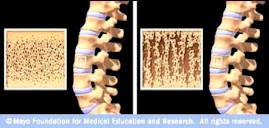
Source: www.mayoclinic.com