The primary goal of any osteoporosis treatment is prevention of stress fractures. The following abstract is from one of the most recent studies on strontium ranelate highlighted by the International Osteoporosis Foundation (IOF) at www.iofbonehealth.org/pio/latest-issue/volume-10-issue-4-2009/overview.html:
"Meunier et al report on 1649 osteoporotic women randomized to strontium ranelate (SrR) or placebo for four years followed by a one-year treatment-switch period for half of the patients. Over four years, risk of vertebral fracture was reduced by 33%. Among patients with two or more prevalent vertebral fractures, risk reduction was 36%. Lumbar BMD increased over five years in patients who continued with SrR, and decreased in patients who switched to placebo. Osteoporos Int 2009;20:1663-73"
Human Skeleton

Tuesday, March 2, 2010


Friday, January 22, 2010
Strontium Citrate Clinical Trial Still Recruiting
"The researchers are seeking post-menopausal women who are at least one year but less than five years past their last menstrual period. Participation in the study will include a screening visit with blood draw at UC Davis Medical Center, followed by a blood draw and free DEXA scan at the Veterans Administration Northern California Health Care Center."
"Participants will be randomly assigned to one of two groups. One group will take strontium citrate plus calcium and vitamin D for three months, while the other group will take a placebo plus calcium and vitamin D for three months. During the three-month period, participants will visit UC Davis Medical Center three times for short questionnaires and blood draws. DEXA scans and test results can be provided to participants.For more information or to schedule a screening visit, contact Stephanie Burns, study coordinator, at (530) 754-7576 or (916) 734-5562 or scope@phs.ucdavis.edu."
"Participants will be randomly assigned to one of two groups. One group will take strontium citrate plus calcium and vitamin D for three months, while the other group will take a placebo plus calcium and vitamin D for three months. During the three-month period, participants will visit UC Davis Medical Center three times for short questionnaires and blood draws. DEXA scans and test results can be provided to participants.For more information or to schedule a screening visit, contact Stephanie Burns, study coordinator, at (530) 754-7576 or (916) 734-5562 or scope@phs.ucdavis.edu."
Wednesday, January 20, 2010
Update On Strontium Citrate Clinical Trial
Here is the latest update on the Strontium Citrate Clinical Trial known as the Scope Study and being conducted at the University of California at Davis (UCD). Per Stephanie Burns, study coordinator, "we are currently half-way through our recruitment period. We should have results in about a year’s time."
Tuesday, December 29, 2009
Osteologix To Market Strontium Malonate In EU By 2012
On December 09, 2009, Osteologix Inc. (OLGX.OB) announced that it should be prepared to file a marketing application in 2011 in the European Union for its proprietary strontium therapy, NB S101 (strontium malonate). If successful, this will be Osteologix' first marketing approval of NB S101 for the treatment of postmenopausal osteoporosis. Following the successful completion of the company's initial Phase 2 study comparing NB S101 (strontium malonate) to Protelos (strontium ranelate), which is marketed by Les Laboratoires Servier (Servier), Osteologix sought feedback on its development program from various regulatory authorities. Osteologix has determined that the company will be positioned to pursue a European Marketing Application for NB S101 as a treatment for post-menopausal osteoporosis. The company expects that it can complete the additional development work in 2010 and will be prepared to file a marketing application during the first half of 2011. This pathway is in keeping with the Company's overall strategy of developing its once-daily strontium tablet for the osteoporosis market. Osteologix has initiated discussion with potential regional and global partners and believes that the selected partner(s) will be able to begin marketing the product by 2012, providing them with at least 12 years of patent protection in the European Union.
This is an abbreviated version of a press release by Osteologix. See the original at www.osteologix.com.
This is an abbreviated version of a press release by Osteologix. See the original at www.osteologix.com.
Friday, November 6, 2009
Strontium Ranelate Reduces Fracture Risk
The TROPOS study of strontium ranelate (Protelos) reached the following conclusions about fracture risk reduction:
The number of patients experiencing a hip fracture was reduced by 36% (P=0.046) over 3 years of treatment in postmenopausal women over 74 years of age.
Protelos also reduced the relative risk of nonvertebral fracture by 16% (P=0.04) over 3 years compared with placebo.
Protelos reduced the risk of major fragility fractures (fracture of the hip, wrist, pelvis and sacrum, ribs and sternum, clavicle, humerus) by 19% (P=0.031) over 3 years compared with placebo.
In patients without prevalent vertebral fracture at baseline, Protelos reduced their risk of experiencing a first fracture by 45% (P<0.001).
The number of patients experiencing a hip fracture was reduced by 36% (P=0.046) over 3 years of treatment in postmenopausal women over 74 years of age.
Protelos also reduced the relative risk of nonvertebral fracture by 16% (P=0.04) over 3 years compared with placebo.
Protelos reduced the risk of major fragility fractures (fracture of the hip, wrist, pelvis and sacrum, ribs and sternum, clavicle, humerus) by 19% (P=0.031) over 3 years compared with placebo.
In patients without prevalent vertebral fracture at baseline, Protelos reduced their risk of experiencing a first fracture by 45% (P<0.001).
Thursday, November 5, 2009
BMD Improvements With Strontium
Research indicates that over three years, strontium can improve bone mineral density by 8-14%, depending on the site. These findings come from three studies on strontium ranelate (STRATOS, SOTI, and TROPOS). One study on strontium malonate (Strong study) showed a 2.66% increase in BMD at the lumbar spine after just three months. The University of California at Davis (UCD) is conducting a three-month clinical trial on strontium citrate, but the results may not be available before May, 2010.
The STRATOS trial (2002) of strontium ranelate determined that 680 mg strontium was the optimum dose. It was followed by a much larger study (SOTI study, 2004) of 1,649 osteoporotic postmenopausal women over a three-year period. Participants that received 680 mg of strontium daily, along with calcium and vitamin D supplements, increased lumbar bone mineral density by an average of 14.4% and femoral neck BMD an average of 8.3%.
The TROPOS study in 2005 focused on non-vertebral fractures in 5,091 postmenopausal women with osteoporosis. After five years, this double-blind, placebo-controlled study found an 8.2% improvement in the femoral neck and a 9.8% improvement in the total hip bone density.
In 2007, Osteologix, Inc. announced the results of its phase II clinical trial (Strong study) involving 289 postmenopausal women with low bone mineral density. The company reported that after three months, a 680 mg dose of strontium malonate increased lumbar spine BMD by 2.66%.
The STRATOS trial (2002) of strontium ranelate determined that 680 mg strontium was the optimum dose. It was followed by a much larger study (SOTI study, 2004) of 1,649 osteoporotic postmenopausal women over a three-year period. Participants that received 680 mg of strontium daily, along with calcium and vitamin D supplements, increased lumbar bone mineral density by an average of 14.4% and femoral neck BMD an average of 8.3%.
The TROPOS study in 2005 focused on non-vertebral fractures in 5,091 postmenopausal women with osteoporosis. After five years, this double-blind, placebo-controlled study found an 8.2% improvement in the femoral neck and a 9.8% improvement in the total hip bone density.
In 2007, Osteologix, Inc. announced the results of its phase II clinical trial (Strong study) involving 289 postmenopausal women with low bone mineral density. The company reported that after three months, a 680 mg dose of strontium malonate increased lumbar spine BMD by 2.66%.
Subscribe to:
Posts (Atom)
Wandering Skeleton

Artist: Joel Hoekstra
Osteoporotic Bone
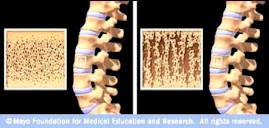
Source: www.mayoclinic.com