Human Skeleton

Human Skeleton

WELCOME TO STRONTIUM FOR BONES BLOG

Have you experienced negative, and even dangerous, side effects from Fosamax (alendronate), Boniva (ibandronate), Actonel (risedronate), Reclast (zoledronic acid), Prolia (denosumab), Forteo (teriparatide), Tymlos (abaloparatide), or other drugs prescribed for osteoporosis? If you have, then rest assured there is a safe, effective treatment for this condition. Strontium, primarily in the form of strontium citrate, is taken orally once a day.

Visitors to my blog can leave comments or ask questions and can remain anonymous, if they wish. Their comments are relayed to my g-mail inbox. Below each post, the number of comments for that post is cited and underlined because it is a link. By clicking on that link below any post, a window opens so that a visitor can leave a comment. Ideally, visitors leave comments on posts most relevant to their comments. All comments to my posts are moderated by me.

Browse the posts and visit the link library of references.


Blog Archive

Showing posts with label alendronate. Show all posts

Friday, February 16, 2018

BMD Increases by Varying Amounts with Strontium Citrate and Decreases by Varying Amounts after Discontinuation


A study published September 13, 2016, presents three case studies of patients who took strontium citrate (680 mg strontium per day) for six years, five years, and four years (Cases 1, 2, and 3, respectively) and then stopped taking it for two years, one year, and one year (Cases 1, 2, and 3, respectively). The study gives the increases in BMD with SrC and the decreases when the supplement was discontinued.  Of note is the fact that both the increases and decreases vary with the site (lumbar spine or total hip), the individual, and the number of years of use or discontinuation of SrC. Also, keep in mind that stopping any of the osteoporosis drugs will also result in loss of some of the BMD gains because there is no cure for osteoporosis.

Case 1
A 76-year-old female with osteoporosis (OP) took alendronate weekly for 10 years till 2006, then every other week for another year and was initiated on a drug holiday. She started self-administrating SrC (680mg/day) in 2006 and continued to take daily calcium (600mg bid) and vitamin D (2000units). Serum calcium and Vitamin D (32-66ng/ml) remained normal. She continued SrC on her own till 2012, when she agreed to stop taking it due to concerns about accumulation and toxicity.

On dual-energy X-ray absorptiometry (DXA) scan, total hip mean BMD increased 2.7% in the first 2 years on SrC after stopping alendronate, and continued to increase to a maximum of 9.2% after 6 years of treatment with SrC (1.53%/year). Lumbar Spine (LS) BMD was non-diagnostic due to degenerative changes in the spine.

In the first 2 years off of SrC, total hip mean BMD decreased by 5.7%.

Case 2
A 64-year-old female with history of OP, which was diagnosed in 2001, took Actonel 35mg weekly for 5 years, stopped for more than a year and resumed Actonel intermittently for another 2 years before starting drug holiday. She was taking Calcium 500 mg in the multivitamin and 2500 mg of vitamin D. Serum calcium and vitamin D were within normal range. She started strontium citrate (680mg strontium) daily in 2009 and took it for 5 years, stopping it in 2014.

Yearly assessment of her BMD via DEXA scan showed an increase of 4.3% at LS spine (L1-L4 vertebrae), and 7.6 % at total hip within 1 year of SrC treatment. At 5 years, BMD increase was 6.5 % at LS and 12% for mean total hip. She agreed to stop SrC at this time.

One year after stopping SrC, LS BMD decreased by 9.1 % and total hip BMD decreased by 4.2%.

Case 3
A 59-year-old female with OP was treated with weekly alendronate for 4 years till 2007, when she stopped it due to concerns for osteonecrosis of jaw. She was advised to resume alendronate in 2008 due to declining BMD, but opted not to take it.

She started self-administration of 680mg of SrC daily in February 2009 and continued it for four years till January 2013, when she stopped it due to myalgias and concern about risk for toxicity. Due to her history of ulcerative colitis, she was limited in dairy intake, although she averaged half a cup of almond milk daily and took calcium supplements. Serum calcium and vitamin D were within normal range.

BMD via DEXA scan showed an increase of 10.7 % at LS (L1-L4) at 2 years after starting SrC, and 4.3 % at total hip.

BMD decreased by 14% at LS and by 6.4% at total hip a year after stopping SrC.

Mirza FS, Azim S, Bhargava A (2016) Change in Bone Mineral Density with Strontium Citrate: An Illusion or Reality. J Nutrition Health Food Sci 4(3): 1-3. DOI: http://dx.doi.org/10.15226/jnhfs.2016.00167

Thursday, September 4, 2014

Chronic Kidney Disease and Osteoporosis


http://www.ncbi.nlm.nih.gov/pubmed/24991405

Bonekey Rep. 2014 Jun 25;3:542. doi: 10.1038/bonekey.2014.37. eCollection 2014.

Fractures across the stages of chronic kidney disease (CKD) could be due to osteoporosis, some form of renal osteodystrophy defined by specific quantitative histomorphometry or chronic kidney disease-mineral and bone disorder (CKD-MBD). CKD-MBD is a systemic disease that links disorders of mineral and bone metabolism due to CKD to either one or all of the following: abnormalities of calcium, phosphorus, parathyroid hormone or vitamin D metabolism; abnormalities in bone turnover, mineralization, volume, linear growth or strength; or vascular or other soft-tissue calcification. Osteoporosis, as defined by The National Institutes of Health, may coexist with renal osteodystrophy or CKD-MBD. 
 
Differentiation among these disorders is required to manage correctly the correct disorder to reduce the risk of fractures. While the World Health Organization (WHO) BMD criteria for osteoporosis can be used in patients with stages 1-3 CKD, the disorders of bone turnover become so aberrant by stages 4 and 5 CKD that neither the WHO criteria nor the occurrence of a fragility fracture can be used for the diagnosis of osteoporosis. The diagnosis of osteoporosis in stages 4 and 5 CKD is one of exclusion--excluding either renal osteodystrophy or CKD-MBD as the cause of low BMD or fragility fractures. Differentiations among the disorders of renal osteodystrophy, CKD-MBD or osteoporosis are dependent on the measurement of specific biochemical markers, including serum parathyroid hormone (PTH) and/or quantitative bone histomorphometry. 
 
Management of fractures in stages 1-3 CKD does not differ in persons with or without CKD with osteoporosis assuming there is no evidence for CKD-MBD, clinically suspected by elevated PTH, hyperphosphatemia or fibroblast growth factor 23 due to CKD. Treatment of fractures in persons with osteoporosis and stages 4 and 5 CKD is not evidence based, with the exception of post hoc analysis suggesting efficacy and safety of specific osteoporosis therapies (alendronate, risedronate and denosumab) in stage 4 CKD. This review also discusses how to diagnose and manage fragility fractures across the five stages of CKD.

Monday, June 22, 2009

Study Shows Protelos Builds Better Bone Than Fosamax

A two-year double-blind study included 88 women over age 50 with postmenopausal osteoporosis who were treated with either Protelos (strontium ranelate) 2 g. daily or Fosamax (alendronate) 70 mg. weekly. The study, which used high-resolution computerized tomography, showed that Protelos increased cortical bone thickness, bone volume and trabecular bone density to a significantly greater extent than Fosamax over a one-year period.

The one-year interim results on bone microstucture, a determinant of bone strength, showed a +5.3% increase in cortical thickness and a +2.0% increase in bone volume in the Protelos-treated group. There was no change in the Fosamax-treated group.

For more information and references, see www.medicalnewstoday.com/printerfriendlynews.php?newsid=132149

Wandering Skeleton

Wandering Skeleton
Artist: Joel Hoekstra

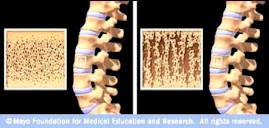
Osteoporotic Bone

Osteoporotic Bone
Source: www.mayoclinic.com

How Strontium Builds Bones

Strontium is a mineral that tends to accumulate in bone. Studies have shown that oral doses of strontium are a safe and effective way to prevent and reverse osteoporosis. Doses of 680 mg per day appear to be optimal. See my "For More Information About Strontium" links section.

Osteoporosis is caused by changes in bone production. In healthy young bones there is a constant cycle of new bone growth and bone removal. With age, more bone is removed and less new bone is produced. The bones become less dense and thus more fragile.

Scientists believe that strontium works in two ways. It may stimulate the replication of pre-osteoblasts, leading to an increase in osteoblasts (cells that build bone). Strontium also directly inhibits the activity of osteoclasts (cells that break down bone). The result is stronger bones.

When taking strontium, be sure to take 1200 mg calcium, 1000 IU vitamin D3, and 500 mg magnesium daily. It is best to take strontium late at night on an empty stomach. Calcium and strontium may compete with each other for absorption if taken together.