Human Skeleton

Human Skeleton

WELCOME TO STRONTIUM FOR BONES BLOG

Have you experienced negative, and even dangerous, side effects from Fosamax (alendronate), Boniva (ibandronate), Actonel (risedronate), Reclast (zoledronic acid), Prolia (denosumab), Forteo (teriparatide), Tymlos (abaloparatide), or other drugs prescribed for osteoporosis? If you have, then rest assured there is a safe, effective treatment for this condition. Strontium, primarily in the form of strontium citrate, is taken orally once a day.

Visitors to my blog can leave comments or ask questions and can remain anonymous, if they wish. Their comments are relayed to my g-mail inbox. Below each post, the number of comments for that post is cited and underlined because it is a link. By clicking on that link below any post, a window opens so that a visitor can leave a comment. Ideally, visitors leave comments on posts most relevant to their comments. All comments to my posts are moderated by me.

Browse the posts and visit the link library of references.


Blog Archive

Showing posts with label strontium carbonate. Show all posts

Monday, December 21, 2015

Strontium Carbonate Products


Strontium citrate is more readily absorbed than strontium carbonate, just as calcium citrate is more readily absorbed than calcium carbonate. If you eat food when you take calcium carbonate, you can get around the absorption problem, but, for best absorption, strontium should be taken on an empty stomach. You must not take food, supplements, or antacids containing calcium or magnesium within two hours of taking strontium because calcium and magnesium compete for absorption with strontium. For best absorption, strontium should be taken on an empty stomach.

Some people cannot take citrate products due to digestive problems. They may be interested in one of the following two strontium carbonate products. 
1.  
 BioStrong Strontium Piperine contains 680 mg strontium (as strontium carbonate) and BioPiperine (black pepper extract) in two tablets. Piperine improves absorption.

http://www.healthconcernsblog.com/wp-content/uploads/2014/02/BioStrong.pdf


2.      OsteoValin by Basic Research contains 400 IU vitamin D, 80 mcg vitamin K, and 1012 mg Osteoval Carbonate Forte Proprietary Blend of strontium carbonate, Quercetin, and Hesperidin in one capsule. NEVER EXCEED 1 CAPSULE PER DAY.

Quercetin and Hesperidin are flavonoids. Flavonoids are generally considered beneficial anti-oxidants, but there is some controversy about Quercetin. An FDA study on rats found Quercetin to be mutagenic. Other studies indicate it works to prevent cancer. Quercetin is also an anti-histamine and an anti-inflammatory. I found a website with references and a balanced discussion on the pros and cons of Quercetin at http://www.diet-and-health.net/Supplements/Quercetin.html.

Hesperidin is a flavonoid found in citrus fruits. It is part of vitamin P. As a powerful anti-oxidant, it has many benefits from retarding the aging process to helping the body detoxify carcinogens.

I am not aware of any specific benefit to bones for either Quercetin or Hesperidin.


Thursday, January 22, 2015

Strontium Minerals Come from Mexico


Strontium (Sr) occurs in nature as mineral deposits of celestine (celestite) (strontium sulfate) and strontianite (strontium carbonate). Citric acid and citrate also occur in nature. The chelate strontium citrate (as provided in supplemental form) is made synthetically from strontium minerals and citrate.

Celestite is the most commonly used strontium mineral. The strontium compounds in the government report referenced below are strontium oxide, sr. hydroxide, sr. peroxide, sr. nitrate, and sr. carbonate.  

Import Sources (2009–12): Strontium minerals: Mexico, 100%. Strontium compounds: Mexico, 80%; Germany, 12%; China, 7%; and other, 1%. Total imports: Mexico, 87%; Germany, 8%; China, 4%; and other, 1%.

One hundred percent (100 %) of the strontium minerals imported into the U.S. come from Mexico. None of the strontium minerals imported into the U.S. come from China.

Some time ago, I wrote to Doctor’s Best and asked if its Strontium Bone Maker, a product I take, comes from China. A representative from the company said, “No, our product is U.S.-made.”  Well, that answer was true to a point. Doctor’s Best probably buys strontium citrate from another company that imports celestite from Mexico to make strontium citrate in the U.S. I had to do a lot of sleuthing on the internet to find this information.

I keep hearing from people concerned that the strontium they take, or are considering taking, comes from China. I’ve also read posts on osteoporosis forums from so-called “experts” who keep repeating false information about strontium coming from China. For these reasons, I decided to post this information, citing a U.S. government publication for import sources.

It would be possible for a company to import strontium compounds (sr. carbonate, sr. nitrate) manufactured in China and then make sr. citrate from those, but it is unlikely when the mineral, celestite (strontium sulfate), is available from Mexico. A mine in China is believed to be the only developed strontianite deposit in the world per Hong, Wei, 1993, Celestite & strontianite—Review of ore processing and exploration: Industrial Minerals, no. 309, June, p. 55, as cited in “Strontium” by Joyce A. Ober.


As already stated, the U.S. is not importing strontium minerals from China.
Other than the natural occurrence as mineral, strontium carbonate is prepared synthetically in one of two manners. First of which is from naturally occurring celestine also known as strontium sulfate (SrSO4) or by using soluble strontium salts by the reaction in solution with a soluble carbonate salt (usually sodium or ammonium carbonates). For example if sodium carbonate was used in solution with strontium nitrate:

Sr(NO3)2 (aq) + Na2CO3 (aq) → SrCO3 (s) + 2 NaNO3 (aq).


Since 100% of the strontium minerals imported into the U.S. come from Mexico, and only 7% of the strontium compounds come from China, there is only a small chance the strontium in your strontium citrate supplement came from China.


Alternatives to Citrate Products—Strontium and Calcium and Magnesium


Some people get an upset stomach when taking citrate supplements, such as calcium or magnesium or strontium citrate. A citrate is a derivative of citric acid. What are these people to do?

One possible substitute for strontium citrate is strontium carbonate. Health Concerns BioStrong tablets contain 750 mg of strontium carbonate (340 mg active) and BioPerine (Black Pepper Fruit extract). The manufacturer suggests two tablets per day between meals. This product is available at www.amazon.com. Strontium carbonate is not as well absorbed as sr. citrate. The BioPerine is supposed to help absorption; so, this may be a good formula, but I have not tried it. It has a 5-star rating and 5 reviews at Amazon.

When it comes to calcium supplements, there are many choices beside ca. citrate. Other choices include   calcium alpha-ketogutarate, ca. ascorbate, ca. aspartate, ca. carbonate, ca. gluconate, ca. hydroxyapatite, ca. lysinate, ca. malate, ca. pyruvate. Some calcium supplements combine calcium from several calcium salts. Coral calcium is a calcium salt derived from fossilized coral reefs (primarily from limestone and coastal deposits). Coral calcium is composed primarily of calcium carbonate, with small amounts of magnesium and other trace minerals. Oyster shell calcium is calcium carbonate from oyster shells.

I use Country Life, Gluten Free, Calcium-Magnesium Complex tablets. One serving (two tablets) contains 1000 mg calcium (as calcium hydroxyapatite, citrate, aspartate, alpha-ketoglutarate, lysinate), 500 mg phosphorus (as calcium hydroxyapatite), and 500 mg magnesium (as magnesium oxide, citrate, aspartate, taurinate, alpha-ketoglutarate). I take only one tablet (1/2 serving) per day. The rest of my calcium comes from food plus 162 mg (as calcium carbonate) in my multivitamin. This formulation does contain calcium citrate and magnesium citrate, but they are combined with several other sources of both minerals. This product has a 4 ½-star rating, 180 reviews for the 180-tablet size and 51 reviews for the 360-tablet size at www.iherb.com, where I buy all my supplements.


Solgar, Chelated Calcium contains 1000 mg calcium (as calcium glycinate amino acid chelate, calcium carbonate) per serving of six tablets that can be taken in two doses or more, preferably with meals. This product has 4 ½-stars at www.iherb.com. I have not tried it.

There are several sources of magnesium besides magnesium citrate. As noted above, I get my magnesium from Country Life, Gluten Free, Calcium-Magnesium Complex. The magnesium in this product is from five sources: magnesium oxide, citrate, aspartate, taurinate, and alpha-ketoglutarate. Other sources of magnesium include magnesium chloride, glycinate chelate, malate, and oxide. 

One tablet of Now Foods, Magnesium Malate, 1000 mg contains 150 mg magnesium (from 1000 mg magnesium malate) and 100 mg calcium (from calcium carbonate).  As a dietary supplement, take one tablet 3 times daily, preferably with meals, for a total of 450 mg magnesium and 300 mg calcium. This product has a 4 1/2-star rating and 57 reviews at www.iherb.com. I have never tried these tablets.

Bluebonnet Nutrition, Chelated Magnesium has 200 mg magnesium (as magnesium glycinate chelate, magnesium oxide) in one capsule. It has a 4 1/2-star rating and 66 reviews at www.iherb.com. I have not used this product.


Wandering Skeleton

Wandering Skeleton
Artist: Joel Hoekstra

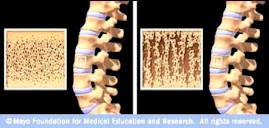
Osteoporotic Bone

Osteoporotic Bone
Source: www.mayoclinic.com

How Strontium Builds Bones

Strontium is a mineral that tends to accumulate in bone. Studies have shown that oral doses of strontium are a safe and effective way to prevent and reverse osteoporosis. Doses of 680 mg per day appear to be optimal. See my "For More Information About Strontium" links section.

Osteoporosis is caused by changes in bone production. In healthy young bones there is a constant cycle of new bone growth and bone removal. With age, more bone is removed and less new bone is produced. The bones become less dense and thus more fragile.

Scientists believe that strontium works in two ways. It may stimulate the replication of pre-osteoblasts, leading to an increase in osteoblasts (cells that build bone). Strontium also directly inhibits the activity of osteoclasts (cells that break down bone). The result is stronger bones.

When taking strontium, be sure to take 1200 mg calcium, 1000 IU vitamin D3, and 500 mg magnesium daily. It is best to take strontium late at night on an empty stomach. Calcium and strontium may compete with each other for absorption if taken together.