Study data showed a beneficial effect in preventing fractures, including in patients at high risk of fracture. Available data do not show evidence of an increased cardiovascular risk with Protelos/Osseor in patients who did not have a history of heart or circulatory problems.
Human Skeleton
WELCOME TO STRONTIUM FOR BONES BLOG
Have you experienced negative, and even dangerous, side effects from Fosamax (alendronate), Boniva (ibandronate), Actonel (risedronate), Reclast (zoledronic acid), Prolia (denosumab), Forteo (teriparatide), Tymlos (abaloparatide), or other drugs prescribed for osteoporosis? If you have, then rest assured there is a safe, effective treatment for this condition. Strontium, primarily in the form of strontium citrate, is taken orally once a day.
Visitors to my blog can leave comments or ask questions and can remain anonymous, if they wish. Their comments are relayed to my g-mail inbox. Below each post, the number of comments for that post is cited and underlined because it is a link. By clicking on that link below any post, a window opens so that a visitor can leave a comment. Ideally, visitors leave comments on posts most relevant to their comments. All comments to my posts are moderated by me.
Browse the posts and visit the link library of references.
Visitors to my blog can leave comments or ask questions and can remain anonymous, if they wish. Their comments are relayed to my g-mail inbox. Below each post, the number of comments for that post is cited and underlined because it is a link. By clicking on that link below any post, a window opens so that a visitor can leave a comment. Ideally, visitors leave comments on posts most relevant to their comments. All comments to my posts are moderated by me.
Browse the posts and visit the link library of references.
Showing posts with label ischemic heart disease. Show all posts
Friday, February 21, 2014
Strontium Ranelate to Remain Available in EU
As of February 21, 2014, the European Medicines Agency
(EMA) has concluded its review of strontium ranelate (Protelos/Osseor). The EMA is
recommending the medication remain available in the European Union (EU) but further restricting its
use to patients who cannot be treated with other medicines approved for
osteoporosis due to contraindications or intolerance. These patients should continue
to be evaluated regularly by their doctor, and treatment should be stopped if
patients develop heart or circulatory problems. Patients with established,
current or past history of ischemic heart disease, peripheral arterial disease
and/or cerebrovascular disease, or those with uncontrolled hypertension should
not use the medicine.
Study data showed a beneficial effect in preventing fractures, including in patients at high risk of fracture. Available data do not show evidence of an increased cardiovascular risk with Protelos/Osseor in patients who did not have a history of heart or circulatory problems.
Tuesday, April 23, 2013
Strontium and Your Heart
A committee of the European Medicines Agency (EMA) has
recommended the following restrictions in the use of strontium ranelate (sold
in the European Union under the brand names Protelos and Osseor) to reduce the
risk of adverse cardiac events:
1a. Strontium ranelate should only be used for the treatment
of severe osteoporosis in postmenopausal women at high risk for fracture and
severe osteoporosis in men at increased risk for fracture.
2a.Strontium ranelate should not be used in patients with
current or past history of ischemic heart disease (such as angina or MI),
peripheral arterial disease (PAD), or cerebrovascular disease.
3a.Strontium ranelate should not be used in patients with
hypertension that is not controlled by treatment.
What, if anything,
should those of us taking strontium citrate do?
Here is what I think.
1b. Strontium citrate can be used as a supplement by men and
women with osteopenia or osteoporosis. (I believe the first restriction on
strontium ranelate is mostly for cost containment because bisphosphonates,
especially the generic equivalents, are much cheaper than strontium ranelate.)
2b. Strontium citrate can be used UNDER MEDICAL SUPERVISION
in patients with current or past history of ischemic heart disease, PAD, or
cerebrovascular disease.
3b. Strontium citrate should not be used in patients with uncontrolled
hypertension. Patients must get their hypertension under control by medication.
Strontium citrate can be used UNDER MEDICAL SUPERVISION in patients with
hypertension that is controlled by treatment.
Subscribe to:
Posts (Atom)
Wandering Skeleton
Artist: Joel Hoekstra
Osteoporotic Bone
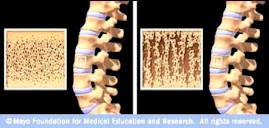
Source: www.mayoclinic.com
How Strontium Builds Bones
Strontium is a mineral that tends to accumulate in bone. Studies have shown that oral doses of strontium are a safe and effective way to prevent and reverse osteoporosis. Doses of 680 mg per day appear to be optimal. See my "For More Information About Strontium" links section.
Osteoporosis is caused by changes in bone production. In healthy young bones there is a constant cycle of new bone growth and bone removal. With age, more bone is removed and less new bone is produced. The bones become less dense and thus more fragile.
Scientists believe that strontium works in two ways. It may stimulate the replication of pre-osteoblasts, leading to an increase in osteoblasts (cells that build bone). Strontium also directly inhibits the activity of osteoclasts (cells that break down bone). The result is stronger bones.
When taking strontium, be sure to take 1200 mg calcium, 1000 IU vitamin D3, and 500 mg magnesium daily. It is best to take strontium late at night on an empty stomach. Calcium and strontium may compete with each other for absorption if taken together.
Osteoporosis is caused by changes in bone production. In healthy young bones there is a constant cycle of new bone growth and bone removal. With age, more bone is removed and less new bone is produced. The bones become less dense and thus more fragile.
Scientists believe that strontium works in two ways. It may stimulate the replication of pre-osteoblasts, leading to an increase in osteoblasts (cells that build bone). Strontium also directly inhibits the activity of osteoclasts (cells that break down bone). The result is stronger bones.
When taking strontium, be sure to take 1200 mg calcium, 1000 IU vitamin D3, and 500 mg magnesium daily. It is best to take strontium late at night on an empty stomach. Calcium and strontium may compete with each other for absorption if taken together.
For More Information about Strontium
- A Dose-response Study With Strontium Malonate
- A Review of the latest insights into the mechanism of action of strontium in bone
- Antifracture Efficacy Over 10 Years With Strontium Ranelate
- Combination of Micronutrients for Bone (COMB) Study: Bone Density after Micronutrient Intervention
- Echolight REMS Scan of Young, Normal Female
- Effect of bone strontium on BMD measurements
- Effect of Lumbar Scoliosis on DXA Results
- Effects of SrR on Calcium Metabolism
- Effects of strontium ions on growth and dissolution of hydroxyapatite and on bone mineral detection
- Influence of strontium on bone mineral density and bone mineral content measurements by dual X-ray absorptiometry
- Interpretation of BMD Scans in Patients Stopping Strontium
- Melatonin-micronutrients Osteopenia Treatment Study (MOTS)
- National Osteoporosis Foundation
- Osteoporosis And Bone Physiology
- Post-Marketing Assessment of the Safety of Strontium Ranelate
- PubMed Abstract On The SOTI Study
- PubMed Abstract On The TROPOS Study
- Strontium ranelate Aristo
- Strontium Ranelate For Spinal Osteoarthritis
- Strontium: Breakthrough Against Osteoporosis
- Summary Safety Review - Strontium
- The Effects of Strontium Ranelate on the Risk of Vertebral Fracture in Women with Postmenopausal Osteoporosis
- The Influence of Strontium on Bone Tissue Metabolism and Its Application in Osteoporosis Treatment
- Thirteen Key Diagnostic Tests