Human Skeleton

Human Skeleton

WELCOME TO STRONTIUM FOR BONES BLOG

Have you experienced negative, and even dangerous, side effects from Fosamax (alendronate), Boniva (ibandronate), Actonel (risedronate), Reclast (zoledronic acid), Prolia (denosumab), Forteo (teriparatide), Tymlos (abaloparatide), or other drugs prescribed for osteoporosis? If you have, then rest assured there is a safe, effective treatment for this condition. Strontium, primarily in the form of strontium citrate, is taken orally once a day.

Visitors to my blog can leave comments or ask questions and can remain anonymous, if they wish. Their comments are relayed to my g-mail inbox. Below each post, the number of comments for that post is cited and underlined because it is a link. By clicking on that link below any post, a window opens so that a visitor can leave a comment. Ideally, visitors leave comments on posts most relevant to their comments. All comments to my posts are moderated by me.

Browse the posts and visit the link library of references.


Blog Archive

Showing posts with label dietary patterns. Show all posts

Wednesday, March 25, 2015

Dietary Patterns and Bone Mineral Density in Postmenopausal Women with Osteoporosis


Background/Objectives:

The aim of this study was to investigate the association between dietary patterns and bone mineral density (BMD) in postmenopausal women with osteoporosis.

Subjects/Methods:
This cross-sectional study included 156 postmenopausal and osteoporotic Brazilian women aged over 45 years. BMD of lumbar spine, total femur (TF), femoral neck and of total body (TB), as well as body composition (fat and lean mass), was assessed by dual-energy X-ray absorptiometry. Body mass index and lifestyle information were also obtained. Dietary intake was assessed by using a 3-day food diary. Dietary patterns were obtained by principal component factor analysis. Adjusted multiple linear regression analysis was applied in order to evaluate the predictive effect of dietary patterns on BMD. Significance was set at P less than 0.05.

Results:
Five patterns were retained: ‘healthy’, ‘red meat and refined cereals’, ‘low-fat dairy’, ‘sweet foods, coffee and tea’ and ‘Western’. The ‘sweet foods, coffee and tea’ pattern was inversely associated with TF BMD (β=−0.178; 95% CI: −0.039 to −0.000) and with TB BMD (β=−0.320; 95% CI: −0.059 to −0.017) even after adjusting for energy and calcium intake, lean mass, age and postmenopausal time.

Conclusions:
A concomitant excessive consumption of sweet foods and caffeinated beverages appears to exert a negative effect on BMD even when the skeleton already presents some demineralization. Food and beverage intake is a modifiable factor that should not be neglected in the treatment of individuals with osteoporosis.
European Journal of Clinical Nutrition (25 March 2015) | doi:10.1038/ejcn.2015.27


Wandering Skeleton

Wandering Skeleton
Artist: Joel Hoekstra

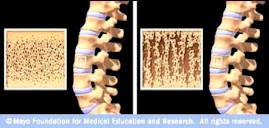
Osteoporotic Bone

Osteoporotic Bone
Source: www.mayoclinic.com

How Strontium Builds Bones

Strontium is a mineral that tends to accumulate in bone. Studies have shown that oral doses of strontium are a safe and effective way to prevent and reverse osteoporosis. Doses of 680 mg per day appear to be optimal. See my "For More Information About Strontium" links section.

Osteoporosis is caused by changes in bone production. In healthy young bones there is a constant cycle of new bone growth and bone removal. With age, more bone is removed and less new bone is produced. The bones become less dense and thus more fragile.

Scientists believe that strontium works in two ways. It may stimulate the replication of pre-osteoblasts, leading to an increase in osteoblasts (cells that build bone). Strontium also directly inhibits the activity of osteoclasts (cells that break down bone). The result is stronger bones.

When taking strontium, be sure to take 1200 mg calcium, 1000 IU vitamin D3, and 500 mg magnesium daily. It is best to take strontium late at night on an empty stomach. Calcium and strontium may compete with each other for absorption if taken together.