Bone 2014
Moise H, Chettle DR, Pejović-Milić A
Ten female volunteers were recruited as part
of the Ryerson and McMaster University Strontium (Sr) in Bone Research
Study to have their bone Sr levels measured as they self-supplemented
with Sr supplements of their choice. Of the ten volunteers, nine were
suffering from osteopenia and/or osteoporosis. Non-invasive bone Sr
measurements were performed using an in vivo x-ray fluorescence (IVXRF)
I-125 based system. Thirty minute measurements were taken at the finger
and ankle, representing primarily cortical and trabecular bone,
respectively. For analysis, the 14.2keV Sr K-alpha peak normalized to
the Coherent peak at 35.5keV was used.
Baseline readings,
representing natural bone Sr levels were acquired since all volunteers
had no previous intake of Sr based supplements or medications. Once Sr
supplements were started, a 24h reading was taken, followed by frequent
measurements ranging from weekly, biweekly to monthly. The longest
volunteer participation was 1535days. The mean baseline Sr signal
observed for the group was 0.42±0.13 and 0.39±0.07 for the finger and
ankle, respectively. After 24h, the mean Sr signal rose to 1.43±1.12 and
1.17±0.51, for the finger and ankle, respectively, representing a
statistically significant increase (p=0.0043 & p=0.000613).
Bone Sr levels continued to increase throughout the length of the
study. However the Sr signal varied widely between the individuals such
that after three years, the highest Sr signal observed was 28.15±0.86
for the finger and 26.47±1.22 for the ankle in one volunteer compared to
3.15±0.15 and 4.46±0.36, for the finger and ankle, respectively in
another. Furthermore, while it was previously reported by our group,
that finger bone Sr levels may plateau within two years, these results
suggest otherwise, indicating that bone Sr levels will continue to rise
at both bone sites even after 4years of Sr intake.
http://www.ncbi.nlm.nih.gov/pubmed/24434614
Human Skeleton

Showing posts with label bone strontium levels. Show all posts
Showing posts with label bone strontium levels. Show all posts
Monday, October 20, 2014


Monitoring bone strontium levels of an osteoporotic subject due to self-administration of strontium citrate with a novel diagnostic tool, in vivo XRF: a case study
Bone 2012
Moise H, Adachi JD, Chettle DR, Pejović-Milić A
A previously developed in vivo X-ray fluorescence (IVXRF) I-125 based system was used to measure bone strontium levels non-invasively in an osteoporotic female volunteer. The volunteer was recruited in December 2008, as part of the Ryerson and McMaster University Strontium in Bone Research Study and measured at twice weekly, weekly and monthly intervals. Thirty minute measurements were taken at the finger and ankle bone sites, representing primarily cortical and trabecular bone, respectively and the strontium K-alpha X-ray peak at 14.16 keV was used in the analysis.
Since the volunteer had no prior history of strontium based medications or supplementation, baseline natural strontium levels were obtained followed by a 24h measurement of first intake of strontium citrate supplements (680 mg Sr/day). While the baseline levels of 0.38 ± 0.05 and 0.39 ± 0.10 for the finger and ankle, respectively, were on par with those previously reported in Caucasians among twenty-two healthy non-supplementing strontium individuals by our group, an increase began to be seen after 24 hrs of 0.62 ± 0.14 and 0.45 ± 0.12 for the finger and ankle, respectively. By 120 h, the increase was statistically significant at 0.68 ± 0.07 and 0.93 ± 0.05, respectively. Further increases occurred within an interval of 90-180 days, with the most recent, after 800 days, at the finger and ankle being 7 and 15 times higher than the initial baseline reading.
The intriguing results show bone strontium incorporation and retention follow a pattern, suggesting strontium levels, at least in the ankle, do not plateau within two to three years and will continue to increase over time, as an individual takes strontium supplements. The ability of this IVXRF system to monitor and measure bone strontium levels over time provides a useful diagnostic tool to help gain insight into strontium bone kinetics.
http://www.ncbi.nlm.nih.gov/pubmed/22549020
Moise H, Adachi JD, Chettle DR, Pejović-Milić A
A previously developed in vivo X-ray fluorescence (IVXRF) I-125 based system was used to measure bone strontium levels non-invasively in an osteoporotic female volunteer. The volunteer was recruited in December 2008, as part of the Ryerson and McMaster University Strontium in Bone Research Study and measured at twice weekly, weekly and monthly intervals. Thirty minute measurements were taken at the finger and ankle bone sites, representing primarily cortical and trabecular bone, respectively and the strontium K-alpha X-ray peak at 14.16 keV was used in the analysis.
Since the volunteer had no prior history of strontium based medications or supplementation, baseline natural strontium levels were obtained followed by a 24h measurement of first intake of strontium citrate supplements (680 mg Sr/day). While the baseline levels of 0.38 ± 0.05 and 0.39 ± 0.10 for the finger and ankle, respectively, were on par with those previously reported in Caucasians among twenty-two healthy non-supplementing strontium individuals by our group, an increase began to be seen after 24 hrs of 0.62 ± 0.14 and 0.45 ± 0.12 for the finger and ankle, respectively. By 120 h, the increase was statistically significant at 0.68 ± 0.07 and 0.93 ± 0.05, respectively. Further increases occurred within an interval of 90-180 days, with the most recent, after 800 days, at the finger and ankle being 7 and 15 times higher than the initial baseline reading.
The intriguing results show bone strontium incorporation and retention follow a pattern, suggesting strontium levels, at least in the ankle, do not plateau within two to three years and will continue to increase over time, as an individual takes strontium supplements. The ability of this IVXRF system to monitor and measure bone strontium levels over time provides a useful diagnostic tool to help gain insight into strontium bone kinetics.
http://www.ncbi.nlm.nih.gov/pubmed/22549020
Friday, July 4, 2014
Monitoring Bone Strontium Intake in Females Taking Strontium Citrate
Ten female volunteers were recruited
to have their bone strontium (Sr) levels measured as they self-supplemented
with Sr supplements of their choice. Nine of the ten had been diagnosed with osteopenia
and/or osteoporosis. Non-invasive bone Sr measurements were performed using an in
vivo x-ray fluorescence (IVXRF) I-125 based system. Thirty minute
measurements were taken at the finger and ankle, representing primarily
cortical and trabecular bone, respectively.
Baseline readings, representing
natural bone Sr levels were acquired since all volunteers had no previous
intake of Sr based supplements or medications. Once Sr supplements were
started, a 24 hour reading was taken, followed by frequent measurements ranging
from weekly, biweekly to monthly. The longest volunteer participation was
1535 days (4.2 years).
The mean baseline Sr signal observed
for the group was 0.42 ± 0.13 and 0.39 ± 0.07 for the finger and ankle,
respectively. After 24 hours, the mean Sr signal rose to 1.43 ± 1.12 and
1.17 ± 0.51, for the finger and ankle, respectively, representing a
statistically significant increase. Bone Sr levels continued to increase
throughout the length of the study. However, the Sr signal varied widely
between the individuals. After three years, the highest Sr signal observed was
28.15 ± 0.86 for the finger and 26.47 ± 1.22 for the ankle in one volunteer
compared to 3.15 ± 0.15 and 4.46 ± 0.36, for the finger and ankle, respectively,
in another. Furthermore, while it was previously reported by our group, that
finger bone Sr levels may plateau within two years, these results suggest
otherwise, indicating that bone Sr levels will continue to rise at both bone
sites even after 4 years of Sr intake.
The most
important points of this study are as follows:
- The bone Sr signal varies widely between subjects but follows a similar pattern.
- Results suggest bone Sr levels won't plateau as long as one supplements with Sr.
- This diagnostic tool is satisfactory for monitoring bone Sr levels over time.
The original article was published
online in “Bone” on February 08, 2014.
http://www.thebonejournal.com/article/S8756-3282%2814%2900004-0/abstract
Wednesday, November 27, 2013
Strontium Ranelate and Strontium Citrate Studies
Numerous studies on sr. ranelate
found increasing BMD correlated with decreasing fracture risk (references #16
and #21-25 listed at the end of the Comb Study cited below). The French
pharmaceutical company, Servier, funded the research on sr. ranelate to market
the drug in Europe and elsewhere. Taking a drug through all the required
clinical trials takes millions of dollars and the resources of a large company
like Servier, which is present in 140 countries,
with more than 20,000 employees, including close to 3000 in Research and
Development (R&D).
Strontium
citrate is not patentable and is sold as a supplement in the U.S. and Canada. There
is no monetary incentive for a large pharmaceutical company to do research on
strontium citrate. Any research on sr. citrate is most likely to come from
universities that have obtained grants. We will continue to see small-scale
strontium citrate studies that will add to our knowledge. I do not expect to
see large-scale clinical trials involving thousands of subjects taking
strontium citrate over a period of several years. Those are the types of trials
needed to prove fracture-risk efficacy.
The
following is a review of some significant studies on strontium citrate:
In 2007, two American researchers
with SDM College of Dental Sciences in Buffalo, NY, presented
their work on osteoblasts at a dental conference. They wrote: “The data support the hypothesis that strontium citrate increases
the proliferative/alkaline phosphatase activity of human osteoblastic cells
from alveolar bone. The results validate previous research that has been done
with other forms of strontium in clinical studies and rodent calvarial cells
and indicates that strontium citrate could be a promising agent in treating
oral as well as systemic bone disorders.” The abstract of their paper is available here:
http://iadr.confex.com/iadr/2007orleans/techprogram/abstract_89231.htm
Monday, August 26, 2013
Non-Invasive Measurement of Bone Strontium Levels
Many of you have probably read that
the only way to measure the amount of strontium in bone is to do a bone biopsy.
That is no longer true, at least not in a research setting. A case study
published last year in Bone used an in vivo X-ray
fluorescence (IVXRF) I-125 based system to measure bone strontium levels
non-invasively in an osteoporotic female volunteer before and after she began
taking strontium citrate supplements (680 mg Sr/day).
Thirty-minute
measurements were taken at the finger and ankle bone sites, representing
primarily cortical and trabecular bone, respectively. Baseline natural strontium levels were obtained followed by a 24h measurement of first
intake of strontium citrate supplements (680 mg Sr/day). The baseline levels of
strontium (prior to supplementation) were 0.38 ± 0.05 and 0.39 ± 0.10 for the
finger and ankle, respectively. After 24 hrs the levels were 0.62 ± 0.14 and
0.45 ± 0.12 for the finger and ankle, respectively. By 120 h, the increase was
statistically significant at 0.68 ± 0.07 and 0.93 ± 0.05, respectively. Further
increases occurred within an interval of 90-180 days, with the most recent,
after 800 days, at the finger and ankle being 7 and 15 times higher than the
initial baseline reading. The results show bone strontium incorporation and retention follow a pattern and suggest strontium levels, at least in the ankle, do not plateau within two to three years and will continue to increase over time, as an individual takes strontium supplements. The ability of this IVXRF system to monitor and measure bone strontium levels over time provides a useful diagnostic tool to help gain insight into strontium bone kinetics.
Subscribe to:
Posts (Atom)
Wandering Skeleton

Artist: Joel Hoekstra
Osteoporotic Bone
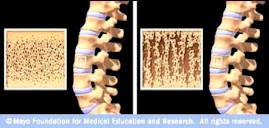
Source: www.mayoclinic.com