Human Skeleton

Human Skeleton

WELCOME TO STRONTIUM FOR BONES BLOG

Have you experienced negative, and even dangerous, side effects from Fosamax (alendronate), Boniva (ibandronate), Actonel (risedronate), Reclast (zoledronic acid), Prolia (denosumab), Forteo (teriparatide), Tymlos (abaloparatide), or other drugs prescribed for osteoporosis? If you have, then rest assured there is a safe, effective treatment for this condition. Strontium, primarily in the form of strontium citrate, is taken orally once a day.

Visitors to my blog can leave comments or ask questions and can remain anonymous, if they wish. Their comments are relayed to my g-mail inbox. Below each post, the number of comments for that post is cited and underlined because it is a link. By clicking on that link below any post, a window opens so that a visitor can leave a comment. Ideally, visitors leave comments on posts most relevant to their comments. All comments to my posts are moderated by me.

Browse the posts and visit the link library of references.


Blog Archive

Thursday, January 22, 2015

Alternatives to Citrate Products—Strontium and Calcium and Magnesium


Some people get an upset stomach when taking citrate supplements, such as calcium or magnesium or strontium citrate. A citrate is a derivative of citric acid. What are these people to do?

One possible substitute for strontium citrate is strontium carbonate. Health Concerns BioStrong tablets contain 750 mg of strontium carbonate (340 mg active) and BioPerine (Black Pepper Fruit extract). The manufacturer suggests two tablets per day between meals. This product is available at www.amazon.com. Strontium carbonate is not as well absorbed as sr. citrate. The BioPerine is supposed to help absorption; so, this may be a good formula, but I have not tried it. It has a 5-star rating and 5 reviews at Amazon.

When it comes to calcium supplements, there are many choices beside ca. citrate. Other choices include   calcium alpha-ketogutarate, ca. ascorbate, ca. aspartate, ca. carbonate, ca. gluconate, ca. hydroxyapatite, ca. lysinate, ca. malate, ca. pyruvate. Some calcium supplements combine calcium from several calcium salts. Coral calcium is a calcium salt derived from fossilized coral reefs (primarily from limestone and coastal deposits). Coral calcium is composed primarily of calcium carbonate, with small amounts of magnesium and other trace minerals. Oyster shell calcium is calcium carbonate from oyster shells.

I use Country Life, Gluten Free, Calcium-Magnesium Complex tablets. One serving (two tablets) contains 1000 mg calcium (as calcium hydroxyapatite, citrate, aspartate, alpha-ketoglutarate, lysinate), 500 mg phosphorus (as calcium hydroxyapatite), and 500 mg magnesium (as magnesium oxide, citrate, aspartate, taurinate, alpha-ketoglutarate). I take only one tablet (1/2 serving) per day. The rest of my calcium comes from food plus 162 mg (as calcium carbonate) in my multivitamin. This formulation does contain calcium citrate and magnesium citrate, but they are combined with several other sources of both minerals. This product has a 4 ½-star rating, 180 reviews for the 180-tablet size and 51 reviews for the 360-tablet size at www.iherb.com, where I buy all my supplements.


Solgar, Chelated Calcium contains 1000 mg calcium (as calcium glycinate amino acid chelate, calcium carbonate) per serving of six tablets that can be taken in two doses or more, preferably with meals. This product has 4 ½-stars at www.iherb.com. I have not tried it.

There are several sources of magnesium besides magnesium citrate. As noted above, I get my magnesium from Country Life, Gluten Free, Calcium-Magnesium Complex. The magnesium in this product is from five sources: magnesium oxide, citrate, aspartate, taurinate, and alpha-ketoglutarate. Other sources of magnesium include magnesium chloride, glycinate chelate, malate, and oxide. 

One tablet of Now Foods, Magnesium Malate, 1000 mg contains 150 mg magnesium (from 1000 mg magnesium malate) and 100 mg calcium (from calcium carbonate).  As a dietary supplement, take one tablet 3 times daily, preferably with meals, for a total of 450 mg magnesium and 300 mg calcium. This product has a 4 1/2-star rating and 57 reviews at www.iherb.com. I have never tried these tablets.

Bluebonnet Nutrition, Chelated Magnesium has 200 mg magnesium (as magnesium glycinate chelate, magnesium oxide) in one capsule. It has a 4 1/2-star rating and 66 reviews at www.iherb.com. I have not used this product.


Monday, January 5, 2015

Americans Consume Too Much Sodium (Salt)


Sodium intake from processed and restaurant foods contributes to increased rates of high blood pressure, heart attack, and stroke. Decreasing sodium intake to within recommended limits could prevent thousands of deaths annually.
Americans eat too much sodium, commonly consumed as salt. High sodium consumption raises blood pressure. High blood pressure is a major risk factor for heart disease and stroke, the nation's first and third leading causes of death, respectively.

Research shows a dose-dependent relationship between consuming too much salt and elevated blood pressure. When salt intake is reduced, blood pressure begins decreasing for most people within a few days to weeks. Populations who consume diets low in salt do not experience the increase in blood pressure with age that is seen in most Western countries.
Sodium Consumption and the American Food Supply
We all need a small amount (e.g., between about 180 mg and 500 mg per day) of sodium to keep our bodies working properly.

The Institute of Medicine recommends 1500 mg of sodium per day as the Adequate Intake level for most Americans and advises everyone to limit sodium intake to less than 2300 mg per day, the Tolerable Upper Limit. Current dietary guidelines for Americans recommend that adults in general should consume no more than 2,300 mg of sodium per day. At the same time, consume potassium-rich foods, such as fruits and vegetables. However, if you are in the following population groups, you should consume no more than 1,500 mg of sodium per day and meet the potassium recommendation (4,700 mg/day) with food.
  • You are 51 years of age or older.
  • You are African American.
  • You have high blood pressure.
  • You have diabetes.
  • You have chronic kidney disease.
The 1,500 recommendation applies to about half of the U.S. population overall and the majority of adults. Nearly everyone benefits from reduced sodium consumption.
  • The Adequate Intake (AI) of 1500 mg per day is the recommended average daily sodium intake level. The IOM set the AI for sodium for adults at 1500 mg per day to ensure that the overall diet provides sufficient amounts of other nutrients and to cover sodium sweat losses in physically active individuals.
  • The Upper Limit (UL) of 2300 mg per day refers to the highest daily level of sodium that is likely to pose no risk of adverse health effects to almost all individuals in the general population. The UL is not a recommended intake and there is no apparent benefit to consuming levels of sodium above the Adequate Intake (AI).
  • The average daily sodium intake for Americans age 2 years and older is 3,436 mg.
  • Since the 1970s, the amount of sodium in our food has increased, and we are eating more food each day than in the past.
The vast majority of the sodium consumed is from processed and restaurant foods; only a small portion is used in cooking or added at the table.

(This article does not mention that high salt intake can also lead to osteoporosis. See my previous post, "Salt and Osteoporosis.")

For the original article with data sources, see:

Wandering Skeleton

Wandering Skeleton
Artist: Joel Hoekstra

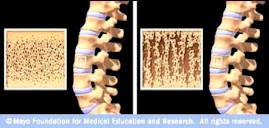
Osteoporotic Bone

Osteoporotic Bone
Source: www.mayoclinic.com

How Strontium Builds Bones

Strontium is a mineral that tends to accumulate in bone. Studies have shown that oral doses of strontium are a safe and effective way to prevent and reverse osteoporosis. Doses of 680 mg per day appear to be optimal. See my "For More Information About Strontium" links section.

Osteoporosis is caused by changes in bone production. In healthy young bones there is a constant cycle of new bone growth and bone removal. With age, more bone is removed and less new bone is produced. The bones become less dense and thus more fragile.

Scientists believe that strontium works in two ways. It may stimulate the replication of pre-osteoblasts, leading to an increase in osteoblasts (cells that build bone). Strontium also directly inhibits the activity of osteoclasts (cells that break down bone). The result is stronger bones.

When taking strontium, be sure to take 1200 mg calcium, 1000 IU vitamin D3, and 500 mg magnesium daily. It is best to take strontium late at night on an empty stomach. Calcium and strontium may compete with each other for absorption if taken together.