Human Skeleton

Human Skeleton

WELCOME TO STRONTIUM FOR BONES BLOG

Have you experienced negative, and even dangerous, side effects from Fosamax (alendronate), Boniva (ibandronate), Actonel (risedronate), Reclast (zoledronic acid), Prolia (denosumab), Forteo (teriparatide), Tymlos (abaloparatide), or other drugs prescribed for osteoporosis? If you have, then rest assured there is a safe, effective treatment for this condition. Strontium, primarily in the form of strontium citrate, is taken orally once a day.

Visitors to my blog can leave comments or ask questions and can remain anonymous, if they wish. Their comments are relayed to my g-mail inbox. Below each post, the number of comments for that post is cited and underlined because it is a link. By clicking on that link below any post, a window opens so that a visitor can leave a comment. Ideally, visitors leave comments on posts most relevant to their comments. All comments to my posts are moderated by me.

Browse the posts and visit the link library of references.


Blog Archive

Saturday, August 15, 2015

Histomorphometric and μCT Analysis of Bone Biopsies From Postmenopausal Osteoporotic Women Treated With Strontium Ranelate


“Strontium ranelate is a new anti-osteoporotic treatment. On bone biopsies collected from humans receiving long-term treatment over 5 yr, it has been shown that strontium ranelate has good bone safety and better results than placebo on 3D microarchitecture. Hence, these effects may explain the decreased fracture rate.”

“Introduction: Strontium ranelate's mode of action involving dissociation of bone formation and resorption was shown in preclinical studies and could explain its antifracture efficacy in humans.”

“Materials and Methods: One hundred forty-one transiliac bone biopsies were obtained from 133 postmenopausal osteoporotic women: 49 biopsies after 1–5 yr of 2 g/d strontium ranelate and 92 biopsies at baseline or after 1–5 yr of placebo.”

“Results and Conclusions: Histomorphometry provided a 2D demonstration of the bone safety of strontium ranelate, with significantly higher mineral apposition rate (MAR) in cancellous bone (+9% versus control, p = 0.019) and borderline higher in cortical bone (+10%, p = 0.056). Osteoblast surfaces were significantly higher (+38% versus control, p = 0.047). 3D analysis of 3-yr biopsies with treatment (20 biopsies) and placebo (21 biopsies) using μCT showed significant changes in microarchitecture with, in the strontium ranelate group, higher cortical thickness (+18%, p = 0.008) and trabecular number (+14%, p = 0.05), and lower structure model index (−22%, p = 0.01) and trabecular separation (−16%, p = 0.04), with no change in cortical porosity. The changes in 3D microarchitecture may enhance bone biomechanical competence and explain the decreased fracture rate with strontium ranelate.”

Figure 1. 3D microstructure from μCT of transiliac bone biopsies from postmenopausal osteoporotic women receiving strontium ranelate (2 g/d) or placebo for 3 yr.


Tuesday, August 11, 2015

Sequential Therapy with Bisphosphonates and Strontium Ranelate


"A recent study provides evidence that prior bisphosphonate therapy results in blunting and delay of the BMD response to strontium ranelate. In a prospective study in postmenopausal women with osteoporosis, 56 bisphosphonate-naïve women and 52 women treated with an oral bisphosphonate for at least one year, who had stopped bisphosphonate therapy within the last month, were given strontium ranelate 2 g daily, together with calcium and vitamin D supplements. After 1 year of treatment, BMD in the lumbar spine had increased 5.6% in bisphophonate-naïve women and by 2.1% in women previously treated with bisphosphonates; at both 6 and 12 months the BMD increase in the former group was significantly less than in the latter. At the total hip there was no significant change in BMD at one year in the bisphophonate pretreated women compared to an increase of 3.4% in the treatment naïve group. In an extension of this study, it was shown that BMD in the spine in pretreated women increased in parallel with treatment naïve women from 6 months onwards, whereas some blunting of the BMD response at the hip was still observed after 2 years of treatment. The most likely mechanism to explain these effects is that bisphosphonates inhibit the uptake of strontium into bone because of suppression of bone turnover and the consequent reduction in newly formed bone."


"Osteoporosis: Diagnosis and Management," Dale W. Stovall (ed.), Wiley (Jul 15, 2013), 288 pages, Chapter 13, pages 202-203.

Thursday, July 23, 2015

Fat Soluble and Water Soluble Vitamins


“Many people think that taking a daily cocktail of vitamins, minerals, antioxidants and other supplements is a prescription for a healthy diet. But it's also likely that they don’t know whether the nutrients they're taking are fat soluble, water soluble, or if they are getting more of some nutrients than they need.”


“Vitamins are classified as either fat soluble (vitamins A, D, E and K) or water soluble (vitamins B and C). This difference between the two groups is very important. It determines how each vitamin acts within the body.”

“The fat soluble vitamins are soluble in lipids (fats). These vitamins are usually absorbed in fat globules (called chylomicrons) that travel through the lymphatic system of the small intestines and into the general blood circulation within the body. These fat soluble vitamins, especially vitamins A and E, are then stored in body tissues.”

“Fat soluble vitamins, once they have been stored in tissues in the body, tend to remain there. This means that if a person takes in too much of a fat soluble vitamin, over time they can have too much of that vitamin present in their body, a potentially dangerous condition called hypervitaminosis (literally, too much vitamin in the body).”

“Persons can be also be deficient in the fat soluble vitamins if their fat intake is too low or if their fat absorption is compromised, for example, by certain drugs (that interfere with the absorption of fat from the intestine) or by certain diseases such as cystic fibrosis (in which there is a deficiency of enzymes from the pancreas which similarly interferes with the absorption of fat from the intestine).”

 “There is a big difference between the water soluble vitamins and the fat soluble vitamins and this is absolutely a critical distinction.”

Fat-Soluble Vitamins: A, D, E, and K

“Quick Facts...”
  • “Small amounts of vitamin A, vitamin D, vitamin E and vitamin K are needed to maintain good health.”
  • “Fat-soluble vitamins will not be lost when the foods that contain them are cooked.”
  • “The body does not need these vitamins every day and stores them in the liver and adipose (fat) tissue when not used.”
  • “Most people do not need vitamin supplements.” (This is debatable, and I don’t agree, but I do want to admonish people to respect the upper intake limits for all vitamins, especially the fat soluble ones, and for minerals, such as calcium and magnesium.)
  • “Megadoses of vitamins A, D, E or K can be toxic and lead to health problems.”
  • “Requirements for vitamins may be expressed in different mathematical units. Close attention should be paid to ensure that similar units are being compared.”

http://www.ext.colostate.edu/pubs/foodnut/09315.html

Water-Soluble Vitamins and Nutrients

“Water-soluble nutrients work best when you get them in the proper amounts. When you eat or take more than your body needs, the body adapts by absorbing just what it needs, and then it usually excretes the excess in your urine -- but not always. A study in the August 2010 Journal of Nutrition Science and Vitaminology found that urinary excretion of certain vitamins and other nutrients was reduced when study participants fasted.”

“The field of nutrition is ever-changing, and experts used to think that taking excess amounts of a water-soluble nutrient was harmless because the excesses would just be eliminated in urine. Today, we know that’s not the case, and that some water-soluble vitamins and nutrients are handled differently by the body than others.”

“Just because most water-soluble vitamins are not stored by the body, you can’t assume that it is safe or effective to take more than the safe upper limit. In addition, you need to account for the vitamins and nutrients you get from the food you eat, says Ruth Frenchman, MS, RD, a spokesperson for the American Dietetic Association.”

"Certain water-soluble vitamins in excess can cause problems, such as too much vitamin B6 can cause nerve problems, too much niacin can cause flushing, and excess vitamin C can cause kidney stones," Frenchman observes. Excess folic acid may also mask a vitamin B12 deficiency, which is more common in people over age 50.”
http://www.webmd.com/vitamins-and-supplements/nutrition-vitamins-11/fat-water-nutrient?page=2


Wandering Skeleton

Wandering Skeleton
Artist: Joel Hoekstra

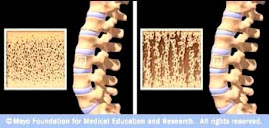
Osteoporotic Bone

Osteoporotic Bone
Source: www.mayoclinic.com

How Strontium Builds Bones

Strontium is a mineral that tends to accumulate in bone. Studies have shown that oral doses of strontium are a safe and effective way to prevent and reverse osteoporosis. Doses of 680 mg per day appear to be optimal. See my "For More Information About Strontium" links section.

Osteoporosis is caused by changes in bone production. In healthy young bones there is a constant cycle of new bone growth and bone removal. With age, more bone is removed and less new bone is produced. The bones become less dense and thus more fragile.

Scientists believe that strontium works in two ways. It may stimulate the replication of pre-osteoblasts, leading to an increase in osteoblasts (cells that build bone). Strontium also directly inhibits the activity of osteoclasts (cells that break down bone). The result is stronger bones.

When taking strontium, be sure to take 1200 mg calcium, 1000 IU vitamin D3, and 500 mg magnesium daily. It is best to take strontium late at night on an empty stomach. Calcium and strontium may compete with each other for absorption if taken together.